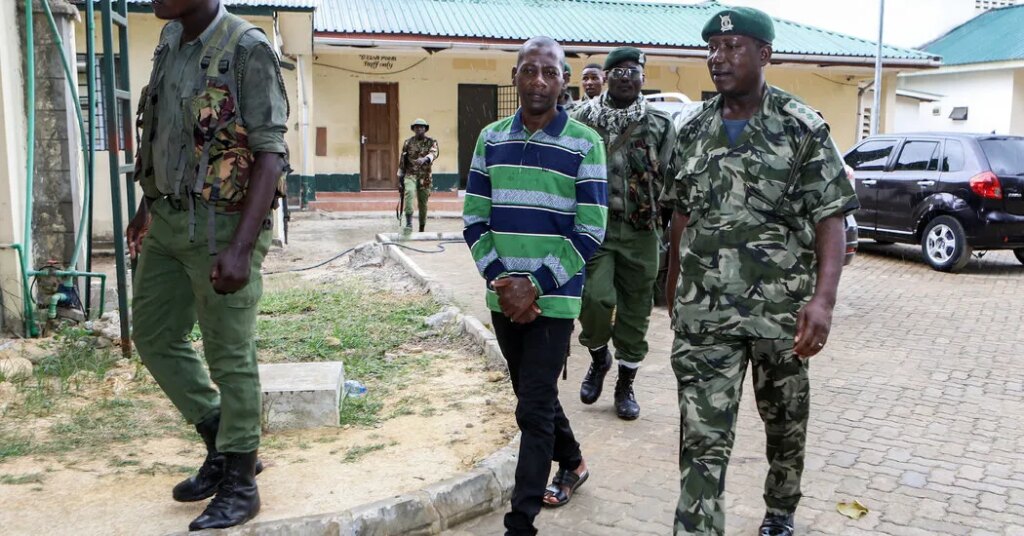
A Kenyan court convicted a cult leader on Monday of murdering nearly 200 children after he told his followers to starve themselves to death to meet Jesus in a case that has caused national shock.
The cult leader, Paul Nthenge Mackenzie, ordered his followers to cease eating and aides enforced his directive with violence, the judge, Lady Justice Diana Kavedza-Mochache, told the court in the port city of Mombasa.
“The evidence identifies him as the principal source of the doctrine under which fasting was transformed from an act of religious observance into a prescribed route to death,” the judge said, adding: “Where starvation did not produce death, the children were killed by hand.”
Mr. Mackenzie was arrested in 2023 after the Kenyan authorities had exhumed the bodies of more than 400 people who had died in the preceding two years in the Shakahola Forest, a remote area of southeastern Kenya near the Indian Ocean. State prosecutors charged him with 191 killings, all but one of which was of a child.
Critics said the authorities could have stopped Mr. Mackenzie much sooner, as he became the latest global example of a cult leader wielding distorted religious teaching to gain inordinate power over his flock, with deadly consequences.
Mr. Mackenzie, a former taxi driver and small-time televangelist, had marketed Shakahola to his followers as an evangelical sanctuary where they could find refuge from the apocalypse, which he preached was fast approaching. Operating there roughly from 2019 to 2023, he told his followers that they should fast to meet Jesus and assure their salvation.
His trial began in 2024.
Many of the bodies exhumed from Shakahola were of people who died from starvation, though some also showed signs of strangulation, according to government pathologists.
Mr. Mackenzie had preached that parents should make sure their children fasted in the sun and died first so that they reached heaven before adult family members, one former member of the cult told The New York Times.
The judge said on Monday that in one particularly cruel case, a follower who had delivered her seventh child in the forest had been “supervised” so that she would not nurse her newborn. The baby died 12 days later, the judge said.
She also convicted 29 of Mr. Mackenzie’s aides of the murders. The dead, most of whom were under 10 years old, included the children of those convicted.
“Based on the totality of the evidence, the court finds each accused parent legally responsible for the deaths of their respective children,” Judge Kavedza-Mochache said. She said that sentencing would be delivered on Nov. 6.
Ms. Kavedza-Mochache said that Mr. Mackenzie’s actions amounted to crimes against humanity, but did not convict based on that finding.
Enos Amanya, a guard and grave digger at the forest camp, pleaded guilty to the charges in January and testified against the preacher. He said he was involved in concealing graves flattening the earth and planting vegetation.
The events in the forest, known in Kenya as the Shakahola Massacre, are one of several instances around the world in which charismatic cult leaders have gained immense sway over their followers to devastating effect. Such leaders have often twisted mainstream religious doctrines and leveraged their influence by urging their followers to cut themselves off from the world.
The most notorious example took place in 1978 at a remote settlement in Guyana, in South America, when the cult leader Jim Jones ordered his followers to take their own lives. More than 900 people died. Another cult in western Uganda killed at least 700 people, many by poisoning, before what its leader said would be the end of the world at the millennium.
In 1993, a government siege of the Branch Davidians religious sect in Waco, Texas, led to a fire and shootout in which 75 people died.
In Kenya, a deeply religious and deeply Christian country, the Shakahola case caused soul-searching and rights groups asked how the group’s activities went undetected for so long.
Critics say the failure of oversight was all the more stark because Mr. Mackenzie had been arrested in 2017 on charges including radicalization and promoting extremist beliefs and because he was known as an outspoken critic of government initiatives like a new ID card system.
Mr. Mackenzie stood trial in that 2017 case and was acquitted, but after a further arrest on similar charges two years later, he announced that he was closing down his church and retreating to the forest. He invited followers to purchase plots there in what he said would be a new Holy Land.
Lives could have been saved if the warnings of former members of the cult been heeded and if local security forces had been more diligent, according to the Kenya National Commission on Human Rights, a state organization. It described the record of the authorities in the case leading up to the trial as “deplorable.”
The post Cult Leader Convicted of Mass Murder by Court in Kenya appeared first on New York Times.