Scott and Sharon Jacobs were driving near their home in South Dakota when they saw something odd stuck on a fence near a cattle field. Sharon jumped out of the car and ran through the tall grass toward it.
“It’s an owl,” Sharon yelled to her husband.
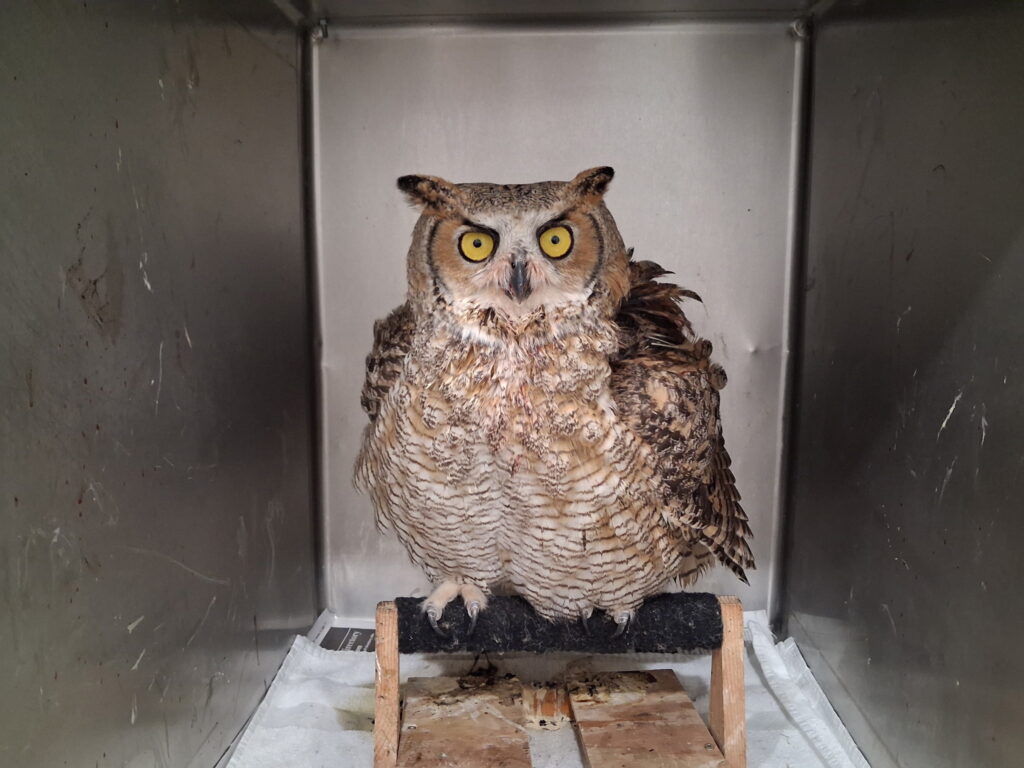
It was alive and staring at her with striking yellow eyes.
Scott joined her, and when they got within a few feet of the great horned owl, they could see that it had flown into a barbed wire fence and its wing was tangled and pierced by the wire. The bird began clicking its beak — a warning to keep a distance.
The Jacobses are animal lovers — they have two rescue dogs, a cat and three horses. Sharon said this is not the first time they have stopped to help injured wildlife, including birds, squirrels and snakes.
“You name it, we have tried to nurture it,” Sharon said.
The couple owns an art gallery — Scott is a professional artist — and a restaurant in Deadwood, about 15 miles from where they live in Spearfish.
From their previous experiences with animals, they knew that covering the owl’s head could help calm it. Without a blanket or towel, they grabbed a tote bag from the car and gently lowered it over the bird.
Then they spotted a car coming down the road and flagged it down. The driver, a man who works at a nearby restaurant, said he had a pair of gloves in his car that could offer protection from the owl’s powerful talons.
But even with the gloves, the owl was too entangled to free it by hand. Soon, the daughter of the property owner happened to drive by, and the couple asked her to FaceTime her father so they could explain what was happening and ask permission to cut the fence.
“As soon as he saw the bird caught, hopelessly hanging there, he was like ‘Oh definitely cut the fence,’” said Scott, who first told the story to Cowboy State Daily.
In a stroke of luck, the man who had stopped to help had wire cutters in his car. Scott cut out a section of the fence, but the owl was still gripping another strand with its talons. Scott carefully worked one of its feet free, and the owl then released its other foot from the wire and grabbed onto Scott’s gloved hand.
“It felt like it knew I was there to help,” he said.
While Scott was working to free the owl, Sharon reached out to their veterinarian, Warren Whalen, who told them to bring the bird in right away. Whalen does not typically treat birds, he said, but he has in the past.
At the clinic, Whalen gave the owl anesthesia, then removed the remaining piece of barbed wire embedded beneath the skin of its wing.
“I felt pretty good that there weren’t any broken bones, and I could feel the tendons,” Whalen said, noting that the owl was just over two pounds.
Sign up for The Optimist newsletter
Get inspiring stories delivered to your inbox every Sunday.
The Jacobses said they were relieved.
“The fact that it did not tear anything crucial or break a bone is a miracle,” Sharon said.
For Sharon, saving the owl carried particular meaning, she said. About seven years earlier during a storm, she was asleep when lightning struck the roof directly above her.
The next morning, there was a dead great horned owl on the roof, and it had apparently been struck by the lightning. An insurance adjuster told her that the damage to the house could have been far worse had the lightning struck the roof directly, Sharon said.
“I truly believe that this owl saved me,” she said. Now, “I have to save this owl.”
Whalen was able to stabilize the injured bird, but it needed more care. The Jacobses connected with Black Hills Raptor Center, a wildlife rehabilitation organization, and a volunteer came to retrieve the owl and bring it to the center.
“Scott and I were both driving to work, just praying that this beautiful creature will survive,” Sharon said.
Maggie Engler, executive director of the volunteer-run nonprofit, said birds that get stuck in barbed wire fences seldom survive.
“This is the first time in 16 years where I have admitted a bird caught in a barbed wire fence that had a chance of making it,” she said. “Most often in a case like this, you’re euthanizing the bird.”
The owl had two holes in its left wing but, crucially, no damage to the tissue connecting its shoulder and elbow, which is essential for flying.
“We thought, if we can keep infection out of this, we got a chance,” Engler said.
Staff at the center painstakingly removed the damaged tissue and feathers that could lead to infection, treated the wounds and gave the owl antibiotics and pain medication. They also tried to keep their distance.
“Something that people don’t realize is that any owl hates people, and great horned owls are even more notorious for hating people,” Engler said.
She said the Jacobses took a risk handling the bird without specialized gear.
“Sharon and Scott were incredibly brave,” she said. “I make all my volunteers handle great horned owls with welding gloves.”
The center does not know whether the owl is male or female, Engler explained, as determining the sex requires a blood or DNA test that is not necessary for treatment.
In the weeks since the rescue, the owl has continued to improve. It is eating well and showing a desire to fly.
“The bird still wants to be a wild animal, and that’s what we look for,” Engler said.
Once the holes in its wing have healed, staff will move the owl into a larger space and see if it’s strong enough to fly. Once it is, they plan to release it near the spot where the Jacobses found it.
“Research shows us that when you can release a raptor back to where it came from, it is better for the bird,” Engler said.
She said the owl almost certainly would not have survived without the chain of people who stepped in to help.
“Any time we get to interact with someone who loves wildlife as much as the volunteers of our organization love wildlife, we’re ecstatic,” said Engler, who sends the Jacobses frequent updates about the owl. “It means there’s still hope out there.”
Scott has saved a piece of the barbed wire and plans to incorporate it into a painting of the owl.
He and his wife said they’d like to be there when the bird is returned to the wild.
“I will be crying like a baby,” Sharon said.
“I can’t imagine how that would feel,” Scott added. “How many people get the opportunity in their life to save something like this?”
The post An owl was tangled in barbed wire. A chain of strangers saved its life. appeared first on Washington Post.