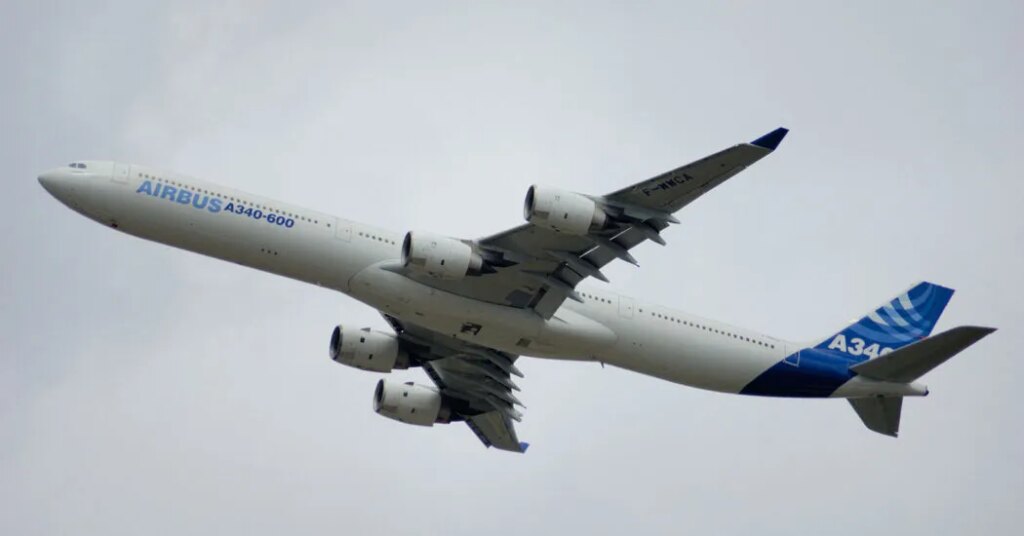
The Airbus A340-600 is not the world’s fastest, newest or sleekest airplane. Its cabin is dated compared to its modern, high-tech counterparts. It guzzles far more fuel than its rivals and relies on four engines to fly routes that other planes do with two.
Still, the A346, as it is known, has developed a devout fan base that is drawn to its abnormally long fuselage, restrooms that can be configured to be down a set of stairs adjacent to the cargo hold and the power of its four engines.
“The A346 has been one of my favorite aircraft since about the age of 7,” said Connor Joossens, 31, an aviation maintenance student, who lives in Orlando, Fla.
But the plane’s days are coming to an end. On Oct. 18, Lufthansa, one of only three passenger carriers that still uses it, will fly the plane for the last time, from Washington’s Dulles International Airport to Frankfurt Main Airport. (Of the other two carriers, one is in Iran and the other is in Venezuela, making it unlikely most people will fly on their planes.)
Personal tributes have flooded social media while aviation photographers have traveled thousands of miles to shoot the plane one last time. And some fans have spent thousands of dollars — and shaped entire intercontinental trips — to get on a farewell flight.
Mr. Joossens is one of them. For most of his life, the opportunity to fly on an A346 had eluded him. But in June, when his wife had to go to Finland for work, he saw his opportunity. Instead of flying the most direct route from their home in Orlando, which would have taken about 14 hours, they first traveled to Washington, then flew the A346 to Frankfurt, and then connected to Helsinki, arriving in Finland about 24 hours after they departed.
Mr. Joossens said flying on the plane for the first and last time was an amazing, yet slightly bittersweet experience. “It’s really disheartening to see these amazing planes retire,” he said.
Charmaine D’Cruz, who runs Lufthansa Group’s ground operations at Dulles, said many passengers are drawn to the downstairs restrooms, often taking pictures of the staircase and waiting area. “Passengers always make sure to see it,” she said. “It’s special.”
On Borrowed Time
The jet entered service in 2002, engineered to compete with Boeing’s 747 and connect cities that many thought were too far apart for twinjets to safely fly between and that were out of range for the shorter, underpowered A340-300 (with engines often mockingly compared to hair dryers). For the A346, however, power was not a problem.
But the plane was hardly a success. Fewer than 100 were built, while Boeing’s competitor aircrafts saw thousands roll out over generations. After Boeing introduced the 777-300ER in 2004, matching the A346’s capacity and range with half the engines, many considered the Airbus jet an anachronism.
The final four planes Lufthansa has been flying were already living on borrowed time. The carrier originally retired the aircraft after the pandemic flatlined international travel, and had already ordered dozens of modern, fuel-efficient jets. But many of those have been delayed for years, so the airline resurrected the A346 to meet the soaring demand for post-pandemic travel.
“It was a special situation for us,” said Francesco Sciortino, a member of Lufthansa’s board and the pilot captaining the aircraft’s final flight from Dulles. It helped that the airline already had pilots certified to fly it, and that the aircraft was reliable. “But this era should be over already,” he said. “It’s time.”
Does he believe that the A346 will be missed?
Pilots will reminisce about the four engines, Captain Sciortino said, but “from the perspective of a passenger who is not an aircraft enthusiast, to be honest, they will miss nothing.”
In a world where most planes are indistinguishable from one another, the A346 does stand out, and not just because of its extra engines. Its 75-meter fuselage — the longest in the world for more than a decade — appears even longer to the naked eye because of its narrowness relative to its length. Passengers sitting in the back have said that, on takeoff, they would see the front of the plane lurch toward the sky long before they felt themselves lift off.
“It’s just one of those planes that you see in the air, and there’s no mistaking what it is,” said Cameron Stone, 23, a ramp agent in Sacramento. Rather than fly with a single layover from Berlin to California in August, he flew from the German capital to Frankfurt, then from there to Dulles Airport on an A346, then from Washington to Los Angeles and finally north to Sacramento. “It’s such an oddball of an aircraft,” he said.
‘Beauty and the Beast’
“It was just an incredible beast of a machine,” said Chris Pohl, 63, a pilot living in southern France and one of the first A346-certified captains who has flown Airbus jets for 37 years and who runs a popular aviation Instagram. “We used to call it Beauty and the Beast, because it’s beautiful with four big monster Rolls-Royce engines slung under the wings.”
They are so powerful, Captain Pohl said, that even “if you lost an engine flying across the Atlantic, you could actually climb to a more efficient altitude.”
But such power comes at the expense of efficiency, with the A346 burning as much as 40 percent more fuel compared to Airbus’s most advanced wide-body jets.
Jason Steyn, 32, a copywriter from Cluj-Napoca, Romania, flew on an A346 by chance. “I didn’t think I would ever be able to do it,” he said. But when business brought him to New York in August, he was shocked to see one on his itinerary.
“I was geeking out to the ground crew as we were boarding,” Mr. Steyn said. “They were kind of looking at me funny, like ‘Come on, dude, it’s just a plane.’”
Follow New York Times Travel on Instagram and sign up for our Travel Dispatch newsletter to get expert tips on traveling smarter and inspiration for your next vacation. Dreaming up a future getaway or just armchair traveling? Check out our 52 Places to Go in 2026.
The post The Last Flight of the A346: An Aviation Love Story appeared first on New York Times.