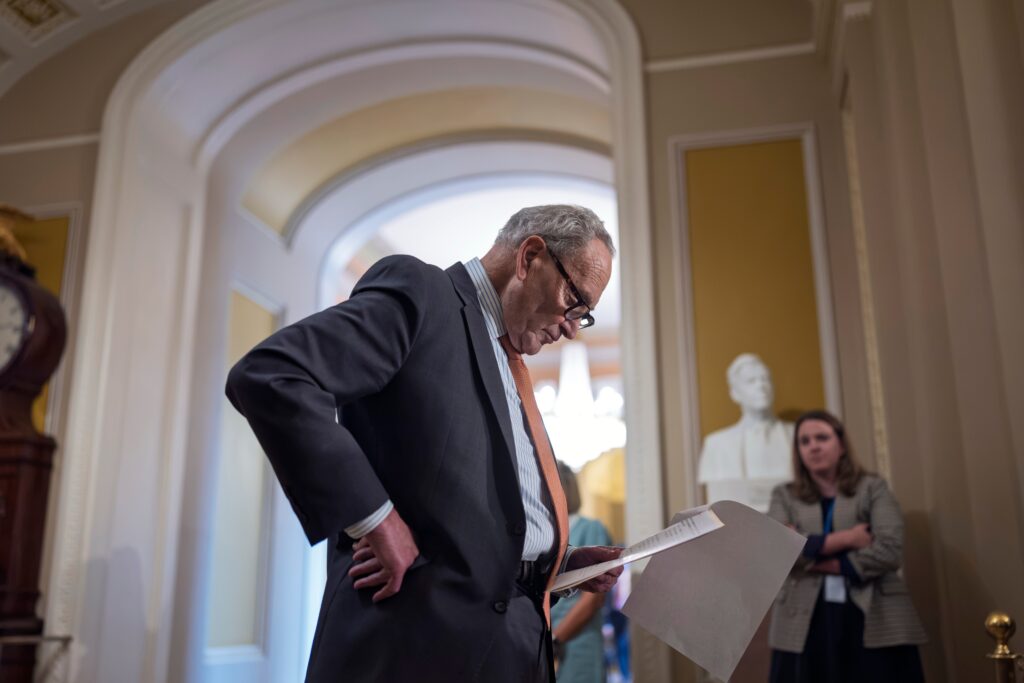
Federal law enforcement officials told lawmakers Thursday that mail containing “suspicious substances” had been sent to some Capitol Hill offices, including those of Senate Minority Leader Chuck Schumer (D-New York) and Sens. Chris Murphy (D-Connecticut) and Alex Padilla (D-California).
No House members have been identified as the intended recipients of the mail, according to an email from House Sergeant at Arms William P. McFarland obtained by The Washington Post.
In an email sent to Senate staff Thursday, the Senate’s sergeant at arms said that the U.S. Postal Inspection Service, the FBI and Capitol Police were investigating multiple suspicious letters, and warned lawmakers to be on guard for unusual mail.
“Law enforcement officials are working to intercept any additional letters before they are delivered, however, it is possible that some letters may reach their destinations,” the email states.
Several other pieces of suspicious mail were sent to state officials this week, the FBI said. The offices of the secretary of state in Ohio and Louisiana, as well as state election officials in Oklahoma, Delaware, and Wisconsin said they were among the recipients.
The letters to state election officials included white powder that appears to be harmless, said David Becker, executive director of the Center for Election Innovation and Research, which assists state and local election officials with election security. Becker said he had talked to recipients and seen some of the letters.
“They are threatening and they contain a lot of the same language we’ve seen in other threats from conspiracy theorists or perhaps people looking to undermine the elections,” he told reporters on Thursday.
In a statement to The Post, the FBI said the mail sent to state officials “contained an unknown substance” and that it is investigating the matter with the help of the U.S. Postal Inspection Service.
It was not immediately clear if the letters sent to the congressional offices were linked to the ones sent to state offices.
In a statement, Josh Sorbe, a spokesman for Murphy, said Murphy’s office received a letter with a “suspicious substance” and that the team was “promptly informed of the letter by FBI, SAA, and Capitol Police, and we continue to work closely with them and federal law enforcement.”
Jackie McGuinness, a spokeswoman for Padilla, said Padilla’s office was notified by the FBI that one of his offices was mailed a letter containing a suspicious substance that was intercepted by the U.S. Postal Service.
Authorities said other mail with suspicious contents sent to the Capitol Hill complex was identified. Mail and packages delivered to the House and the Senate first go through a rigorous screening before being handed to members’ offices.
Officials did not immediately clarify which other offices received the letters. Capitol Police and the Postal Inspection Service referred comment to the FBI, and the FBI did not immediately respond to a request for comment.
Concern about potential — and actual — attacks on public servants has been on the rise in recent years, amid an uptick in insults, harassment and violence against lawmakers and officials.
In April 2025, a man firebombed the residence of Pennsylvania Gov. Josh Shapiro (D) while he and his family slept inside. In June of that year, a gunman killed a Democratic state representative and her husband in their Minnesota home. President Donald Trump has survived two assassination attempts. Threats against members of Congress, their staff and their families skyrocketed in 2025, according to data from the Capitol Police released in January, climbing for the third year in a row.
“People continue to have a false sense of anonymity online, which has resulted in more investigations during the past several years,” according to the Capitol Police. Across both political parties, lawmakers find their inboxes, voicemails and social media comments clogged with vitriol.
According to a survey released this summer by Princeton University and nonpartisan nonprofit CivicPulse, 17 percent of surveyed local elected officials across the country reported being threatened during the first three months of 2026 and 39 percent reported being harassed.
Three quarters said they were less willing to engage in political or civic activities, such as running for higher office or working on controversial issues, because of safety and security concerns. These impacts are especially pronounced for new officeholders, women officials and minority officials, according to researchers.
Earlier this year, two Supreme Court justices made a rare trip to Capitol Hill, telling lawmakers that the growing number of threats necessitated a significant expansion of the court’s security funding.
Maegan Vazquez contributed to this report.
The post Suspicious materials sent to Schumer, other members of Congress, authorities say appeared first on Washington Post.