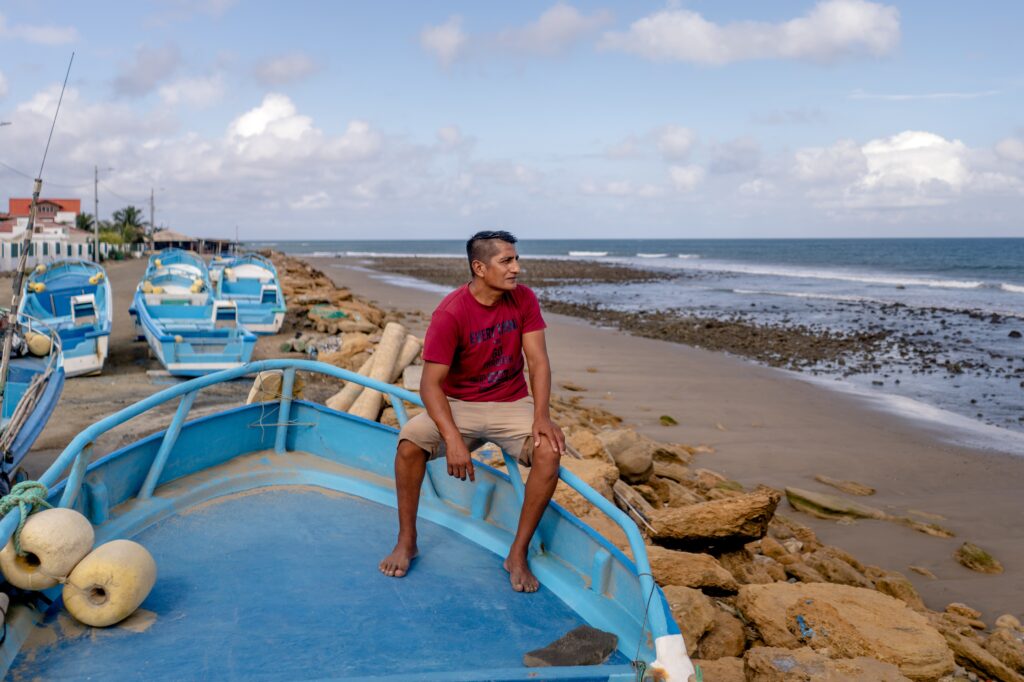
MANTA, Ecuador — The nine fishermen could not see or hear anything as armed U.S. Marines and sailors shoved them onto a military vessel. With hands cuffed, eyes covered and ears plugged, they were told to wait with their heads bowed, surrounded by a stench of urine, one of the men said.
On social media, U.S. Southern Command said the vessel was supporting narco-terrorists and posted a video of U.S. forces blowing it up. The strike cut off a “critical node in the traffickers’ logistics chain,” Southern Command boasted.
But two days after U.S. forces handed the men to Ecuadorian authorities, they were released.
Police and prosecutors provided no evidence of the alleged smuggling — no photos of excess fuel tanks, no text messages, no intelligence linking them to drug traffickers. A judge ruled their detention was illegal.
The strike on Sept. 2 was part of a new phase in the Trump administration’s military campaign against alleged drug boats in waters near Ecuador. Instead of blowing up go-fast boats with crew members on board, U.S. forces are seizing and destroying large fishing vessels accused of providing drug traffickers with fuel to make their journeys toward the United States.
In eight interdictions in less than a month, U.S. forces detained 160 crew members at sea before blowing up their fishing boats, calling them “narco-terrorist” refueling vessels. But most detainees have been released without charges or acquitted as Ecuadorian courts ruled, in case after case, that prosecutors failed to prove any crime.
The interdictions are being conducted jointly with Ecuador, where the government of President Daniel Noboa has welcomed U.S. troops to fight drug-related violence. Unlike in most other strikes in the U.S. military’s year-long campaign, the crew on these vessels are not killed.
U.S. Southern Command, which oversees military operations in the region, declined to comment on the operations with Ecuador.
The State Department did not respond to a request for comment.
Ecuador’s defense ministry, foreign ministry and interior ministry also did not respond to requests for comment.
Joint operations
According to an Ecuadorian intelligence official, the U.S. proposed the joint operations as it became clear the Pentagon’s broader boat strike campaign wasn’t significantly disrupting the drug trade.
The Washington Post reported in July that a Drug Enforcement Administration assessment found the strikes had not reduced the amount of cocaine entering the United States, nor did it lower supplies or increase prices of the drug.
By attacking the vessels that smuggle gas for traffickers to refuel near the Galápagos Islands, U.S. officials argued they could cut off a key logistical hub for a larger number of drug boats, according to the Ecuadorian intelligence official.
By this logic, instead of knocking out one go-fast boat, they could cut off 10, said the intelligence official who, like other current and former Ecuadorian officials interviewed for this story, spoke on the condition of anonymity to discuss sensitive details of military operations.
Ecuadorian officials agreed to support and join the U.S. operations as long as the attacks did not involve blowing up the boats with crews still aboard, the intelligence official said. The South American country provided intelligence to help identify these vessels, the official said.
What happens after the strikes — and whether the crews are investigated and prosecuted — does not appear to be a main focus for the United States, according to the official and a second Ecuadorian intelligence official.
Asked about the interdictions in Ecuador and why crews are now being removed before boats are destroyed, U.S. Secretary of State Marco Rubio told reporters last month that “we will still blow up ships if need be.”
“What you saw early last year is those were unilateral operations in international waters,” Rubio said. The new operations, he said, are happening in cooperation with other nations in their territorial waters. “And when you do that,” he said, “you have to do it based on the understandings that you have with them, and they have to comply with their own laws.”
It is unclear why the U.S. isn’t providing evidence to Ecuadorian authorities, if such evidence even exists.
One possibility is confidentiality concerns related to ongoing investigations. Another is Washington’s broad lack of trust in an Ecuadorian judicial system that has been severely weakened by narco-corruption.
Deterrence
Whatever the reason, the two Ecuadorian intelligence officials said, the Trump administration told Ecuador its main goal is deterrence.
“They’re saying, you know what? If they’re prosecuted or not, if they’re put in prison or not, I don’t care,” one of the officials said. “I’ll take that boat, and that’s it.”
This report on the newest phase of the U.S. boat strike campaign, and the lack of evidence provided to investigate or prosecute alleged gas smuggling, is based on interviews with crew members from three recently targeted vessels, their lawyers, and current and former Ecuadorian officials, and on judicial documents and other evidence provided in court.
“There’s no evidence, because the boats were bombed,” said Juan Alvia Cevallos, a lawyer representing several of the crews. “And if there was a crime committed? They destroyed the evidence.”
Juan Pappier, deputy director for the Americas at Human Rights Watch, a New York-based advocacy group, said the United States has failed to show these communities “that there was a reason to arrest these people and a reason to destroy these vessels.”
“If you’re not able to show that,” Pappier said, “your credibility is severely undermined.”
Of the 160 crew members, 14 were never brought before Ecuadorian authorities, 32 were acquitted and 56 were released without being charged, according to Human Rights Watch. Another 58 were released with restrictions as their cases are adjudicated.
Some crew members reported being beaten, threatened and forced to sign documents they could not understand, according to Human Rights Watch, which interviewed the men.
The fishermen on these boats are often contracted on a trip-by-trip basis, and some crew members said they had only been on one previous fishing expedition with their boat.
One vessel, seized by the U.S. military on Sept. 15, was carrying an Ecuadorian government biologist working as a monitor to deter illegal fishing.
Key partner in Trump’s drug war
Ecuador has become an increasingly important security partner for the Trump administration, and the U.S. military has ramped up operations there despite a referendum late last year in which Ecuadorians voted against allowing foreign military bases in their country.
In March, the United States helped the Ecuadorian military strike multiple properties in a rural area near the Colombian border.
The waters near the Galápagos Islands have become a sort of covert gas station, where fishermen can earn tens of thousands of dollars on a single trip by smuggling fuel to a drug boat at sea, Ecuadorian Navy officials say.
Larger vessels often carry extra motors to convert smaller fishing vessels into go-fast boats with double motors to ferry gas out to drug traffickers, one of the Ecuadorian intelligence officials said.
But such cases are difficult to prove without evidence of surplus gas, extra motors, improper fishing credentials, or other proof, such as phone communications, officials say. Many of those involved in smuggling fuel are legally registered fishermen.
The Americans approach
Juan Carlos Posligua had been fishing since he was a teenager, but the job in late August was only his second time on the Conquista II. On a previous trip, the 44-year-old fisherman earned $230 for a 17-day journey.
This time, on their way back, a hose in the ship’s hydraulic system malfunctioned. As a mechanic tried to fix it, he told the others there was a small airplane circling above.
About a half-hour later, Posligua spotted the U.S. military vessel.
Soon after, U.S. Marines and sailors approached on a smaller boat. Two helicopters flew directly above them, and U.S. forces pointed their weapons down at the fishermen. The Marines and sailors were launched from the USS San Antonio, at the direction of Gen. Francis L. Donovan, the head of U.S. Southern Command, in coordination and collaboration with Ecuador, according to a statement by Southern Command.
Without explanation, the U.S. forces boarded and searched the boat. They told the crew to kneel with their heads to the ground and hands above their heads. After an hour, they handcuffed the fishermen with zip ties and loaded them onto the U.S. ship, where they were sent into a below-deck storage area.
When the nine fishermen were turned over to the Ecuadorian authorities, two days later, the men were described by Ecuador’s Navy as “naufragos,” or shipwreck survivors, and later released.
In a police report provided to the prosecutor overseeing the case in Manta, authorities said the men were “rescued” at sea after being intercepted by the U.S. Navy on the grounds that they were allegedly selling and transporting fuel to criminal groups.
More than a month later, Posligua’s documents are still being held by prosecutors, and he is unable to work. Along the Manta coastline, the fishing industry has been paralyzed by fear.
“People aren’t going out anymore, and I can’t work,” Posligua said. “I lost everything.”
Initially, intelligence officials said, the attacks seemed to accomplish their key goal of deterring fishermen from transporting gas to drug smugglers. Drug seizures at sea seemed to decline, one intelligence official said.
But on Oct. 3, the Ecuadorian Navy announced it had captured a go-fast boat just west of Manta, with about 55 bundles of suspected drugs, worth $50 million in the U.S. market.
Alex Horton in Washington contributed to this report.
The post Seize crew, then blow up boat. U.S. shifts tactics in anti-drug strikes at sea. appeared first on Washington Post.