Perhaps the most in-demand screening at the Cannes Film Festival in May had no red carpet and required no formal wear. The movie, showing just once in a packed 300-seat theater, also had no chance of winning an award.
The occasion was the unveiling of a new restoration of Ken Russell’s “The Devils,” or “Ken Russell’s The Devils,” as the distributor Warner Bros. Clockwork is calling it for its release on Oct. 16. This period piece, about the targeting of a debauched 17th-century priest (Oliver Reed) for supposedly instigating a case of demonic possession among nuns, was greeted in some quarters as a scandal in 1971. But it has long been a cause for cinephiles, who have been intrigued by its modernist aesthetic, its bouts with censorship and its extended stretches of unavailability.
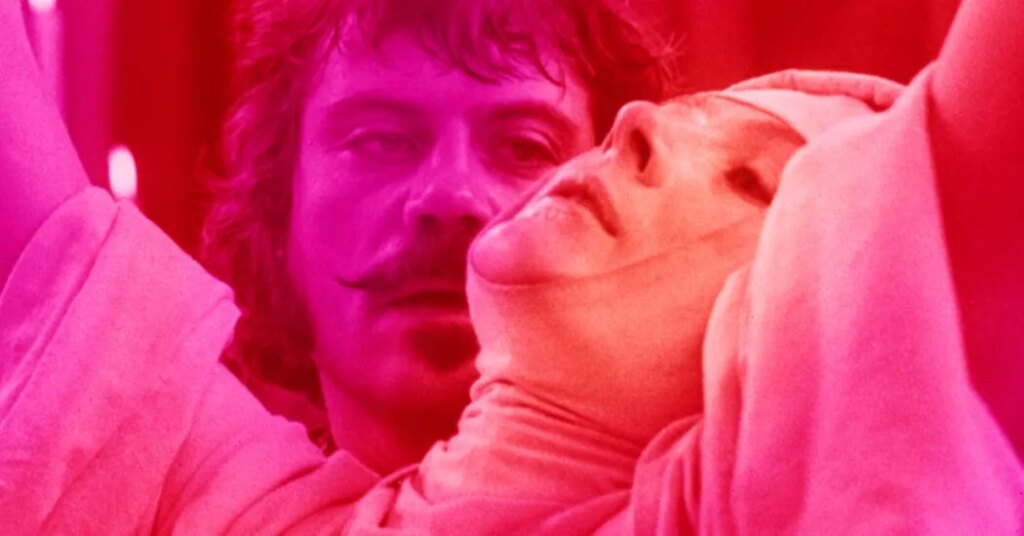
By a certain light, this is the first time that the British director’s vision will be seen properly. The restoration contains censored moments once thought lost, like frenzied, naked nuns writhing sexually on a giant crucifix or a Mother Superior (Vanessa Redgrave) making love to a phallic bone fragment. Those additions were first shown in 2004. But even that material hasn’t been seen in top visual quality until now.
In 1971, “The Devils” faced fury and dismissals. Reviewing the film in The New York Times, Vincent Canby wrote that the picture was “of so little substance, obscene or otherwise, that I can only believe that the men and women of the Motion Picture Association, who rated the film ‘X,’ must be in league with Beelzebub, or with Warner Brothers.” Russell tangled on television with the London Evening Standard critic Alexander Walker, who had excoriated the movie, and hit him on the head with a newspaper.
The uproar makes sense in context. “When people saw the film, because Ken’s imagery is so visceral, they were shocked by it,” said the critic Mark Kermode, who befriended Russell in the 1990s and was instrumental in finding the lost footage and reintegrating it into the director’s cut, which he provided to Clockwork. “This produced a kind of scandalous air. The censors had problems with it, the studio had problems with it, and the story became, ‘This shocking film.’”
Yet Russell, who died in 2011 at 84, was adapting a respected 1952 nonfiction book, “The Devils of Loudun” by Aldous Huxley, and a stage version by John Whiting that followed in 1961.
The plot centers on a Roman Catholic priest, Urbain Grandier (Reed), who unabashedly pursues sexual relationships with women, but also presides over the walled city of Loudun as a sort of secular stronghold where Catholics and Protestants live together peaceably. The community’s self-governance poses a threat to Cardinal Richelieu’s authoritarian aspirations for a unified France. And when Redgrave’s Sister Jeanne, repressing lust for Grandier, insinuates that the priest has engaged in demonic activity, the authorities sense an opportunity.
In short, this may be a movie famous for being filled with sexualized nuns, but their performance of ecstasy is coerced. Father Barré (Michael Gothard) tortures Sister Jeanne and goads the other nuns, who are under threat of their lives, into a state of orgiastic delirium.
“It is really a brilliantly serious, heartfelt story about brainwashing, about the politicization of religion, about the use of hysteria,” Kermode said on a video call. He noted that this is a through line in the work of Russell, a Catholic convert who had a complicated relationship with his faith.
“Ken was very interested in religion, but also in false religion, in false messiahs,” Kermode said. “If you look, for example, at something like ‘Tommy’” — Russell’s 1975 screen adaptation of The Who’s rock opera — “‘Tommy’ is absolutely a story about false messiahs.”
The use of religion, or at least the perception of how it was being used, surely factored into the reception. “The Devils” opened five years after the incalculably more conservative, best picture-winning “A Man for All Seasons,” about the 16th-century martyr Sir Thomas More. Each film ends with a man on trial forced to choose between his beliefs and his life in a dispute that has fused church and state. But More, unlike the sweaty, flesh-and-blood Grandier, is never shown to be a hypocrite, and Russell treats Grandier’s hypocrisy as deeply human, worthy of sympathy.
In an interview, Richard Crouse, author of “Raising Hell: Ken Russell and the Unmaking of ‘The Devils,’” pointed to another 1966 event: Time magazine’s publication of a cover emblazoned with the words “Is God Dead?” Crouse said that satanic themes were also working their way into movies like “Rosemary’s Baby” (1968) and “The Exorcist” (1973).
But in his book, Crouse points out that “The Devils” never achieved the popular success of those films. The difference, he said in an interview, was the Russell film’s sheer bleakness. “It was widely condemned as sacrilegious when it first came out,” Crouse said, noting objections at the Vatican and from the British conservative activist Mary Whitehouse.
And, he added, the film “fought and lost more battles with censor boards than almost any other film that I could think of that was made by a major studio, that starred big international stars, that was directed by a director like Ken Russell, who had big hits before this.”
Russell moved on quickly. Incredibly, “The Devils” was the second of three features he put out in 1971, along with “The Music Lovers” and “The Boy Friend.” And for a long time, the only home-movie version was an R-rated cut available on a miserable VHS tape. In recent years, “The Devils” has appeared on disc in certain territories, and it has intermittently turned up on streaming services like the Criterion Channel, but never in a complete or visually uncompromised form.
Russell’s boundary-pushing pictorial sensibility may be the biggest revelation of this restoration. Two years off the critical acclaim for his polished D.H. Lawrence adaptation “Women in Love” (1969), which had a comparatively easy ride past the censors, Russell used “The Devils” to begin advancing the more hallucinatory style that would define later films like “Lisztomania” (1975) and “Altered States” (1980).
His production designer was Derek Jarman, who went on to become an important experimental filmmaker, and who created a convent interior that looks like nothing so much as a white-tiled bathhouse, an image that Kermode said was derived from Huxley.
Kermode added that it was important to Russell that “The Devils” look contemporary. “If you were in Loudun at that point, it didn’t look like an old, mossy city,” he said. “It looked like a modern city. He wanted viewers of the film to see the film as modern.”
That also accounts for the deliberate anachronisms. Some viewers find it jarring that Father Barré, in tinted sunglasses, resembles John Lennon. “He wanted to show that it was always happening, this kind of thing,” Lisi Trebble Russell, who met Russell in the 1970s and was married to him for the last decade of his life, said on the video call with Kermode. “And so he intentionally cast someone that was extremely out of the front row of the Beatles.”
While Trebble Russell cited other hallmarks of the era that may have been on Russell’s mind — the Vietnam War, the mind-control experiments of MKUltra — she emphasized that classical music was his first love.
At Cannes, she told the audience that when Russell had the lost footage returned to the film, he responded, “Now I have my rhythm back.”
The post In 1971, This Film Was a Scandal. In 2026, It’s a Respected Period Piece. appeared first on New York Times.