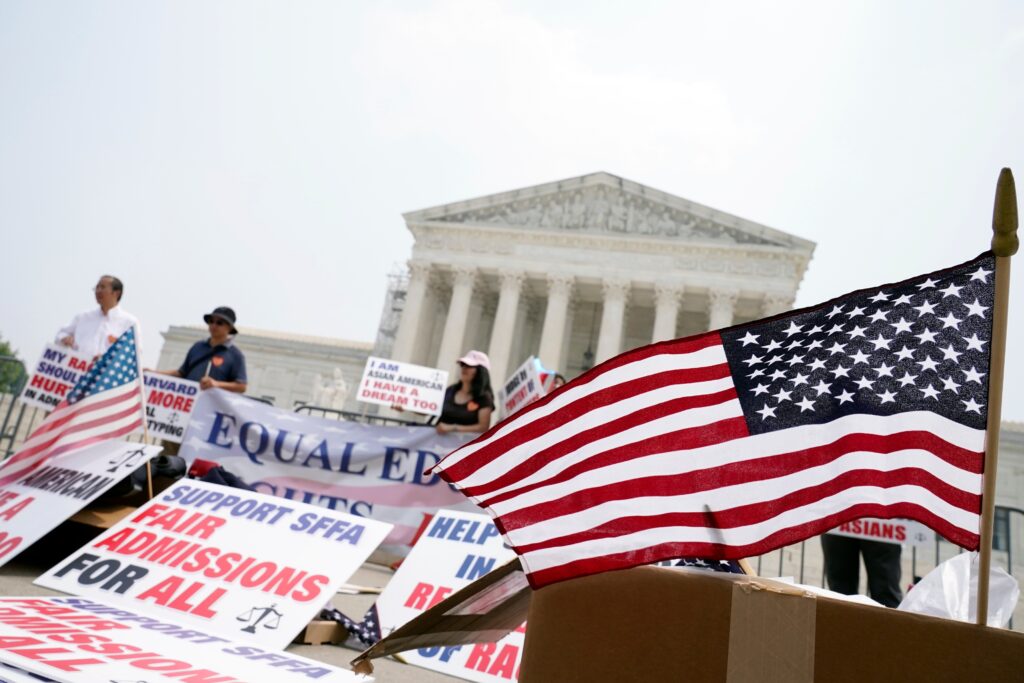
Edward Blum, a visiting fellow at the American Enterprise Institute, is founder and president of Students for Fair Admissions.
Three years after the U.S. Supreme Court struck down racial preferences in college admissions, the evidence is overwhelming that the practice hasn’t ended — it simply went underground.
Fortunately, the U.S. Justice and Education departments are bringing the lawbreaking to light. In August, the Justice Department’s Civil Rights Division told Duke University’s law school that it had violated the 1964 Civil Rights Act. Assistant Attorney General Harmeet Dhillon concluded that Duke “continues to intentionally discriminate,” citing internal communications reflecting “a sustained, determinative emphasis on racial diversity in admissions and a deliberate effort to preserve racial outcomes.”
A university spokesperson said the school is “committed to complying with the law … in a manner that is consistent with our academic mission,” but the DOJ’s conclusion was based on hard data: The median LSAT scores of rejected Asian and White applicants in the 2024-2025 cycle at Duke far exceeded the median scores of admitted Black applicants, who were 3½ times more likely to be admitted than a similarly qualified Asian applicant.
At the UC Berkeley’s law school, a joint Justice Department and Education Department investigation uncovered an even greater discrepancy in test scores. Black applicants were nearly six times more likely to be admitted than White applicants with comparable qualifications. The agencies found that half of admitted Black students scored below 95 percent of admitted White students on the LSAT.
Shortly before the Supreme Court’s ruling, Erwin Chemerinsky, the law school’s dean, anticipated what was to come. He told the New Yorker, “What colleges and universities will need to do after affirmative action is eliminated is find ways to achieve diversity that can’t be documented as violating the Constitution.” In its findings, the Justice Department quoted this line as evidence of Berkeley’s intent to obfuscate and rig the admissions process if race was eliminated as an allowable factor. In response to the DOJ’s letter, Chemerinsky said that “race is not considered in any way in admissions decisions.”
But work-arounds don’t appear to be confined to just these two law schools, and reprimanding schools one by one can accomplish only so much. The Justice Department has made similar discoveries at UC San Francisco’s medical school, UCLA’s law and medical schools, and George Washington University’s medical school.
What appears to be happening is that schools are continuing to pursue racial outcomes through racial proxies, such as race-targeted recruiting and essay prompts that solicit reflections on “identity.” Before the Supreme Court’s ruling, Yale, Princeton and Duke warned in a friend-of-the-court brief that they could not “obtain the diverse student body” that they said was “essential” without using racial preferences. Yet after the ruling, Yale’s Black and Hispanic enrollment rose. School administrators attributed the increase to “Landscape” — a tool created by the nonprofit College Board that rates applicants by their neighborhood and high school. College Board dropped Landscape in 2025 amid criticism that it worked as a proxy for race.
Asian enrollment fell at Yale, Princeton and Duke, even as it rose at other elite schools. Students for Fair Admissions sent letters asking these three schools for the data explaining this discrepancy, but we received no answer for more than two years. And that’s the issue: These schools will never voluntarily provide admissions data.
The remedy is mandatory public disclosure. To shed light on racial discrimination in admissions more broadly, every competitive institution that accepts federal funds should be required to report the racial and statistical profiles of its applicants, its admitted students and its matriculating classes. This would include standardized test scores, GPAs, family income, Pell Grant eligibility, AP coursework and other metrics, broken down by race and ethnicity.
The data from Duke and Berkeley became public only because of a federal compliance review. Universal disclosure would give students, parents, courts, scholars and journalists the same information that investigators found at Duke and Berkeley. In addition, regulators should treat racial proxies — such as racial-identity essays — as violations in their own right.
Providing this basic data disclosure has unsurprisingly been met with fierce resistance from admissions offices throughout the country. When the Education Department moved to expand required admissions reporting, 17 states, led by Massachusetts, sued to block it, which will likely keep the rule tied up in federal court for months, if not years.
A full disclosure process is not about pursuing claims of “disparate impact,” which infer discrimination from an unequal outcome alone, even when a policy is race-neutral. What the federal agencies assert they found at Duke and Berkeley is far worse: documented, intentional decisions to admit applicants based on their race. That is classic “disparate treatment” — a direct form of discrimination that our nation’s civil rights laws prohibit.
It is encouraging that federal enforcement is finally catching up with the Supreme Court’s ruling, but it can’t depend on one administration’s priorities. Congress should codify mandatory disclosure into law so that it survives the next election and the next lawsuit.
The post How to stop colleges from discriminating by race appeared first on Washington Post.