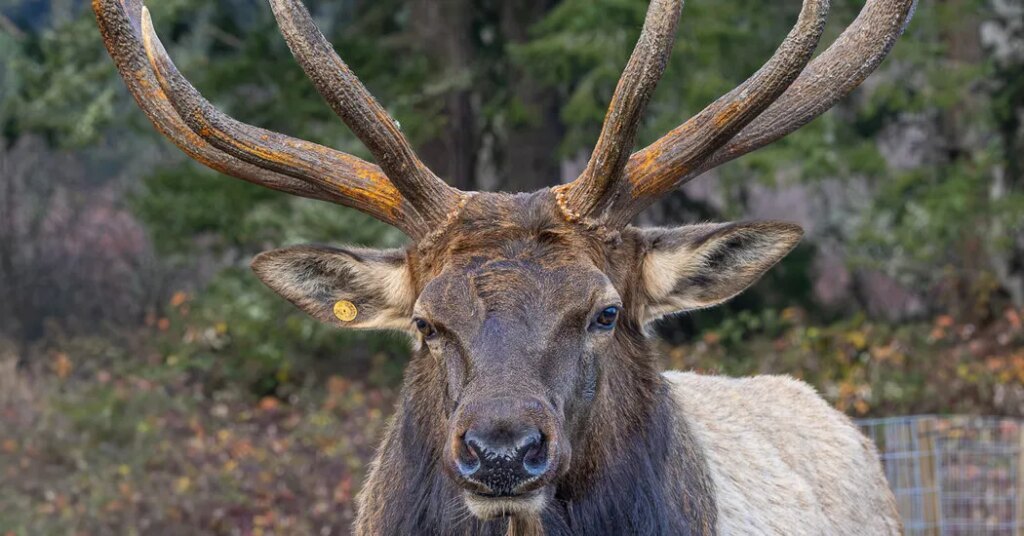
One summer around 14 years ago, a young elk ditched the American mainland, swam alone to a misty island and never left.
The animal chose Whidbey Island, a stretch of rolling hills and steep bluffs north of Seattle. Known as Bruiser, he was the only one of his kind on that strip of land. And now, the elk — who enchanted locals with his ironclad loyalty and wily antics — has died, leaving residents heartbroken.
“Everyone has a Bruiser story,” said Margaret Nichols, 71, who lived on Whidbey Island for years and returns monthly.
To a degree, she said, Bruiser was the island’s mascot, his likeness immortalized on keychains, earrings, T-shirts and stickers. “We were practically hyperventilating,” Ms. Nichols said of the first time her family saw him.
But why did a nearly 1,000-pound, 6-foot-tall wild beast inspire such devotion?
The elk was to some a unifying animal, which was welcome for an island divided along political lines like many other communities. He had come to symbolize conservation and independence and his presence reassured some residents that they chose correctly when trading the bustling city life for a quiet island.
Whidbey Island was enough for Bruiser. So he was right for the people, too.
And Bruiser, who had a penchant for snacking on apples he found on trees in people’s yards, was entertaining in his own way.
His antlers somehow became hopelessly entangled in all sorts of things: a bicycle, yard art, clotheslines. He often butted against fences and tarps, residents said.
“He was always up to something,” said Cynthia Mason, 64, a resident on Whidbey Island. “There was a little mischievous side to him.”
The island, about 169 square miles covered in lush forests, beaches and stunning cliffs, is a study in contrasts. The U.S. Navy erected an air base on it in the 1940s, at one point housing more than 11,000 people. There’s agriculture: farmers growing tomatoes, peppers and berries. Some of the island’s 71,000 residents commute by boat 75 minutes or longer each way to Seattle for office jobs, locals said.
Bruiser once was a member of the North Cascades elk herd managed by the state and the Point Elliott Treaty Tribes in Skagit Valley, Wash., about 60 miles north of Seattle. The herd is the northernmost pack in the state. At about 1,600 animals, it is the smallest of the 10 herds recognized by the Washington Department of Fish and Wildlife.
For motives unknown, Bruiser braved chilly waters and dangerous currents in Skagit Bay, leaving the U.S. mainland and arriving on the island’s shore around 2012, said Kurt Licence, a wildlife biologist with the Washington Department of Fish and Wildlife. The route is about two to four miles, though it is not exactly known what course Bruiser took, Mr. Licence said.
The morning of Sept. 13, 2012, Fred Goodman was walking on his property near Strawberry Point, by the eastern shore of Whidbey Island. There, he spotted a tawny coat and antlers, much to his astonishment.
Mr. Goodman, who spent a career in wildlife management, knew.
It was an elk.
An elk had not been spotted on Whidbey Island for more than 100 years after the island’s elk population was hunted to zero around the early 1900s, officials and residents said.
At the time, Mr. Goodman called an officer with the Washington Department of Fish and Wildlife, Ralph Downes, who confirmed that an elk was roaming Whidbey.
The local newspaper, The Whidbey News-Times, published a story recounting how the elk had graced its shores, Mr. Downes said, and word spread. The newspaper documented a relationship between Mr. Downes and Bruiser, with the officer receiving about a half-dozen calls about the elk’s exploits in a single year.
A well-known Bruiser tale involved him playing with a rope swing attached to a buoy in February 2017. The rope was wound around the antlers, and the bull couldn’t get it off.
Bruiser bucked and thrashed when Mr. Downes and others tried to free him. He ran, but the buoy kept hitting his face, and Bruiser became more angry, Mr. Downes recalled.
He crashed in the woods, went over a bluff and fell on a beach, still furious and wearing the unwanted crown, he said.
Mr. Downes was part of a group that tranquilized Bruiser. “He woke up just as pissed off as when he fell asleep,” he said. “He wasn’t very thankful.”
Perhaps Bruiser longed for a way back to his herd. During the rut, or the mating season when an elk becomes more aggressive, he would be spotted bugling — making a mating call — toward the Washington State mainland.
Despite his frustrations, Bruiser stayed.
Ansel Santosa, 35, and co-owner of the Ballydídean Farm Sanctuary, said Whidbey Island’s politics are narrowly split. Only 33 votes separated the Republican from the winning Democratic candidate for governor in 2024 in a district that includes the island. But Bruiser was a topic everyone could rally behind. He never saw the animal, and yet felt a special connection from the pictures posted on social media.
“He gave me hope that we could become part of the community in that way,” Mr. Santosa said.
After Bruiser’s death, The News-Times published a 1,602-word tribute to “the neighbor who never paid rent.”
As he grew in years, the residents’ love for Bruiser grew. But the beast — who was anywhere from 15 to 18 years old — grew haggard. Bulls rarely live more than 12 years, according to the state’s Fish and Wildlife Department.
Detective Sergeant Ed Wallace, a spokesman for the Island County Sheriff’s Office, recalled a video posted about a week before Bruiser’s death, which showed the elk had damaged antlers and was moving with a limp.
On Oct. 6, the sheriff’s office was called at about 1 p.m. to a private property for a report of a dead elk. A couple came across the carcass while walking on the beach, the detective sergeant said.
It was Bruiser. He wasn’t shot. He was at the base of a cliff with his antlers broken.
Perhaps, Mr. Downes said, Bruiser wanted one last glimpse across the bay from the top of the cliff. He had left behind his herd, but had found a new place to belong, Mr. Goodman said.
“Maybe we were his herd,” he said.
The post Bruiser the Elk Left His Herd for an Island and Made It Home appeared first on New York Times.