The nominal subject of the trippy “You Can See Everything” is Elizabeth Holmes, the celebrated entrepreneur turned celebrity jailbird. As a portrait, the movie is intimate and analytic, informative and incomplete. It’s also off-the-charts bonkers, which isn’t surprising given the participants. Directed by the comic Nathan Fielder and the filmmaker Lance Oppenheim, the movie is, among other things, a wily, disturbing, self-aware exploration of the relationship between documentarians and their subjects. It’s often funny, even if the questions that it raises about truth, reality and knowledge can make it feel like a tragedy — few movies speak as uncannily to the pathos and destabilizing confusions of the present moment.
At this point, it’s a tossup whether Holmes is better known for her pop-cultural profile or her real-world exploits or if Fielder, the creator of absurdist comedy TV shows like “Nathan for You,” is now the bigger draw. Her fame was relatively brief but sensational. In 2014, Forbes deemed Holmes, the founder of a blood-testing start-up named Theranos, the youngest self-made female billionaire. She claimed, among other things, that her technology would revolutionize health care, which proved untrue. By 2022, Holmes had been found guilty of four charges of fraud for deceiving investors, a turn of events that seemed to baffle even the presiding judge. “What was it that caused Ms. Holmes, regrettably, to make those decisions that she did,” Judge Edward J. Davila asked, before sentencing her to 11 years in prison.
That question hovers over the movie, and is as much a head-scratcher as how Fielder and Oppenheim came to make it. At one point there’s an approving reference to Fielder being someone who looks “at things differently.” It’s a rich line for those familiar with his work; it’s obvious that Holmes and her life partner, Billy Evans, were not. It’s also obvious that they were out to shift public perceptions about her or, at least, the ostensible narrative, and that the filmmakers were aware of the role they were being solicited to play. It’s not for nothing that the documentary opens on a tight shot of Evans’s face. “Nobody knows who she is,” Evans says to someone on the phone, shortly before dropping the words “radical transparency.”
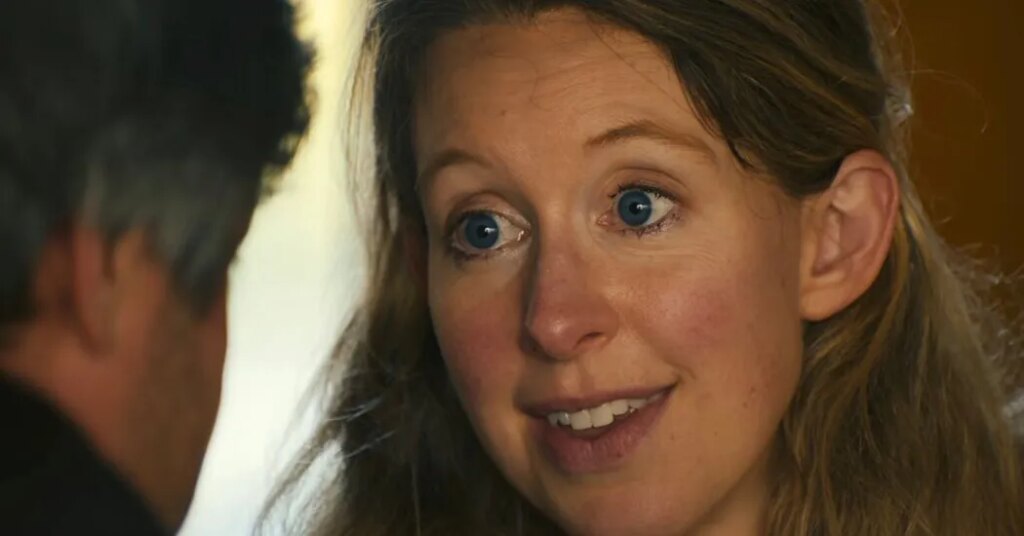
It’s instructive that Holmes isn’t the first person you see in the movie given how she appears in the movie. She was the most famous woman tech entrepreneur to emerge from Silicon Valley, which helped elevate her profile and added frisson of her fall. Her signature look was striking, including long hair that always seemed a smidge messy, as if she were just too busy innovating to comb it. She didn’t seem to blink, which emphasized the whites of her eyes and presumably held others rapt. It’s a neat movie actor trick for creating dominance, which might have been useful in tech-bro land. She blinks in “You Can See Everything” and her distinctive low-pitched voice also seems more natural; it’s about the only thing that does.
Shot over several years, the documentary opens in 2022, 34 days before Holmes entered prison. Throughout it, the filmmakers mix original and extant material, and embrace different documentary approaches (participatory, ethnographic and so on). For the most part, though, “You Can See Everything” — the title refers to a text Holmes sent Fielder — unfolds as a series of intense conversations with Fielder serving as the on-camera interlocutor. Many of these take place in Holmes and Evans’s beachfront place in Del Mar, Calif., where Fielder prods and pushes them in the dining room, on the sofa, wherever, sometimes with the couple’s two young children and her parents in attendance. A number of encounters are shot in such extreme, dermatologic close-up that you become intimately familiar with Fielder’s zits.
Every so often, other members of the small film crew show up on camera, too. These onscreen appearances are reminders of the inherently constructed aspect of the movie and, by extension, the documentary genre, and they dovetail with a movie’s preoccupation with questions of authenticity and artificiality. All the conversations in the movie take place, after all, in front of a small audience that is, in turn, recording these interactions for the far larger movie audience. Whether Holmes’s occasional blinks and tears in these chats are performative is open to question as are her grasp on language, truth, science and reality itself, all of which Fielder seizes on in a series of interactions that grow progressively weirder.
One of Fielder’s superpowers as a performer is his deadpan, which he generally manages to maintain no matter how outlandish the conceit. He’s put it to recurrently unsettling effect on shows in which he — or a version of himself — aggressively toys with the genre of reality television through his interactions with real people. In “Nathan for You,” he offers absurd advice to small-business owners, successfully persuading a frozen-yogurt store manager, for instance, to sell a lab-created fecal-flavored offering, a.k.a. “poo.” The more conceptually ambitious show, “The Rehearsal,” involves him helping people work through assorted personal issues with the use of hired actors and elaborate re-creations of real life.
Both shows are finally less interesting for what they say about their putative subjects than what they say about those of us who watch them and keep on watching in stitches, shock or horror. Fielder likes to test the limits of propriety and (canned) reality, and he’s having some laughs in the process. He’s also creating social psychological experiments that, in their effect, bring to mind Orson Welles’s 1938 broadcast of the H.G. Wells novel “The War of the Worlds,” about an alien invasion. Welles presented part of the drama as breaking news, which panicked listeners, made headlines and irked the Federal Communications Commission. Welles later said that he had underestimated “the extent of our American lunatic fringe.”
That fringe no longer seems marginal, if it ever was. That the world in “You Can See Everything” appears sane is partly because of the legitimacy conferred on Holmes by her fame and the hundreds of millions of dollars that went into Theranos. Serious people took her seriously, which can seem hard to believe given how slippery Holmes and Evans seem here. Indeed, the first image of Fielder in the movie suggests that he and Oppenheim have come to this project with a degree of incredulity. It’s a murky shot of Fielder peering through a window with what looks like comic skepticism. If it’s uncertain what Fielder is thinking at that moment, it is certain that he and Oppenheim have already begun to test your preconceptions.
One of the most gob-smackingly wild things about Holmes is how she was able to scam so many. That’s part of the story here, though the more interesting one concerns what we mean by truth in a world of profound epistemological uncertainty. Again and again, Fielder presses Holmes about her past and her present. He stares into her eyes, and she stares right back, as he interrogates her linguistic elisions and wonders about her grasp on a famous old comedy routine. He also watches her as she watches the 2022 TV drama series “The Dropout,” in which Amanda Seyfried plays Holmes. It’s a dizzying moment, all the more so given that we’re watching, too, swept up in a ricochet of gazes in the mirrored fun house we now live in.
You Can See Everything Rated R for language and male nudity. Running time: 2 hours 54 minutes. In theaters.
The post ‘You Can See Everything’ Review: The Slippery Mind of Elizabeth Holmes appeared first on New York Times.