The artist and writer Rosalyn Drexler (1926–2025) once jotted down in a notebook: “Metaphorical paintings out. Graphic reality paintings in. A painting is a painting; the image is not the painting.” These lines sum up a change that took place in the 1960s with the rise of Pop art.
Eschewing art-making as a pure expression of the soul, Pop’s practitioners dove into the world of existing images, especially mass-produced ones, and picked some to bring to the fore. They pulled from comics (Roy Lichtenstein), advertising (James Rosenquist) and pictures of celebrities (Andy Warhol). The point was to draw attention to the proliferation of images and raise questions, however subtle, about what they said about society.
Drexler was in the vanguard of this movement, although she hasn’t always been recognized as such. Pop was canonized through its male practitioners, a bias that’s begun to shift with efforts like the 2010 exhibition “Seductive Subversion: Women Pop Artists, 1958–1968,” which originated at Philadelphia’s University of the Arts. Being both ignored and celebrated are features of Drexler’s long career. The curator Robert Cozzolino once wrote that she “has been discovered and rediscovered so many times that the art world should be checked for amnesia.”
Now, another season of Drexler rediscovery is upon us — and not just in the art world. Last month, the fashion designer Rachel Comey presented a new collection inspired by Drexler. In November, Hagfish Books will republish “The Cosmopolitan Girl,” one of her many novels, which she wrote under both her own name and the pen name Julia Sorel.
In the interim, Garth Greenan Gallery has devoted the opening of one of its new spaces to Drexler’s art, and on Oct. 22 Anthology Film Archives in Manhattan is screening the 1975 documentary “Rosalyn Drexler: Who Does She Think She Is?,” which captures her madcap, multifaceted creativity. In addition to painting and penning novels, she wrote plays (for which she won multiple Obie awards) and criticism (including for this newspaper), modeled for her husband (the painter Sherman Drexler) and was, briefly, a professional wrestler.
The show at Garth Greenan is titled “My Life Has a Life of Its Own,” after a phrase taped to the cover of one of Drexler’s journals, which is on view. Above the text is a photo collage of herself with three arms and four hands — an apt representation of multitasking. The two hands in her lap are positioned near a typewriter, maybe poised to start her next book. The raised arm and hands hold a free shopping newspaper, which could refer to her method of finding source images in the most lowbrow places, or to her identity as a wife and mother. Drexler dropped out of college to get married when she was 19. She did most of her creative work in the homes — first in Berkeley, then Manhattan and finally Newark, N.J. — where she and Sherman raised their two children.
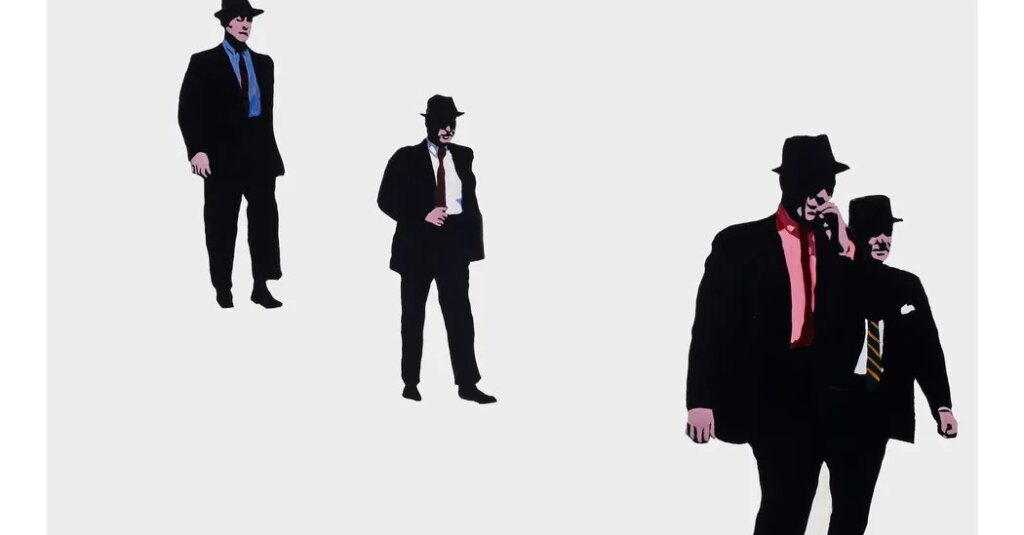
The exhibition, which was curated by the art adviser Fiona Laugharn, focuses on the 1960s, Drexler’s best-known decade as an artist. This is when she honed her Pop style by taking pictures from mass media — usually movie posters and advertisements — and isolating them on canvas; she would paint over them and then surround them with fields of monochrome. So, in “F.B.I.” (1964), four shadowy men in black suits and hats stride ominously across a white void. In “Untitled” (1963), a woman lies facedown in the foreground while two men square off behind her. The figures, rendered in blocky colors, are suspended between a pool of intense blue and an expanse of minty green.
Drexler used source material that was unusual, even taboo, in contemporary art. The subjects at the heart of her art from the ’60s are sex and violence. (She once described “the human dilemma” as “hit or be hit.”) In painting after painting, she depicts women and men embracing or fighting — sometimes it’s hard to tell which. One particularly dark work, “Black Suicide” (1963), depicts an indistinct brown figure falling down and all but disappearing in a series of thickly painted black panels that progress like a comic strip or film reel. Even in lighter pieces, the way Drexler chooses and spotlights images creates a sense of eerie timelessness.
She tackled gender politics more overtly in her “Men and Machines” series. Two of those paintings, on view here, depict the titular subjects almost as appendages of one another, in scenes that feel more sardonic than her other art. But Drexler belonged to the generation just before second-wave feminism and did not have a straightforward relationship with it — even though, like other trailblazing women of her age, she lived an unmistakably feminist life.
In fact, the overarching sensibility that came to my mind in the gallery was that of an outsider attempting to make sense of American society. Drexler (née Bronznick) was the daughter of Russian Jews and for the family, who lived in the Bronx, culture meant vaudeville, Yiddish theater and the movies. This helps explain not only the unabashed pulpiness of Drexler’s aesthetic, but also the searching critique her art represents. Like many others who grew up during the Great Depression, she couldn’t access the American dream, and that freed her up to expose it as a myth.
For Drexler acolytes, the most exciting revelation of the current exhibition is its inclusion of material from her archive. Eight pulpy movie posters hang on a wall near the entrance; their imagery recurs in paintings nearby. Across from the posters are three vitrines overstuffed with notes, drafts, sketches, photographs and press clippings. It’s too much — and too unlabeled — for anyone to fully parse, but the sheer bounty conveys the force of Drexler’s imagination.
The archival material pairs especially well with a set of surprising paintings in the show. In these works, made in the early 1960s, Drexler leans into a collage aesthetic. Sometimes she arranges clippings physically on the canvas; in other cases she’s just using juxtaposition as a visual device. All these works include snippets of text taken out of context. For instance, “Intimate Emotions” (1963) features this phrase pasted on a boat-like form that holds a figure who looks suspiciously like Drexler; eyes closed, she attempts to hold back a man in a suit who’s poised to punch her. Hit or be hit.
Seeing Drexler work more openly in collage places her in a broader lineage that extends from Dada to peers like Ray Johnson and Richard Hamilton, the British progenitor of Pop. It also puts her art more firmly in dialogue with her writing — not just literally, but also stylistically: “The Cosmopolitan Girl” is an entertainingly absurd pastiche about a New York City woman who trains her dog to walk upright and speak and in the process falls in love with him.
The book has such a different tone than the paintings, it’s almost hard to believe that the same person made them. But then, if this show affirms anything, it’s that Drexler could not be contained by a single style, category, or medium. Maybe that’s why the art world keeps forgetting her — because for decades, every time she reappeared, she was doing something new.
Rosalyn Drexler: My Life Has a Life of Its Own
Through Oct. 24, Garth Greenan Gallery, 25 Greene Street, SoHo; 212-929-1351, garthgreenan.com.
The post The Painter the Art World Loves to Forget appeared first on New York Times.