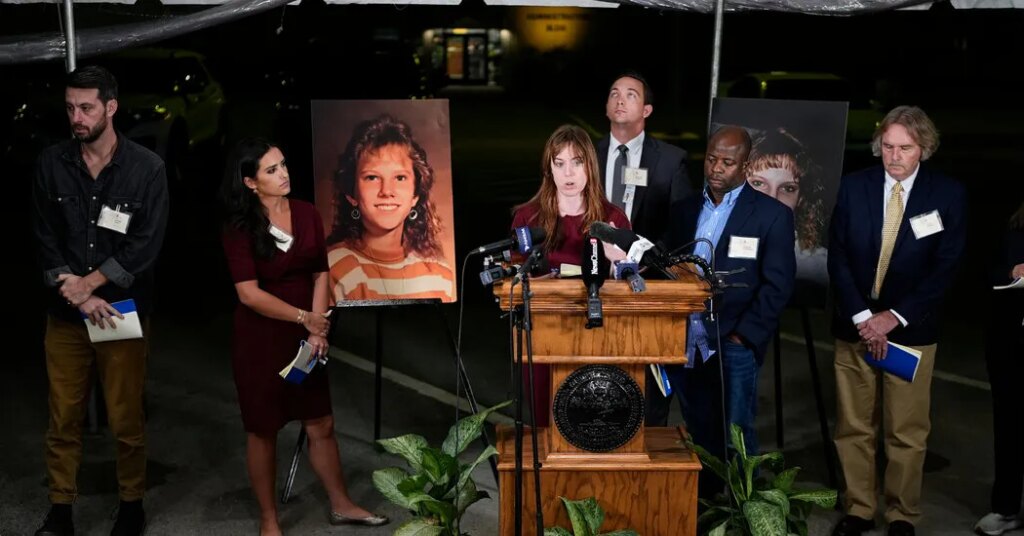
Shocking news of the botched execution of Christa Pike, the first woman set to be executed in Tennessee in nearly 200 years, rippled across Nashville and the country last month. Pike, who was convicted of the 1995 murder of a classmate, was discharged from a hospital this week after surviving two doses of a lethal drug. While Pike recovers at a women’s prison, Gov. Bill Lee of Tennessee has paused capital punishment in the state and ordered an investigation.
Very few people ever witness capital punishment proceedings, and media witnesses often offer the only independent account of what happens inside a death chamber. Catherine Sweeney, a health reporter and newscast host for Nashville’s local news and NPR station (WPLN-FM), and Steven Hale, a criminal justice reporter for The Nashville Banner, were inside Riverbend Maximum Security Institution that day, reporting as media witnesses. The New York Times reporter Emily Cochrane, who is based in Nashville and covers the South, was camped outside in the prison’s parking lot.
A federal appeals court briefly paused the execution that morning. About nine hours later, when the Supreme Court allowed plans to proceed, Catherine and Steven were already sequestered inside. They then watched as Pike survived receiving two doses of the drug pentobarbital. Amid the chaos, both the reporters inside and outside the prison helped their counterparts fill in the blanks when they couldn’t.
In an interview, the journalists shared more of what they saw and heard and the role of human emotion in reporting. These are edited excerpts from the conversation. (For more behind-the-scenes reporting, check out Catherine’s first-person story, and an interview with Steven.)
Catherine and Steven, you were two of the seven media witnesses that day. It was your fifth time in the role. What is a media witness?
CATHERINE SWEENEY: Our job is to give as detailed of an account of the proceedings as we can. There’s hardly anyone who talks to the public about what happens during executions. Attorneys are allowed in the room while the IVs are being put in; we’re not allowed to see that. But other than the attorney and the spiritual adviser, almost nobody is there. Everybody is either related to the victim; related to the person who’s being put to death; a prosecutor, someone who works for the prison system or is part of the legal system. We’re the only people who aren’t aligned with any particular entity. We not only try to document for other media (we do a press conference after) but also our words are also often used in lawsuits, research and policy. They’re cited as being the only neutral account of how an execution happens.
STEVEN HALE: It sort of functions as a pool. Catherine mentioned the press conference that we do after. The idea is supposed to be to tell everyone what we saw; it’s not our story so much as it is representing the media in general.
Catherine and Steven, you’re in and out of the prison; when you’re inside, you don’t have phones. Emily, you were outside the prison, in the parking lot.
EMILY COCHRANE: This crystallized this two-pronged approach. We need people like Catherine and Steven inside, without their phones, totally sequestered, to be cleareyed and accurate about everything they’re seeing. Other reporters like me are outside. At one point, we were escorted — one does not simply wander around this facility without multiple people from the prison with you — to the area where there were protesters for and against the death penalty. We could talk to them and get their perspective and have that in our stories. When there’s this hourslong wait, this back and forth of legal filings, we’re outside in the parking lot, keeping people updated on what we know and what we don’t, while these two and the other media witnesses are inside keeping tabs on what’s happening. It is two halves that keep that game together.
Usually when you think of reporters from different outlets covering the same story, you think of a competitive rush. Walk me through what collaboration looks like.
STEVEN: We don’t have anything on the inside. We’re just in this little group together; there’s a lot of discussing what we see or think. One of the things that will always stick with me from this one: I remember we were sitting in there for close to an hour before they even opened the curtain. At one point, Catherine turned to the rest of us and said, do we think something has gone wrong? That kind of thinking out loud together was helpful.
Us media witnesses were wondering, maybe the people outside know more than we do. I imagine they were outside thinking, they probably know something. It was a combination. We didn’t necessarily know everything they did, and they didn’t know everything we did. It is piecing it together.
If there weren’t media witnesses in the execution, we would have whatever the state says and what the defense attorneys say. We as witnesses try hard to be objective and professional. We just saw this thing that was unsettling, so it’s very helpful to have another layer of neutrality, which is the outside reporters who did not see the thing, asking us about the thing.
EMILY: We are professionals, this is our job, but to witness this, to sit with the moral and ethical complications and questions behind this, is difficult. You’re balancing a lot of really strong emotions from everyone around you. It would have been difficult to witness this had everything gone the way it was supposed to. But with these added layers of complications, it’s been really emotional. It’s heavy. I think that’s another reason we try to have as many people as possible to check you and balance you, whether you’re inside the room, you’re sitting in the parking lot, at home watching this on a computer. All of those layers ensure that for those of us who are covering this, we are doing it fairly and respectfully.
Let’s pick things up after the nine-hour waiting period, when the execution is moving forward.
CATHERINE: We’re in the witness bay. They’re on the other side of a door and of the window. You can sometimes make out what they’re saying, sometimes not. We heard what we thought was Christa crying. We heard some discussion, but we didn’t necessarily hear anything explicit that made us know for sure that there was some issue with the IVs.
There’s a clock to keep track of how things are unfolding over time, but it’s in the death chamber. When the curtain’s closed, we have no way to track time. John North from WBIR was wearing a watch, and we just kept being like, John, what time is it? This should not be taking so long.
STEVEN: When we are originally brought into the witness room, the curtain is closed. At a certain point, there is a mic check; as weird as that sounds to say, someone on the other side in the execution chamber literally says mic check because there’s a microphone hanging. At that point, they turn the lights off in the witness room, they open the curtain, and that’s when we see Christa Pike on the gurney. By the time that happened, we had been sitting in the witness room for an hour, so it was very strange.
CATHERINE: When they opened the curtain, my heart sank. It shouldn’t have taken so long. One of the things that everybody’s been very put off by is this institution of putting the “rock” out.
Yeah, what is that about?
CATHERINE: In the death chamber, there’s almost no staff. They place the IVs and then they go into a hidden antechamber. All of the drugs are pushed from a separate room, into the IVs that flow through a channel in the wall and into the arm. We can’t see them preparing the drugs, we can’t see them injecting them into the line. We can’t see the vials of pentobarbital.
Between that room and the death chamber, there’s a wall with a little trapdoor, and there’s a platform at the base. The trapdoor opens, and a gloved hand places a rock on the platform. Somebody said it felt like a dream sequence.
Protocol says there’s a five-minute waiting period after all the medications are administered. After that five-minute period, the curtain closes for the doctor to certify death. The rock comes out exactly five minutes before the curtain closes. We’ve reverse engineered the idea that it seems like that means the meds are fully administered. But they won’t confirm that.
The curtain opens. You see Christa Pike. What happens next?
CATHERINE: She’s still talking and lively — she and her spiritual adviser were singing songs together. Usually, by the time the rock is out, a person is almost always totally unconscious. I was watching the clock, and four minutes after the rock was put out — a minute before death is supposed to be certified — she was still talking. I looked back at Steven. The curtain closes for them to certify death, and we know she’s not dead.
I don’t know what’s going to come next. The protocol says they can do a second dose. I’ve never seen that; I’ve never even heard of it happening. They asked the spiritual adviser to go back into the death chamber, which, again, I’ve never seen. And I was like, I guess that can only mean one thing. They don’t say anything to us. The curtains open again. And we were like, they’re doing it again. This is a horror show.
The case has drawn national attention. Steven and Catherine, from your perspective as local reporters, does that at all change your coverage? Emily, you’re based out of Nashville, but you’re covering this for a national audience.
CATHERINE: Steven and I talked about this. We got so many interview requests from other countries. And I do think that’s interesting, but as a public radio reporter, my audience is the listeners in Nashville, and then to some extent, the listeners nationally. If I have to choose between serving them and doing an interview in Wales, I will choose the people that I work for.
STEVEN: Most media outlets are not going to cover this for as long as we will because we’re local. So our focus has to be on that. To the extent that we can contribute accurate and good information for coverage that is beyond us is great.
EMILY: As someone who is in Nashville, it’s my job to know and understand the city and the state just as well as these two, but present it differently to a national audience. I’m probably not going to write as frequently because when I do weigh in for a national outlet it does have to meet a different bar.
You need to have more journalists. They can’t and they shouldn’t all be from the same outlet, because not everybody has the staffing capacity. If anything, this shows that you need to have all kinds of folks with different strengths and different backgrounds and different skill sets all on the story at the same time.
You’re bearing witness to history as journalists, but you’re also human beings. Can empathy play a role in your coverage?
CATHERINE: Listening to a person breathe for 45 minutes after they’re supposed to be dead, and not knowing if they’re going to get emergency care, or if they are going to try again to kill this person, was pretty harrowing. I try to be professional and neutral, but at the end of the day, it’s a human being and I’m a human being.
If there is no empathy, it’s easy to sensationalize. People think to be neutral and professional that you have to have no feeling at all. But to have no feeling can also lead you astray in a lot of different ways. Empathy isn’t just for the immediate person. There needs to be empathy for the reader.
EMILY: You don’t want to lose your humanity. You still want to be cleareyed about the facts and what people should know. It’s a balance.
There are two families at the center of this. It’s the family of Colleen Slemmer, who was killed in 1995, who had hoped for closure with this execution and didn’t get it, and then there’s the people who love Christa Pike, who for a variety of reasons didn’t think she should have been executed. It’s not our place to weigh in on the death penalty. It’s not our place to say one way or another whether or not this execution should have happened, or whether it should happen again. What we can do for both of those families, for the people that care about both of these women, is get answers, information and context and put it out there
STEVEN: A big goal for me in reporting on this issue in particular has been trying to expand the circle of empathy. Victims, victim’s families. But also the person who is condemned. Empathy is not excusing or justifying. Its context and information.
The post What Media Witnesses Saw and Heard at Christa Pike’s Botched Execution appeared first on New York Times.