The list of movies that pits a lone man against Earth’s natural hazards, often in claustrophobic settings, is long even in recent history. Think of Tom Hanks’s character stranded on an island in “Cast Away”; Ryan Reynolds trapped underground in “Buried”; a boulder-pinned James Franco in “127 Hours”; or Robert Redford at sea in “All Is Lost.” Yet this subgenre has probably never received the squishy-bellied spin it gets in “Whalefall,” the story of a college student who gets sucked into the digestive system of a sperm whale.
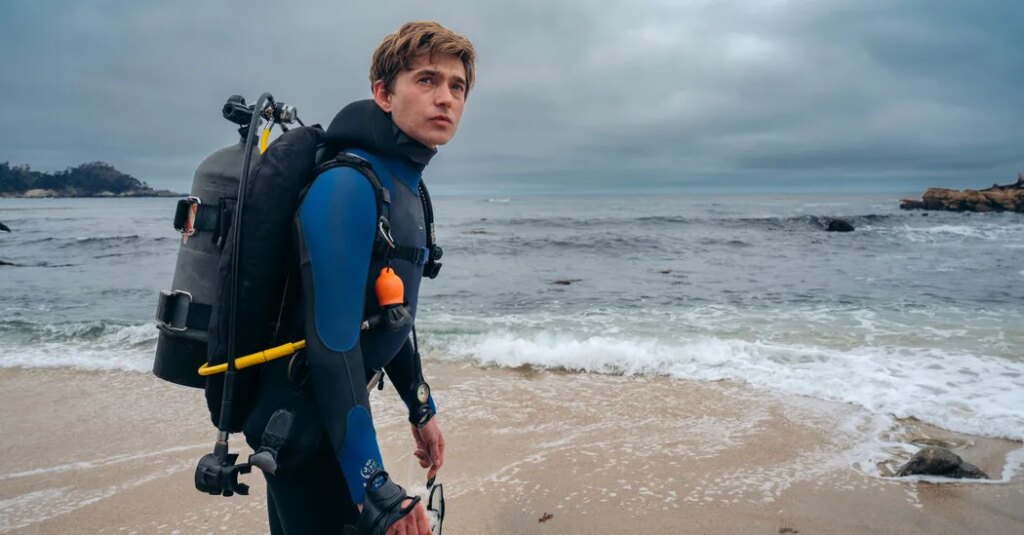
Jay (Austin Abrams, from “Resident Evil”) has suited up in scuba gear to search for the remains of his father, Mitt (Josh Brolin), who died a year earlier. Mitt was suffering from mesothelioma and, as we see in a prologue, threw himself into the ocean rather than expire in a hospital bed.
Mitt, an inveterate seafarer and diver, was a stern parent. “You know there’s more to existence than fun?” he sneers at Jay in one of many flashbacks. (Jay has merely expressed a desire to go to a friend’s birthday celebration at Ocean World, a place Mitt dismisses as “fake ocean.”) We see Mitt berate his teenage son for his “soft lungs” and pressure him to partake of his beloved Pabst Blue Ribbon — to loosen him up, he says, into something a “whale can slurp down easily.”
Now here is Jay in the present, trapped inside a whale, and it turns out that every survival tip Mitt gave him will have a perfect application. While there are obvious biblical parallels between Jay and Jonah, the whale also functions as a multilayered metaphor for the weight of grief. At a certain point in his ordeal, Jay begins talking aloud to the whale and his father at once; they seem fused in his imagination. When answering, in Brolin’s voice, the whale-dad refers to itself as “we.”
Yet there’s also a case to be made that the whale’s stomach are more of a maternal presence, evoking a birth canal from which Jay must emerge. Or perhaps passage through the whale represents a sexual initiation. (When the whale-dad questions Jay about college life, he wants to know if he has a romantic partner.) There is much to ponder during “Whalefall” beyond the obvious question of how Jay will disgorge himself.
Alas, this is a case in which the production design, visual effects and sound teams have committed to their assignment, only to be let down by a blubber-brained screenplay. The whale’s interior is tactile and viscous; you can practically feel the moisture and the suction as Jay struggles to spelunk through his surroundings, or to share the space with a giant squid that has likewise been ingested. The soundtrack is filled with the mysterious, echoing rattles of whale clicks.
But the script, co-written by Daniel Kraus, who wrote the well-regarded 2023 novel the film is based on, and the director, Brian Duffield, has not been purged of the potential for bad laughs. The time-hopping structure has an almost mechanical quality. The Jay-Mitt arguments arrive with monotonous regularity, and each pearl of wisdom that Mitt has handed Jay returns in the most literal-minded way imaginable.
Abrams’s unenviable job requires him to emote in wide-eyed close-ups and enunciate through an oxygen mouthpiece, tasks that few actors could accomplish without looking ridiculous. It’s a challenge that sinks the star.
Whalefall Rated PG-13 for terror and the sort of coarse language you would use if you were trapped inside a whale. Running time: 1 hour 46 minutes. In theaters.
The post ‘Whalefall’ Review: In the Belly of the Beast appeared first on New York Times.