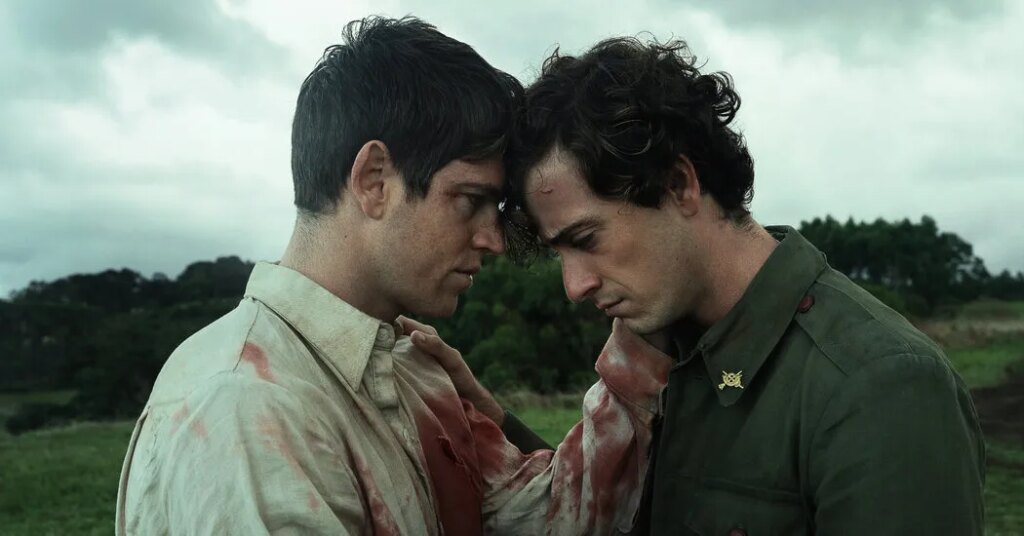
There is plenty to admire in “La Bola Negra,” an intimate Spanish drama with an epic historical sweep and even more majestic aspirations.
Directed by Javier Calvo and Javier Ambrossi from a screenplay they wrote with Alberto Conejero, it touches nearly every aspect of life: love, desire, shame, family conflict and the wish to make something of one’s future. And for most of its running time — a bit over two and a half hours — it draws you into its mysteries and magic.
The film navigates three timelines and is inspired by two plays: Conejero’s recent “La piedra oscura” and Federico García Lorca’s much older, unfinished “La bola negra,” of which only fragments remain. The first timeline, beginning in Granada in 1932, concerns Carlos (newcomer Milo Quifes), who has applied to become a member at an exclusive casino. But via an excruciating vote tallying system, in which large white marble-like balls indicate a “yes” vote and black ones indicate “no,” he learns that he’s been turned down. The reason is whispered but loud anyhow: He is presumed to be gay, and that’s enough to keep him out.
In the 1937 thread, set during the Spanish Civil War, Sebastián (Guitarricadelafuente) is a trumpet player who joins the fascist pro-Franco Nationalists in order to keep them from killing him after his village is bombed by Mussolini’s forces. Eventually he’s put in charge of guarding a wounded Republican prisoner named Rafael (Miguel Bernardeau), who is a former footballer and incredibly beautiful. Rafael is guarding a secret. Sebastián desires him, almost without knowing why.
Jump ahead to 2017 in Madrid, where history student and sometime playwright Alberto (Carlos González) discovers, to his shock, that his unknown maternal grandfather left him a mysterious inheritance that he must collect in person. Encouraged by his partner (Julio Torres), but forbidden by his pugnacious mother (Lola Dueñas), he heads with some uncertainty to the countryside, only to discover that the secrets his grandfather left behind are more personal than he could have dreamed.
Much of the movie is spent weaving from one timeline to the next, and each — at first oddly, later understandably — works in a slightly different register. The 1932 timeline feels dreamy, almost fairy-tale-like; the 1937 segment is at first tragicomic and then just heart-wrenching; the third is straightforwardly realistic and understated. In addition to the main cast, Penélope Cruz and Glenn Close make short, but important appearances. Calvo and Ambrossi (who work together under the moniker Los Javis) vary the tempo of the storytelling, the musical cues and even the colors of the images to keep us oriented, and it’s effective. It takes a while to figure out why and how these stories fit together, but once they do, the structure feels cleverly satisfying.
This is the tale of men in love, or men who wish to be in love, or men who can’t be in love. Key to its watchability is those men: Guitarricadelafuente is particularly good, with giant eyes that signal wonder, fright and desire by turns, a young man who has been tossed around by life and is desperately in search of an anchor. Yet it was González who captured me most, perhaps because his own story isn’t about tragic desire but about the deep longing that can make you crave solid roots. His performance has a magnetism that makes the story’s improbable circumstances feel real and alive.
The 1937 story provides the axis around which the rest of the film rotates, and its placement in a time of fierce conflict between fascism and revolutionaries is no accident. Most of these characters are figuring out, in one way or another, how to live as themselves in a world that demands conformity and rejects everything else. (After all, the voting practice that the title alludes to is the origin of the word “blackball.”)
Taken together, though, the movie is really about something else: the things left unsaid, and not just about sexuality. Spain, like many countries after the fall of their brutal, fascist regimes, opted to adopt a policy of silence. The Pacto del Olvido — Pact of Forgetting — was an agreement, both social and legal, to not speak of the cruelties enacted during the regime of the dictator Francisco Franco after his death in 1975. Among these is the death of Lorca, who was executed by Nationalist forces at the start of the war. His remains have not been found.
In recent decades, younger generations have confronted this silence, with a 2007 law ordering the removal of local monuments to Franco and the cooperation of the state in aiding family of those killed during the war or by the regime to unearth their loved ones. Calvo, Ambrossi and Conejero are of that younger generation, and this film is clearly part of the effort to say what has not always been said, and to breathe new life into Lorca’s legacy, as well.
All of which is admirable. Where the film falls down is in its unnecessarily overwrought third act, in which prior restraint gives way to melodramatic gesturing. It’s not that this final stretch stops making sense; it’s just that it starts to wear out its welcome, repeating its emotional beats, with imaginative flights that show up in one strand of the story feeling detached from the rest. And there’s one final narrative element that — without giving anything away — feels oddly neat for a story this sprawling. Strangely, “La Bola Negra” might have benefited from a broader sense of bracing freedom.
La Bola Negra Rated R for sexual scenes, violence and some profane screaming matches. In Spanish, English and Italian, with subtitles. Running time: 2 hours 35 minutes. In theaters.
The post ‘La Bola Negra’ Review: In Search of Freedom, and Love appeared first on New York Times.