Over the past decade, the nations of the world have struggled to aggressively fight global warming. With a notable exception.
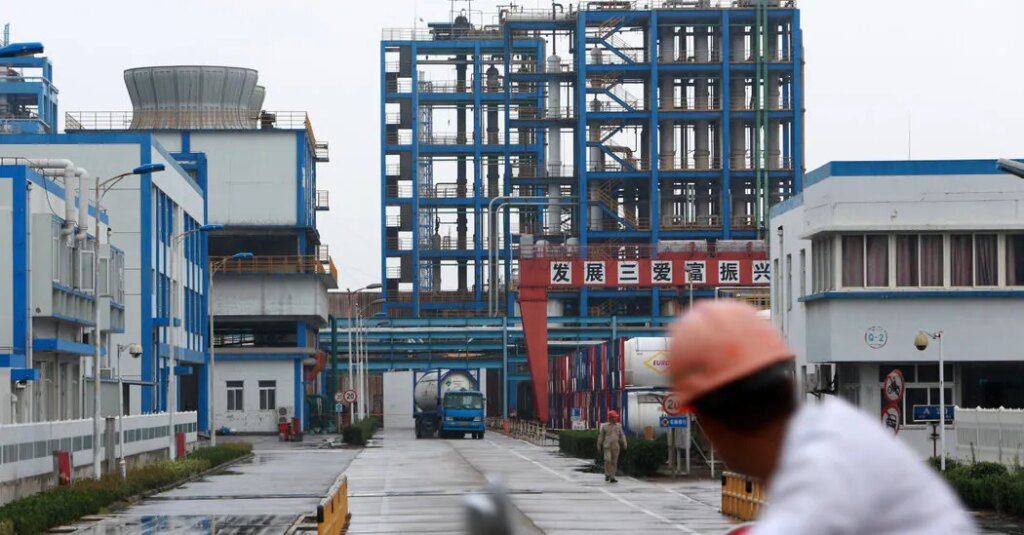
In 2016, more than 170 countries agreed to phase out hydrofluorocarbons, super-polluting chemicals widely used in air-conditioners and refrigerators. Known as HFCs, they are an extremely potent greenhouse gas and trap much more heat than carbon dioxide.
Ten years later, it’s clear that the agreement is succeeding. And it offers a template for how other climate regulations might work despite political backlash to green policymaking, experts say.
The HFC deal has “worked perfectly,” said Paul Bledsoe, who worked on climate issues under President Bill Clinton, and helped push for the HFC pact, known as the Kigali Amendment. “It reduces temperatures fast at an incredibly low cost.”
.
Countries are ahead of their target to cut production and use of HFCs. Chemical companies support the deal and are rolling out alternatives. The United Nations says the accord is projected to prevent 0.5 degrees Celsius of warming, or 0.9 degrees Fahrenheit, by the end of the century.
Under the Paris Agreement, the 2015 international climate deal to fight climate change, the world has sought to limit warming to 1.5 degrees Celsius above preindustrial times, though that is looking increasingly unlikely.
Some climate advocates have said nations should take inspiration from the deal to pursue similar global targets for other super-pollutants, like methane. Another potent greenhouse gas, methane, is released into the atmosphere in huge quantities as a byproduct of oil drilling and production, agriculture and other practices.
Because such gases tend to come from specific sources, they can be more easily curbed without requiring the same contentious society-wide changes that are necessary for reducing carbon dioxide.
Mia Mottley, the prime minister of Barbados, has called the deal to target HFCs “the most successful climate agreement in history” and has campaigned for a methane pact to “replicate it.”
“I feel that we do not need to reinvent the wheel,” she said.
Unlike the Paris Agreement, the Kigali Amendment is legally binding. Countries that fail repeatedly to meet targets could be hit with restrictions on import or exporting the chemicals.
Industrialized countries faced the first HFC targets in 2019, and the U.N. says that global HFC production and consumption peaked in 2023 and fell sharply in 2024. Developing countries face a slower timetable, and they get financial support for carrying out industrial changes, like factory overhauls, that make a phaseout possible. The money comes from a fund replenished by the same wealthier nations that have balked at delivering other kinds of climate assistance.
The Trump administration has rejected other forms of climate finance, withdrawing from funds that help developing countries adapt to climate extremes or recover from disasters.
The White House referred questions to the State Department. The State Department said that the fund “contributes to the development of export markets and the reduction of unfair competition for U.S. companies that have invested in innovative, next generation technologies.”
The Kigali Amendment grew out of a global effort to safeguard the ozone layer. In the 1980s, nations had agreed to scale down the use of chemicals, called chlorofluorocarbons, or CFCs, that destroy the earth’s protective atmospheric layer. There was only one downside: The need for alternative coolants gave rise to HFCs, which didn’t damage the ozone but still accelerated global warming, with 1,000 times the heat-trapping power of carbon dioxide.
It didn’t take long for scientists to document this problem. And when the 1997 Kyoto Protocol gave industrialized countries emissions targets, HFCs were among the gases that could count toward reductions. Still, many policymakers felt that didn’t go far enough. By the mid-2000s, small island countries, worried about sea level rise, raised the idea of amending the Montreal Protocol, wedging a new category of chemical into an existing deal.
Then, in 2013, the issue got a boost. After a meeting in California, Barack Obama and Chinese President Xi Jinping agreed to cooperate on North Korea. And target HFCs.
Chemical companies in both countries got time to prepare and profit from a transition.
“It’s a sectoral agreement that took one bite out of the climate problem, and over time it got stronger and stronger,” said Durwood Zaelke, the president of the Institute for Governance and Sustainable Development.
Since then, global average temperatures have warmed roughly 0.4 degrees Celsius compared to preindustrial times, which is faster than in prior decades. More extreme heat is pushing people in developing countries, as well as Europe, to purchase air-conditioning. The global stock of air-conditioning units is expected to rise to 5.6 billion by 2050, from around 1.6 billion today. The U.N. has emphasized that new appliances, as they come online, should also be more energy efficient.
With those efficiency improvements, the U.N.’s projection — that the deal will prevent 0.5 degrees Celsius of warming — might wind up as an underestimate, said Marco Gonzalez, a former Costa Rican environment minister who led the U.N.’s ozone protection work for more than a decade. “I am certain that the prevention will get higher than 0.5,” Mr. Gonzalez said.
The post How One Global Climate Deal Worked ‘Perfectly’ as Others Faltered appeared first on New York Times.