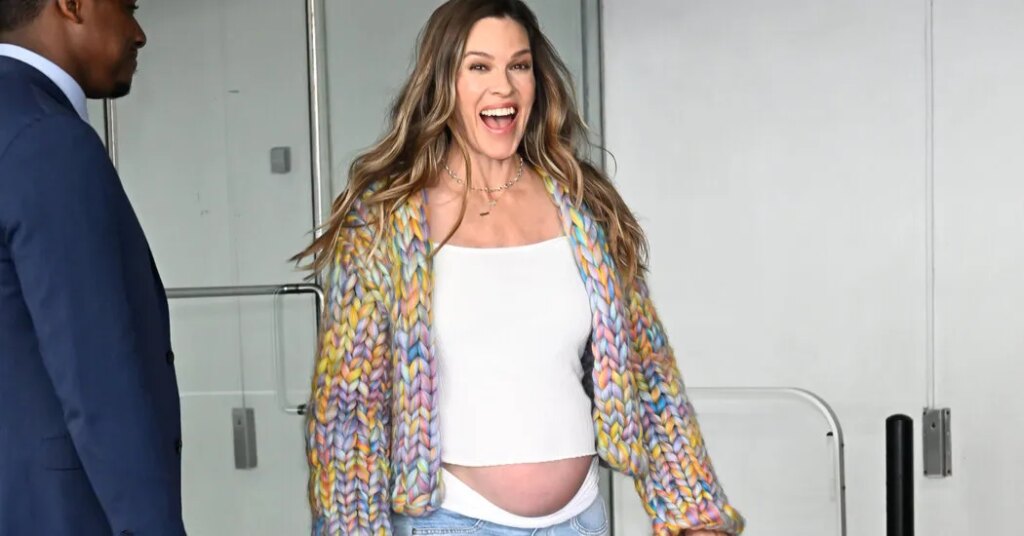
On Wednesday, the actress Hilary Swank posted a video on Instagram about what she called her next project. It “releases in December,” she wrote in the caption: her third child.
The video showed her family, which includes 3-year-old twins, dancing in the dark with glow sticks taped to their bodies so that they all look like stick figures. Toward the end, Swank, who is 52, reveals stick-figure versions of a bump and a baby. Swank didn’t respond to a request for comment.
Swank joins a growing list of celebrities who have chosen to have children later in life, either through surrogacy, adoption or with the help of in vitro fertilization — including Cameron Diaz, Madonna and Naomi Campbell — and have, in turn, changed what motherhood broadly looks like.
“Generations before were served such a binary around motherhood — you either did it between this age and that age, or it was kind of out of grasp for you,” said Lauren Levinger, co-founder of Spread the Jelly, a digital magazine and community for mothers. “But now, seeing women who are choosing to have kids later, who’ve lived very full lives before they made the choice to bring a child into it, just highlights that there are so many ways to choose how to mother, which is an incredible cultural shift.”
Even as the U.S. birthrate in 2023 reached a historic low, the proportion of women who gave birth between ages 40 and 44, which has been steadily increasing for decades, reached its highest point the next year, according to data from the Centers for Disease Control and Prevention.
The rise in women having children later in life is likely “a trend that we’re going to continue to see,” in large part because I.V.F. and egg freezing technologies are getting better and producing higher success rates than even 10 years ago, said Dr. Laura Riley, head of obstetrics and gynecology at NewYork-Presbyterian Weill Cornell Medical Center.
But pregnancy at an advanced age, as it is known medically, does come with risks, Dr. Riley said, such as an increased risk of pre-eclampsia (high blood pressure during pregnancy), gestational diabetes and cardiovascular diseases. “Pregnancy is essentially a nine-month stress test,” she said, and “when you’re 45 and 50, a lot of life has been lived.” There are also increased risks of a preterm birth and the need for a Cesarean delivery.
And, Dr. Riley added, having children at an age when women are likely to go through the menopausal transition comes with its own conundrums, navigating troublesome symptoms while taking care of a small child. “You’re in the ultimate, ‘Oh my god! Like, how is this all going to come together?’ kind of moment.”
Swank, the Academy Award-winning star of “Million Dollar Baby,” froze her eggs when she was 37, she told Women’s Health magazine last year, and had her twins, Aya and Ohm, when she was 48.
“I would have had kids earlier. I’m not saying I actively waited until 47,” she said of her pregnancy in the interview. But parenting at her age comes with its own benefits, she added, like more patience and an established enough career to focus on her children.
Anne Hathaway, who is 43, made her way through press trips for five major films this year while visibly pregnant with her third child — a baby that she’s nicknamed a “buzzer-beater,” she joked on “Late Night With Seth Meyers,” in a nod to the fact that becoming pregnant spontaneously later in life gets harder.
Madonna was 50 when she adopted her fourth child, Chifundo James, and, last month, Lena Dunham became a mother, through surrogacy, at 40.
Earlier this year, Cameron Diaz, who is 53, announced the birth of her third child, Nautas, with her husband, the musician Benji Madden. She had her first child, Raddix, when she was 47 and said on the model Naomi Campbell’s podcast that making the decision to have a family at that age was “a real choice.” (Campbell herself had kids in her 50s.)
“You really have to work hard for it,” Diaz added.
The post Hilary Swank Is Having Her Third Child at 52 appeared first on New York Times.