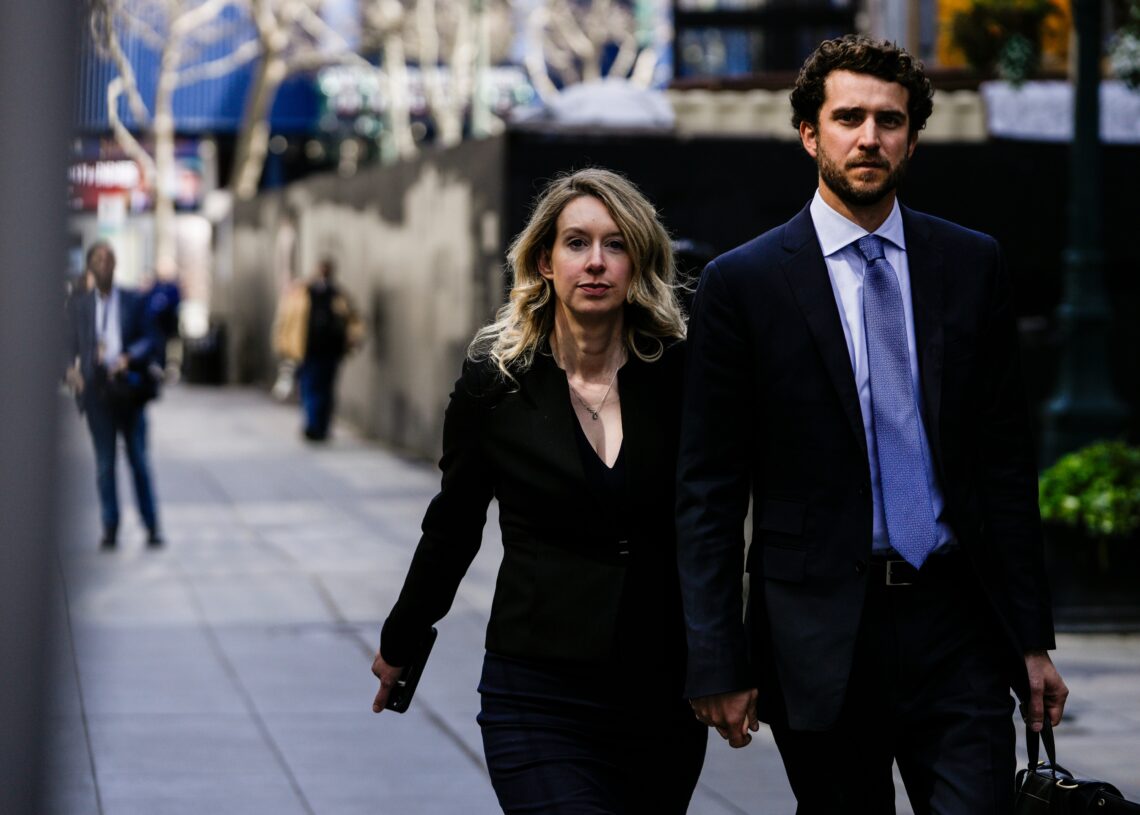
Like many Americans, I’ve read and watched so much about disgraced Theranos founder Elizabeth Holmes by now that I feel like I can recite her Wikipedia page by heart.
But there’s one thing I’ve never quite understood: How could a woman who dropped out of Stanford at 19 and claimed, with no actual scientific training, to have invented a device that would revolutionize health care manage to persuade so many otherwise intelligent and prudent people — from Gen. Jim Mattis to former secretary of state George Shultz to billionaire investors — to give her boatloads of money? What could she possibly have said to them? Why would anyone believe her?
One of the surprises of Nathan Fielder and Lance Oppenheim’s breathtaking new (pseudo?) documentary “You Can See Everything,” which opens nationwide this Friday, is that you come away understanding how Holmes was able to draw people in. In fact, you might even get drawn in yourself.
The film chronicles (among many, many other things) the final weeks in 2023 before Holmes reports to federal prison (where she remains today) for defrauding investors. Fielder and Oppenheim had extraordinary access to their subject. Fielder not only moves in with Holmes and her partner, Billy Evans, he’s also the last person to see her before she’s put in the car to be whisked away. And as we see Holmes up close, it becomes clear that there is something unique about her — a wide-eyed guilelessness that marks her, as Fielder notes in the film, as either the most sincere person on the planet or the most sociopathically manipulative one. The filmmakers embed with her for weeks, at the most trying time of her life, and can’t seem to figure out which it is. What hope did Mattis and the rest of them have?
The film, to be clear, is not a relitigation of the Theranos case; it does not pretend that Holmes was framed or railroaded. But what it does do, in a downright existential way, is examine what truth in fact is: how much of it is subjective, how much is mediated by personal experience and — most vividly — how much a person is or is not lying if they truly, profoundly believe what they are saying.
At one point, Fielder has Holmes bring out Theranos’s infamous Edison device (which had been unceremoniously shoved in the back of the garage of a rented beach house) to explain to him why it didn’t work. Holmes, however, pushes back: It does work. Fielder, confused, notes that the failure of the device is the reason everything — including Holmes’s impending prison stint — happened in the first place. But Holmes appears incapable of conceding this: To her, it’s not that the device doesn’t work, it’s that it doesn’t work yet. After everything, she’s still holding on to her truth.
Later, she tells Fielder that she — Elizabeth Holmes, widely considered one of the most famous fraudsters on earth — has never knowingly told a lie in her life. She says this with such utter, almost heartbreaking sincerity that you want to believe her. In spite of everything you know. Or think you know. Or thought you did.
This battle for the essence of truth is in many ways the battle of our time. In the age of social media, everyone can express how they’re feeling at any moment, and anyone else can see it. But a chasm can exist between factual and emotional truth, and “You Can See Everything” is explicitly about this: We believe what we want to believe, whether we realize it or not, and just because you and I are looking at the same object does not mean we are seeing the same thing.
Holmes — along with Evans, who becomes in many ways the central, increasingly ominous figure in the film — proves an ideal subject for this sort of exploration: There is something so alien, yet so utterly assured, about her that you can get lost looking at and listening to her. Fielder certainly does: Some of the film’s best scenes feature him just staring at her, slack-jawed, as he seems to question the fabric of reality itself.
The movie takes a wild turn halfway through that I wouldn’t dare spoil here, other than to say that it turns the whole film inside out and leaves the viewer even more adrift than they were before … yet it does so in a way that, like a magic trick, proves invigorating rather than distressing. It’s a film that chases truth but, paradoxically, discovers that sometimes the deepest truth really is to be found inside yourself. This is a mind-bender of a movie in every possible way.
I don’t believe Elizabeth Holmes. But I believe Elizabeth Holmes believes Elizabeth Holmes. That’s not enough to forgive her crimes. But her lack of sense, in its mad way, makes complete and total sense. Of course, that’s just my lived reality. Yours may be different. As “You Can See Everything” makes abundantly clear — the only thing it makes abundantly clear, in fact — everybody’s always is.
The post Is it a lie if you believe it? This Elizabeth Holmes film is a mind-bender. appeared first on Washington Post.