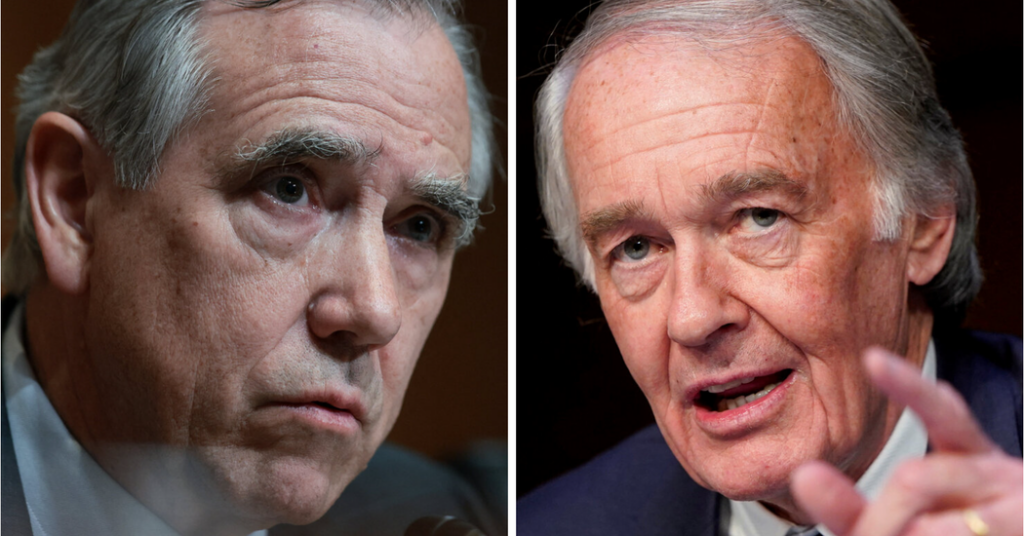
A pair of Democratic senators moved on Thursday to block the nuclear cooperation agreement between the United States and Saudi Arabia, arguing that the Trump administration had abandoned longstanding safeguards and sought to sidestep congressional scrutiny of a deal that could fuel a nuclear arms race in the Middle East.
The resolution, which would have to be adopted by both chambers to block the agreement, faces steep odds, especially in the Republican-controlled House. Some G.O.P. lawmakers there have raised concerns about the deal, but they have not committed to opposing it.
But the action by the two Democratic senators, Jeff Merkley of Oregon and Edward J. Markey of Massachusetts, taken while Congress is in recess ahead of the Nov. 3 midterm elections, will force a debate and vote on the matter when lawmakers return to Washington next month.
The senators’ resolution invokes part of the Atomic Energy Act that allows Congress to review and weigh in on civilian nuclear deals, and formally disapproves of the agreement, which was announced over the summer and transmitted to Congress last month.
The Trump administration has called the pact a way of deepening economic and security ties between the kingdom and the United States. And it has defended the agreement as meeting the nonproliferation requirements established under federal law, while Saudi officials have said it would support the kingdom’s efforts to diversify their country’s energy resources.
But the senators argue that the deal, outlined in what is known as a “123 agreement,” fails to include critical restrictions on uranium enrichment and spent fuel reprocessing, technologies that can be used to produce material for nuclear weapons.
“The U.S.-Saudi nuclear deal is about megatons, not megawatts,” Mr. Markey said in a statement. “Trump should not be sharing nuclear bomb technology with a nation that U.S. intelligence says may want nuclear weapons.”
“This deal is the starting gun for a Middle East nuclear arms race,” he added. “Congress must reject it.”
In an interview, Mr. Merkley said the administration had disregarded safeguards that previous administrations had insisted upon when negotiating similar agreements, potentially undermining decades of efforts to prevent the spread of nuclear weapons.
“Civilian nuclear power plants are often the pathway through which a country pursues a nuclear weapon,” Mr. Merkley said, noting that the infrastructure used to generate nuclear energy can also provide the foundation for a weapons program.
At the center of the dispute is the so-called gold standard for American nuclear cooperation agreements, under which a partner nation commits to forgo domestic uranium enrichment and spent fuel reprocessing. Mr. Merkley pointed to a 2009 nuclear cooperation agreement with the United Arab Emirates that included those restrictions, along with enhanced international inspections.
The Saudi agreement does not impose such requirements. Mr. Merkley said he would drop his opposition if the administration agreed to impose them, but would remain skeptical of Saudi Arabia’s underlying ambitions.
“There’s really no reason for them to develop very, very expensive nuclear electricity except to provide a foundation for a potential nuclear weapons program,” Mr. Merkley said, pointing to their access to alternative energy sources such as solar power.
The objections come as the United States remains at war with Iran, a military campaign Mr. Trump has repeatedly justified as necessary to prevent Tehran from developing nuclear weapons.
Mr. Merkley argued that allowing the deal to take effect without limitations could prompt Iranian officials to become more defiant of the Trump administration’s demands to end their own nuclear weapons program.
“If Saudi Arabia has no requirements controlling its reprocessing or its enrichment, Iran will never agree to any sort of agreement controlling its reprocessing or its enrichment,” he said.
Some Republicans share those concerns. Senator John Kennedy, Republican of Louisiana, said when the agreement was announced that he was not comfortable with it.
“We’re bombing a country to keep them from getting a nuclear weapon,” Mr. Kennedy said during an interview with CBS’s “Face the Nation,” referring to the war with Iran. “But we’re signing a deal with another country.”
Beyond the substance of the agreement, Democrats said the Trump administration had timed its submission to Congress in a way that deliberately aimed to prevent lawmakers from exercising their oversight authority over such deals.
Under the Atomic Energy Act, Congress has three months to review civilian nuclear cooperation agreements. If senators wish to object, they must wait 30 days after the deal is sent to them before they can file an objection. Mr. Merkley said the administration’s decision to transmit the agreement on Sept. 14, just weeks before lawmakers departed Washington to campaign for the midterm elections, was calculated to sidestep a review by the legislative branch and allow the deal to take effect without a congressional vote.
Mr. Merkley accused the administration of pursuing what amounted to a “Congress is out, there’s no way anybody can stop this, we can ignore them strategy.”
The post Democratic Senators Move to Block U.S.-Saudi Nuclear Deal appeared first on New York Times.