KOLKHOZ, by Emmanuel Carrère; translated by John Lambert
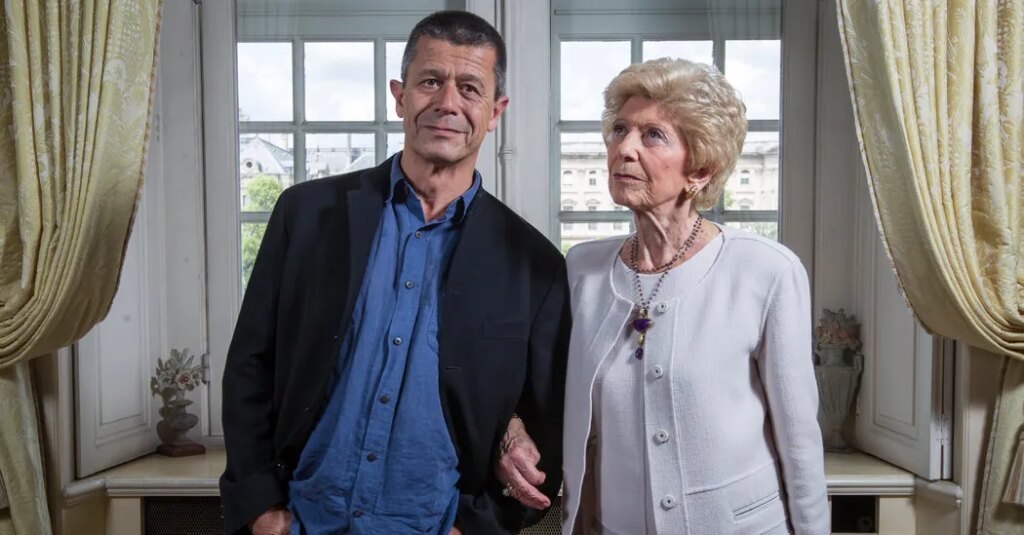
When Emmanuel Carrère was a little boy, he and his two younger sisters would gather around their mother at bedtime while their father was away on business trips. The youngest child would sleep beside her while Emmanuel and his other sister slept on cushions they pulled up around the bed. Their mother, Hélène Carrère d’Encausse, was a Russian-Georgian Frenchwoman who would later become a renowned historian of the Soviet Union. She called their cozy bedtime arrangement their kolkhoz.
“Kolkhoz” was the Soviet term for a small collective farm, and it’s also the title of Carrère’s new book, in which this early memory is a warm prelude to a lifelong game of emotional hide-and-seek. He recalls his childhood idyll taking a turn when he started “feeling an overarching sense of menace” and eventually realized his mother was having an affair.
He later learned that his father had threatened to kill himself if Hélène abandoned the family, so she stayed — resentful but also determined to transform herself. One day she came home with her naturally dark hair dyed blond, shaped into the “flawless blowout” that would become her signature style. Carrère registered a hardening of her face, as well as her gaze. “She no longer looked,” he writes, “she scrutinized.”
Carrère’s multidimensional portrait of his formidably ambitious mother is at the center of “Kolkhoz,” which also traces a century of family history through four generations. Hélène was born stateless and poor in Paris in 1929, to a White Russian mother and a Georgian father who disappeared shortly after Liberation — most likely kidnapped by partisans because of his suspected collaboration with the Nazis. Carrère wrote about his grandfather’s ignominious wartime activities in “My Life as a Russian Novel” (2007), a book that enraged Hélène and led to two years of silence between them.
By then she had already reached the height of her career — scholarly achievement, intellectual celebrity, an appointment as “perpetual secretary” of the Académie Française — and she feared that the revelations about her father would bring everything crashing down.
“I regret having inflicted this torment on her,” Carrère writes, recognizing that from the time she was a girl she was terrified of being labeled the daughter of a collaborator. But he did it anyway. Besides, as far as he can tell, Hélène’s fears were never realized. After Carrère’s big reveal, nobody turned on her; instead, friends pitied her for having a son who so mercilessly divulged old family secrets.
What ended up being more publicly embarrassing for Hélène were her own words. Up until the eve of Russia’s invasion of Ukraine in 2022, she insisted that Vladimir Putin, no matter how brutal, was too rational and self-interested to do anything so crazy. She was mocked for that. But she wasn’t going to let ridicule keep her quiet. Carrère compares her to a “dazed boxer” who gets back into the ring. She acknowledged her mistake, to a point: “She hadn’t seen it coming, but who had?”
As it happens, the day that Putin announced his “special military operation,” Carrère was supposed to fly to Moscow for the film adaptation of his book “Limonov.” He managed to make his way there, and recounts watching Russia’s leading television channel beam blithe broadcasts of “lotteries, endless animal documentaries as war is unfolding.” Carrère, who has long been drawn to moral gray areas, to the presumption that the truth is fraught and inevitably complex, was nevertheless appalled: “No one in their right mind can believe that the truth is even slightly on the side of Putin and his gang.”
In “Kolkhoz,” smoothly translated by John Lambert, the question of truth is an abiding preoccupation. As a teenager, Carrère became very close to his uncle, Hélène’s younger brother Nicolas, who describes growing up in a “layer cake of lies.” In postwar France, collaborators were evil. But at home, the opposite was true: Their father was a hero who had tried to protect the French by making compromises with the Germans, and the people who kidnapped him were the evildoers. Bewildered by the family’s double life, which they maintained to survive the fury of postwar judgment, Nicolas became withdrawn and depressed, and started lying himself at every opportunity, which only worsened his isolation.
Year later Nicolas, now obsessed with truth-telling, tried to talk to Hélène about his compulsive lying. But she rejected his confession, insisting that he never lied. Nicolas said his big sister seemed genuinely astonished, even though she had repeatedly caught him lying as a child and used to lecture him about it: “I know just how able she is to believe the fictions she herself creates to make the world conform to her wishes.” Carrère, having seen his indomitable mother barrel forward with her preferred version of reality, knows this about her, too.
“Kolkhoz,” which won the Prix Médicis last year, reads like a family memoir, though toward the end, Carrère admits to taking a few unspecified “liberties.” Such poetic license isn’t unusual; he has always combined close observations of real events with what he calls “novelistic constructions.” “Kolkhoz” itself began as a “vague project” about his mother’s family. His books are always filled with digressions, but this one is very nearly overwhelmed by them, as Carrère feels his way around events, “looking for a door.”
He finds the door with the death of his mother in 2023, at age 94, in a hospice bed surrounded by her three children, “camped out in our kolkhoz for the last time.” In her books Hélène often used the word “haunted”; “Kolkhoz,” too, is haunted by the affectionate ghost of their little kolkhoz. The narrative of their difficult relationship is scaffolded by a profound tenderness that receded but never entirely disappeared.
Carrère is maybe the only writer I can imagine who could make an unlikely book like this work. He writes unsparingly of Hélène’s self-importance, her tolerance for injustice and intolerance for ambiguity, her seemingly willful delusions and “her usual bad faith.” Yet as someone who describes himself “as always of two minds,” he also never loses sight of the young mother who held him and his sisters close at night, “loving us with such a confident, great love, greater than all else.”
KOLKHOZ | By Emmanuel Carrère | Translated by John Lambert | Farrar, Straus & Giroux | 395 pp. | $33
The post Untangling a Family History Built on Lies appeared first on New York Times.