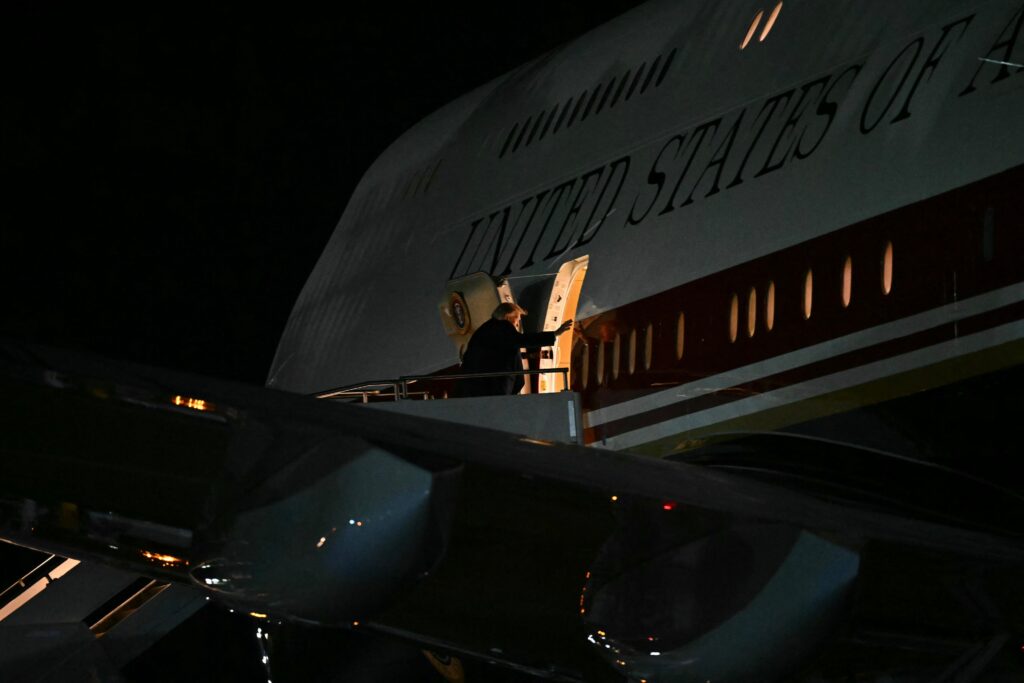
A successful Wall Streeter once told me that the most important resource executives have is their time. That’s true for politicians, too, and it’s especially true for the president of the United States. The fact that President Donald Trump is spending most of his campaign time in places usually thought to be safely Republican is an indication of the massive challenges his party faces in the midterms.
Trump started his recent barnstorming in Texas, where the Republican Senate nominee, state Attorney General Ken Paxton, narrowly trails Democratic state Rep. James Talarico. After stops in deep-red Oklahoma (for a rally just across the Red River from Texas) and Alabama, the president moved on to Ohio, where both Republican gubernatorial nominee Vivek Ramaswamy and Sen. Jon Husted (R) are locked in tight races. Trump has also visited Clarksville, Tennessee, and Grand Island, Nebraska, places he carried handily two years ago.
Its easy to see why Trump went to Nebraska; GOP Sen. Pete Ricketts is facing a strong challenge from independent Dan Osborn there. Alabama and Tennessee might seem more puzzling. But Democrats have targeted two GOP House candidates in those states, and voting patterns point to the deep hole the GOP finds itself in. Alabama’s 2nd District was recently gerrymandered to unseat first-term Democratic Rep. Shomari Figures; Trump would have won it by 14 percentage points. Democrats also are bullish on Tennessee’s 5th District, which is a plus-23 Trump seat, citing an internal poll that showed their nominee, Columbia Mayor Chaz Molder, down by only eight points.
The pattern continued this week. Monday took Trump to Youngstown, Ohio, perhaps the archetype of the blue-collar manufacturing town whose voters shifted hard toward Republicans in 2016. Tuesday brought him to Sarah Palin’s hometown of Wasilla, Alaska, to campaign in that state’s GOP heartland. Wednesday he will be in Bullhead City, Arizona, and Kalispell, Montana. The counties he will visit — Mohave, Arizona, and Flathead, Montana — backed him by a more than 2-to-1 margin in 2024.
So it’s three weeks from Election Day, and the GOP’s most important figure is crisscrossing the country to persuade his party’s most loyal supporters to vote. That is, frankly, a pathetic place for the president and his party to be so close to the midterms. And Republicans who contend that public polls are skewed toward Democrats should take note: The president would not be spending his scarcest resource in the reddest of red places if private GOP polling showed something different.
In fact, Trump’s travel schedule reveals two more things: a lack of GOP enthusiasm and the president’s problems with swing voters.
On enthusiasm: A party’s base should be primed to run through brick walls to back its candidates. That is especially true of the modern GOP, whose core voters disagree on a lot but generally concur that putting Democrats in power would endanger America’s future. (The Democratic base believes the same about Republicans, of course, hence our extremely vitriolic and polarized politics.) It should send chills down Republicans’ spines that the GOP’s high command isn’t sure the base will turn out.
On swing voters: Notice that Trump is generally not visiting places with large numbers of them. Polls all year have shown that independents strongly disapprove of the president.
The most recent New York Times-Siena College poll of five battleground Senate races in Republican states showed the Democratic candidate winning independents by 24 points. Trump could engage these voters directly, making the case for his first two years and warning them that returning Democrats to power would restore the policies people rejected in 2024. But he’s not doing that, which suggests to me that his advisers don’t think he can change their minds.
We’re not to the finish line yet, though. The big tell will be Trump’s travel schedule for the final weeks of the campaign. If he schedules more rallies in deep-red states and districts, it will be a clear sign that the GOP is trying to stave off disaster. But if he shifts to more purple venues, that probably means the internal polling has improved enough to put Trump in the places where a president traditionally goes.
Watch what people do, not what they say. And in the closing days of a high-stakes campaign, watch where they go. No matter what happy talk emanates from the White House, it will be a scary sign for Republicans if the president is still working to rally the base come Halloween.
The post Trump’s rally schedule reveals more than any poll appeared first on Washington Post.