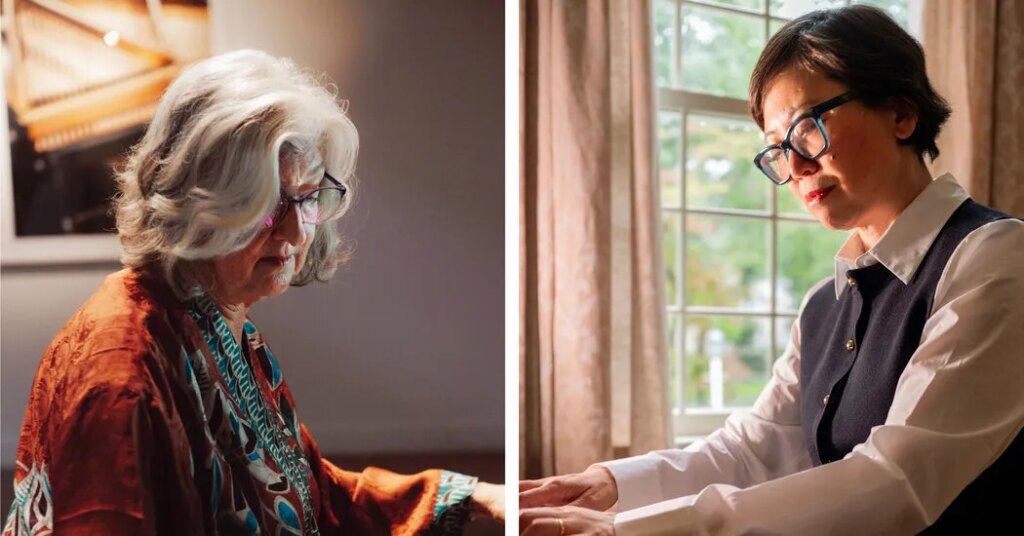
One novel traces the swerves and decisive moments of a pianist’s life, in chapters named after sections of a keyboard suite by Bach. Another imagines the early years of John Field, a composer doomed to the footnotes of music history for inventing a form made famous by someone else.
And both books, out this month, offer an opportunity to see authors who are celebrated for stories about nature, relationships and loss take on a notoriously difficult art form to capture in writing: music. Barbara Kingsolver’s “Partita,” the follow-up to her Pulitzer Prize-winning “Demon Copperhead,” was published on Oct. 6; Yiyun Li’s “Music Against the Night” came out a week later.
Neither author has written about pianists before, but they do play the instrument. Kingsolver grew up learning from a teacher known as Miss Edith, and felt like classical music “took me away in the same way that reading took me away into other worlds,” she said. She went to college on a piano scholarship, but dropped it as a major once she realized that she wasn’t bound for a big solo career.
Still, she said, playing Chopin is “a way that I find my happy place.” Livia, the protagonist of “Partita,” isn’t so different; a prodigy, she uses piano to escape her Appalachian upbringing and the pain of her family’s history. Her ascent is cut off by intoxicating romance and a life-altering injury, though she arrives at the kind of peace you can’t plan, but can only let happen.
Li started to learn piano while writing “Music Against the Night,” in which she braids the youths of Field and Adelaide Percheron, known as Percherette, a strong-willed but thwarted keyboardist who would become his wife. Field wrote nocturnes, intimate and elegant little pieces that were later overshadowed by Chopin’s works in the same style.
Now, Li said, “I’m not good at playing, not good enough yet to play Chopin, or even John Field.” She’s more at the level of Muzio Clementi, she added, referring to Field’s teacher and the composer of some of the most enduring repertoire for piano students.
In a joint video interview, with Kingsolver at home in southwest Virginia and Li in Princeton, the authors discussed why they wanted to write about music, and the surprising themes that their novels ended up sharing. Here are edited excerpts from the conversation.
How much did music inspire the forms of these novels?
YIYUN LI I suppose my novel is a little bit borrowing from the music form, right? You have two sort of contrapuntal movements: ambition for John, aspiration for Percherette. I make a distinction between those. One of them sort of inherited all the ambition of his elders, and he adds on his own ambition. Nobody is really ambitious for Percherette, but she aspires to be something not allowed. There are echoes between their stories: parents and movement across the globe, then friendship and first love. The two strands are never far from each other. That’s how I hear it.
But I’m not a musician, so I’m just making things up. When I started to work on the novel, I went to a piano teacher, Cristina Altamura. She wasn’t keen until I told her I was working on a trilogy about John Field. Then she was interested, because she plays Chopin as her performance specialty. Basically, I auditioned with my book proposal!
BARBARA KINGSOLVER I had the idea of the form of this novel pretty early on. Right around the same time that I decided I would call it “Partita,” I ran across again a quote from Toni Morrison that I really love, which is the epigraph.
“Sometimes you don’t survive whole, you just survive in part. But the grandeur of life is in that attempt.”
KINGSOLVER I think it’s one of the wisest things I’ve ever heard anybody say about life, which is that we get broken time and again. A person can break, and what we do with the pieces, the way we put them back together, is the grandeur of life. And it just occurred to me that this could be a partita. Even if most people don’t know what “partita” means, they can look it up. To write the book as a musical composition made so much sense, and I really went all in. I of course wanted to make it accessible, and there’s enough explanation. But you don’t need to know the difference between a toccata and an allemande to get it, in the same way that you don’t have to have spent time on whaling ships to love “Moby-Dick.”
Both these books also deal with the foundational act of interpretation in piano playing. Percherette tells her students to know the composer’s mind. Barbara, you describe it as almost like a communion across time.
KINGSOLVER I was thinking a lot about how, when I sit down to play something that was written 100 or 200 or even 300 years ago, I’m tapping into this vein of passion going all the way back to the composer. We’ve recently lost two artists really important to me, Dolly Parton and Wendell Berry, and I’ve been thinking a lot about immortality and how artists live forever.
In “Partita,” younger Livia is in the throes of this existential crisis where she’s asking herself: What is music for? What good is it? What does it do for us? These are times in which support for the arts is really crumbling at every level, and I think it’s a reasonable time to ask readers to ask themselves these questions. Livia is kind of cynical. She’s burned out, doubting herself. Not to spoil anything, but there’s a scene at the end in which she has really given grace to interpretation, and really has come to believe that every musician who sits down with their instrument is carrying on something really beautiful.
LI That’s very good. I think interestingly also, my book moved to the earlier moment when music just started to be freed from the church and freed from the court. It became a public entertainment, and Clementi, in the novel, basically said, “We have to teach people how to interpret our music.” Clementi also said music is a pyramid, and he knew that he would not be at the top of the pyramid, never as good as Mozart or Beethoven. But his point was, someone has to be in the middle of the pyramid and hold up all these giants on top.
Percherette aspired to be a great musician, but there’s no place for women to be a musician at the time. She became a teacher, and she was a good teacher. The understanding she had toward the end of the novel is, you know, it doesn’t matter if these girls she is teaching have talents or not, she will make music part of their life, and that seems to me a good aspiration.
Some of the most famous novels about musicians are like Willa Cather’s “The Song of the Lark,” a journey toward greatness. You both wrote about a journey interrupted. Livia doesn’t become a star. John Field isn’t in the pantheon of composers.
LI I love what Barbara said about the immortality of those musicians, but there’s also the opposite of immortality: all these forgotten artists. I certainly feel much closer to Percherette because she’s different from John. Going back to ambition versus aspiration, ambition is, you want to earn worldly fame, you want to have glory. But aspiration is more about, you want to strive for something beyond yourself. All artists have these worldly ambitions, but they’re to me not as interesting or sustaining as aspiration. It’s everyday life, right? Counting time, marking time, and that’s music.
You have this metaphor, also the title of another book of yours: “Things in nature merely grow.” It’s about expansion and persistence, even in a constricted space.
LI I wrote the two books at the same time. It’s the thought that I have to mark time when life is so hard. Still doing things — practicing piano, for instance. It’s anti-immortality, but it’s pro-living, right?
KINGSOLVER I think playing music is such an exercise in mindfulness. You have to be absolutely where you are inside that piece. This is one of the answers to that question, why art? Music takes you outside of your petty woes and cares. It takes you outside of your life into pure time, pure beauty, in the same way that writing does for us.
Getting back to your question about ambition, initially I thought these books could not be more different, but they have so much in common, having to do with barriers: class barriers, gender barriers. It was there in the 1700s, and it’s there right now. And the whole question of ambition, I think, is also gendered. I’ve just noticed in my career that men are admired for ambition, and women are accused of it.
LI Yes.
KINGSOLVER I’ve surely internalized that, because I don’t want to be ambitious. And when I look at music, when you describe the pyramid with Clementi in the middle, I just thought: Where would we be without Clementi? There may have been days we didn’t want to see the Hanon exercises book or the Clementi exercises book, but we knew we needed them. It was like one of the food groups that we had to consume to get to where we wanted to be. I have always resisted the idea of “best” when it comes to art. There’s something that always will bother me about a novel winning a prize, because it suggests that objectively there is a best novel, when I categorically deny that that is true.
It’s like how I actually think John Field’s nocturnes are wonderful.
LI I do, too.
Why did you want to write about him?
LI I was reading Tolstoy’s autobiography with Edmund White. We had a two-people reading club for eight years until he died. Tolstoy was recalling his mother playing a John Field piece, and then he said, “Field, I must make clear, was my mother’s master.” It just stood out. So I started doing research. And speaking of John Field as only a footnote in Chopin’s biography — Percherette only occupies like three passages in John Field’s biography. Whenever there’s a story that’s not told to us, we have this novelist’s urge to go seek and dig.
There are two ways to write about music. One is technically and analytically, which makes for horrible reading. The other is metaphorically, which isn’t easy; you end up stacking metaphor on something already abstract and metaphorical. What was it like to do this in fiction?
KINGSOLVER When Livia goes to music school and she has her first music theory class, this is an awakening. So I needed to describe that to people who are never going to know or care about the tonic and the dominant and such. I had to find metaphors for that, but it has to be very disciplined, it has to be concise, and it has to be paced out so you don’t get too much of it. I found it less daunting, and really enjoyable, to describe the feeling of playing music, just because that’s so familiar to me. Like how you can’t listen to Mozart’s “Rondo alla Turca” without laughing.
When you describe that piece in the book, you write that it has “scales like a toddler pretending to be a king.”
KINGSOLVER And doing a little dance at the top every time with that little B-flat trill. I didn’t find it that different from any other kind of description, to translate those emotional experiences into words. But to write about something that I love so much made me think, “Why did I wait this long?”
LI It’s about the feeling of the music, more than music itself. For this novel, I had the advantage of two musical prodigies not knowing music, as though they haven’t learned a language. They have a feeling, but they cannot articulate it. So John as a little boy hears a chimney sweep in Dublin singing songs, and he hears that as a sort of tired cricket croaking. That’s how I approach writing about music for younger characters, because they’re still learning what music is.
KINGSOLVER For readers who haven’t seen “Partita” yet, there’s a listening list published in the book with annotated page numbers, so you can listen to the music that is being described. That came about because when I was writing, I had to listen to these pieces over and over again to internalize the emotional experience.
LI When you do the book tour, are you going to have the music?
KINGSOLVER I am! In every appearance, we have a piano and a pianist.
LI That’s excellent. I only have one reading with piano. My piano teacher is coming to my Princeton launch.
By the time you get to the end of your John Field trilogy, you’ll be at a level to perform his music at your own readings.
KINGSOLVER You’ve already started learning, so you can’t let that go to waste.
LI By the end of the three books, I’ll be able to play Chopin. That’s my aspiration.
The post How 2 Acclaimed Writers Made Music in Their New Novels appeared first on New York Times.