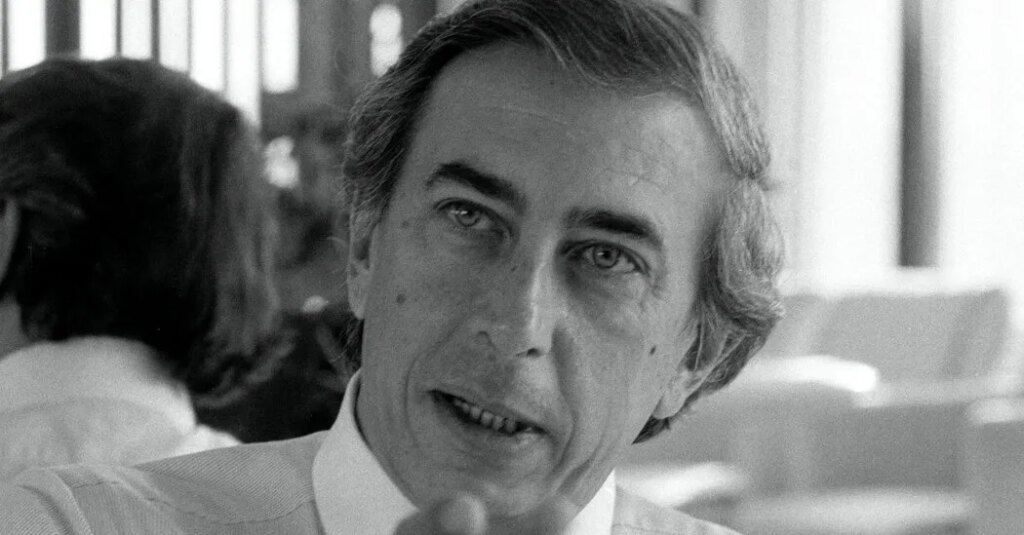
Frank Mancuso, a teenage theater usher from Buffalo who went on to run two major Hollywood studios — Paramount and MGM — in the 1980s and ’90s, shepherding movie hits like “Top Gun,” “Ghost,” “Fatal Attraction” and “Indiana Jones and the Last Crusade,” while also helping to revitalize the James Bond franchise, died at his home in Los Angeles on Oct. 1. He was 93.
His death, of complications from lung cancer, was confirmed by his daughter, Maria Mancuso.
Mr. Mancuso was a rare Hollywood mogul who built his career in sales, marketing and distribution instead of movie production. A soft-spoken executive known as Gentleman Frank, he was the chairman and chief executive of Paramount Pictures from 1984 to 1991. His predecessor, Barry Diller, once called him a “brilliant strategist.”
Earlier in his nearly three-decade career at Paramount, as a marketing whiz and president of its motion picture group, Mr. Mancuso became a pioneer in using music videos and soundtracks to promote movies, helping to make “Saturday Night Fever” (1977) a global disco hit and to elevate “Flashdance” (1983) into a cultural and fashion phenomenon.
He also had a maverick sense for when a movie should be released.
In 1983, Mr. Mancuso opened “Terms of Endearment,” starring Jack Nicholson, Shirley MacLaine and Debra Winger, just before Thanksgiving, at the time considered a drowsy period for movies. It gained momentum for a Christmas audience and eventually won five Academy Awards, including for best picture.
In 1984, when Mr. Mancuso was named Paramount’s chairman, Robert Redford told The New York Times that Mr. Mancuso had adjusted the studio’s schedule four years earlier so that Mr. Redford’s directorial debut, “Ordinary People,” could be released in September 1980, then considered to be an optimal release window for prestige dramas. It won four Academy Awards, including for best picture and best director.
Mr. Redford, who died in 2025, called Mr. Mancuso “extraordinarily decent” in the 1984 Times article, saying, “Like any good doctor, when he has to give you a bad prognosis, he tells you the truth with compassion.”
In response, Mr. Mancuso said, “Most people who know me never mistake my fairness and the calmness in my manner for weakness.” (One of his nicknames was the Godfather.) He continued, “I just don’t like to get an edge that will cost me a relationship.”
The first order Mr. Mancuso gave as Paramount’s chairman was that no script would be shelved or sold without his approval. From the discard pile, he extricated “Top Gun,” believing that the star power of Tom Cruise as an audacious fighter pilot and Kelly McGillis, fresh from her breakout role in “Witness,” along with daring aerial photography, could transform the movie into a “tent pole,” one that attracted massive audiences. It became the top box-office hit of 1986, grossing about $360 million worldwide.
Sherry Lansing, who was the chairwoman of Paramount from 1992 to 2005, signed a production deal in the early 1980s with the studio with her partner Stanley Jaffe. After their first two movies became box-office disappointments, they figured they would have to seek funding elsewhere, Ms. Lansing said in an interview after Mr. Mancuso died.
Mr. Mancuso, she recalled, said: “Why would you think that? I believe in you.”
Their next movie, released in 1987, was “Fatal Attraction,” the rabbit-boiling thriller starring Glenn Close and Michael Douglas that grossed more than $320 million worldwide.
“He knew how to back you in difficult times,” Ms. Lansing said. “You weren’t only as good as your last picture. He made you not afraid to take risks.”
In 1986 and 1987, the golden touch of Mr. Mancuso and Ned Tanen, the president of the studio’s motion picture division, helped Paramount lead all studios at the box office with additional successes such as “Crocodile Dundee,” “Star Trek IV: The Voyage Home,” “The Golden Child,” “Ferris Bueller’s Day Off,” “Children of a Lesser God,” “Beverly Hills Cop II,” “The Untouchables” and “Eddie Murphy Raw.”
While at Paramount, he also helped to oversee the rollout of such television hits as “Cheers,” “Family Ties” and “The Arsenio Hall Show.”
But fortunes can change quickly in Hollywood. In 1991, Mr. Mancuso left Paramount in an acrimonious shake-up. Three big 1990 Paramount films had unperformed financially or been viewed as disappointing — “Days of Thunder,” Mr. Cruise’s stock car vehicle; “The Two Jakes,” a “Chinatown” sequel starring Mr. Nicholson; and “The Godfather Part III.”
Newsweek reported at the time that Mr. Mancuso and his management team had faced criticism for what the magazine described as his increasingly passive leadership style, overblown budgets and tension with top stars like Mr. Cruise and Mr. Murphy.
In March 1991, Martin Davis, the head of Paramount Communications, the studio’s parent company, named Mr. Jaffe the president and chief operating officer of the parent company. With this new layer of management, Mr. Mancuso would have had to answer to Mr. Jaffe instead of Mr. Davis. Mr. Mancuso resigned and sued Paramount for $45 million, claiming a breach of contract. He settled for a reported $20 million.
His career rebounded in 1993, when he was hired to rescue a distressed Metro-Goldwyn-Mayer/United Artists as chairman and chief executive. He served in the role until 1999, helping to reduce MGM’s debt, restore its television and film production and orchestrate the studio’s sale for $1.3 billion in 1996.
He also revived the 007 franchise with three James Bond films — “GoldenEye,” “Tomorrow Never Dies” and “The World Is Not Enough” — and oversaw other successes such as “Stargate,” “The Birdcage,” “Get Shorty” and “Leaving Las Vegas,” for which Nicolas Cage won an Academy Award for his role as a writer struggling with alcoholism.
“He had real integrity and a great knowledge of distribution and what makes a good movie,” Ms. Lansing said.
Frank George Mancuso was born on July 25, 1933, in Buffalo to George Mancuso, a postal worker, and Mary (Scott) Mancuso, who managed the home. He worked a paper route to earn money to see movies on weekends, becoming so entranced at times that he would forget his hat and gloves for the walk home during frigid winters.
At 15, he lied about his age to become an usher at Buffalo’s Lafayette Theater, which had roughly 3,500 seats, and later became assistant general manager while he studied optometry for two years at a local community college. After a stint in the Army, he became a film buyer for the company that owned the theater, and then joined Paramount and began climbing its corporate ladder in 1962.
In addition to his daughter, Mr. Mancuso is survived by his wife, Frances, known as Fay, whom he married in 1957; by a son, Frank Mancuso Jr., a producer; and six grandchildren and one great grandchild.
As Paramount’s chairman, he valued tradition and created a family atmosphere, naming buildings on the lot after such studio luminaries as Cecil B. DeMille and Gary Cooper and displaying Paramount’s Oscars and Emmys in a trophy case. He knew the names of the studio’s gardeners and invited movie people to his home in the Bel Air neighborhood of Los Angeles, where Fay Mancuso served her homemade ravioli.
The movie business has since been radically changed by corporate mergers, streaming platforms and other factors. Mr. Mancuso’s celebrated career, his daughter said in an interview, reflected “a time that doesn’t exist anymore.”
On Oct. 6, five days after his death, Paramount completed its acquisition of Warner Bros. Its new corporate name is Skydance.
The post Frank Mancuso Has Died. He Was Behind Hit Movies of the 1980s and ’90s. appeared first on New York Times.