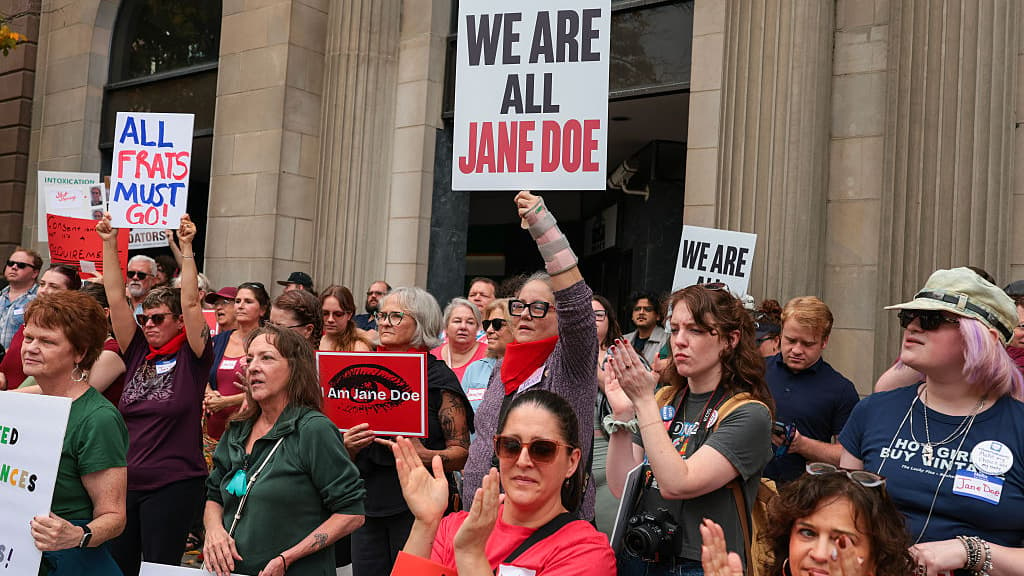
After weeks of pressure on Cornell’s administration over its handling of an alleged gang rape by fraternity members, students and professors are expressing doubt that the university’s leadership is doing enough to address the issue of sexual assault on campus.
They expressed frustration with three measures that were announced Tuesday as a means to “strengthen campus safety”—one of which involved banning fraternity houses from hosting parties or social events for the rest of the academic year. Other measures included adding staff to Cornell’s Office of Civil Rights, working with New York State Police to utilize trauma-informed criminal investigators, and improving education regarding the bystander effect.
“These conversations, and campus protests, have underscored my deep conviction that we must do better: that the time for meaningful and lasting change at Cornell, and at campuses across the country, is now,” Cornell President Michael Kotlikoff said in the announcement.
Read More: After the Cornell Case, Should Colleges Ban Fraternities?
Jack Huber, a member of Students for a Democratic Cornell (SDC), says that this is a step forward—however, it is “not nearly enough to tackle this issue on an institutional level.”
Students are also calling on the university to revoke the degrees of the accused fraternity members; establish independent hearings and minimum sanctions for sexual assault; and commission an external review of the school’s handling of the case.
Cornell acknowledges in its Tuesday statement that the school has “fallen short” and points to the independent review that was launched by the university’s Board of Trustees. It is being led by former U.S. Deputy Attorney General Sally Yates.
Huber says that the campus community believes Cornell is ultimately deflecting responsibility.
“The vast majority of campus is absolutely not satisfied by this response, and many of which are enraged that the administration would so blatantly redirect blame away from themselves to get Cornell out of the news,” Huber says.
Cornell is accused of being negligent in its response to the incident when it was initially reported in 2024. Jane Doe’s lawsuit against the seven men she accuses of rape also accuses Cornell of violating New York law.
The school said on Sept. 28 that when Doe reported the alleged assault in late 2024, it acted in accordance with federal law and triggered Title IX proceedings. An investigation took place in early 2025.
“After investigation, and pursuant to federal law, the matter was sent to a hearing where a panel of trained faculty and staff heard evidence over multiple days,” the school’s statement said, noting that it ultimately applied a “range of sanctions” to the accused students, including expulsions and suspensions.
“The complainant and respondents had the opportunity to testify and present evidence,” it continued.
The statement also pointed out that Cornell’s Chi Phi chapter was closed in 2024 and remained barred from campus.
TIME has reached out to Kotlikoff’s office for comment.
Sabrina Karim, a government professor at Cornell, views the fraternity events ban as a “testing ground for a different policy going forward,” and a move that will buy time to evaluate what’s next.
She agrees, however, that the ban does not go far enough—explaining that a broader and more coordinated approach may be necessary, especially in a rural environment like Ithaca, New York.
Cornell is located in a rural pocket of the Finger Lakes region in upstate New York, surrounded by hills and country roads. Karim believes the climate requires a more robust effort by the university to connect students with external resources, like law enforcement.
“There needs to be, just, a better system,” she says.
Cornell said Tuesday that the New York State Police “will interview survivors who elect to pursue criminal charges and will prepare comprehensive investigative summaries for the appropriate law enforcement agency.” This would take place throughout the duration of the independent review; the school did not comment on what coordinated efforts might take place beyond that timeline.
Faculty Senate weighs no-confidence resolution as students press for reform
Cornell’s statement came one day before the Faculty Senate was scheduled to begin debating a proposed vote of no confidence.
The proposed resolution, which has over 120 supporting signatures, establishes that: “The Faculty Senate has no confidence in the ability of the central administration to effectively address the ongoing crisis of sexual assault at Cornell University.”
If passed, it would represent the strongest faculty rebuke to the university since the Jane Doe investigation began.
Professors at Cornell tell TIME that many faculty members distrust the administration.
Risa Leiberwitz, a professor in the College of Industrial Labor Relations, tells TIME that Cornell’s administration does not adequately listen to campus governance bodies such as the Faculty Senate, student assemblies, and unions.
She says it has taken a “top down” approach to decision-making and “has not shown respect or real commitment to democratic campus governance.”
Others believe that the school’s ban on fraternity events is more of a response to external pressure than a push for long-lasting cultural change on campus.
“As someone who’s been organizing for the vote of no confidence, the timing of this is very suspicious, so it definitely feels like the president is trying to get ahead of [the] meeting,” says Julia Chang, a professor of Hispanic studies at Cornell.
“Trust is eroded between faculty and administration, and between students and administration,” Chang says. “We see this administration as one that is reacting to the news, and to the bad PR, as opposed to leading on this issue.”
“I continue to have concerns, and I know many of my colleagues continue to have concerns, that the Cornell administration is reactive,” Leiberwitz says. “It is reacting to pressure on it in a very drip, drip, drip way.”
In light of that perception, student organizers believe that the only way to get the changes they’re seeking is by continuing to apply pressure.
“What’s clear to us is that the administration is trying to scapegoat fraternities instead of making any commitment to institutional change—change in line with the demands that SDC and dozens of other organizations put forward,” Huber says. “And the fact that it is only a year shows that they are really using this as a temporary fix, something to get the administration out of the news cycle.”
SDC is one of the many student groups that organized a “Justice for Survivors” rally on Oct. 5. Thousands of students and community members attended the protest, according to the Cornell Sun. The SDC also co-sponsored a seven-hour sit-in organized by the school’s NAACP and Black Students United groups on Oct. 7. The next coordinated effort is now in development, according to Huber.
People’s University, a campus activist group, says it plans to protest at a Cornell Board of Trustees meeting Friday. In a press release shared with TIME, the group called for a rally and a symbolic “mock trial” of the seven men accused in Jane Doe’s lawsuit. It also demanded the resignation or removal of Kotlikoff and several other administrators and the abolition of Interfraternity Council Greek life at Cornell.
“We are still putting pressure on the administration and we are not going to stop until we get our demands,” Huber says. “We will not be satisfied until we have institutional change and an independent judicial system, so something like this can never be covered up again.”
The post Cornell’s Fraternity Party Suspension Draws Calls for Broader Reform appeared first on TIME.