The Department of Homeland Security is pushing back on a recommendation from a government watchdog urging the agency to automatically activate body-worn cameras when federal immigration officers pull a firearm or stun gun, arguing that such technology could cause privacy concerns if the cameras are accidentally turned on.
The agency’s stance came in response to a new report Wednesday from the Government Accountability Office that found U.S. Customs and Border Protection and U.S. Immigration and Customs Enforcement have failed to update plans to deploy and monitor body-worn cameras despite significant changes to the program during the Trump administration.
The GAO recommended that ICE adopt automated activation technology, which CBP already uses in cases when officers draw their firearms or activate emergency lights on their vehicles.
By contrast, the GAO reported, ICE’s lack of automated controls “presents the risk of personnel not capturing footage of incidents when they are required to do so.” The auditors wrote that “the inability to capture footage could negatively impact prospects for public engagement, successful data, enforcement, and other partnerships, including a loss of public confidence and transparency.”
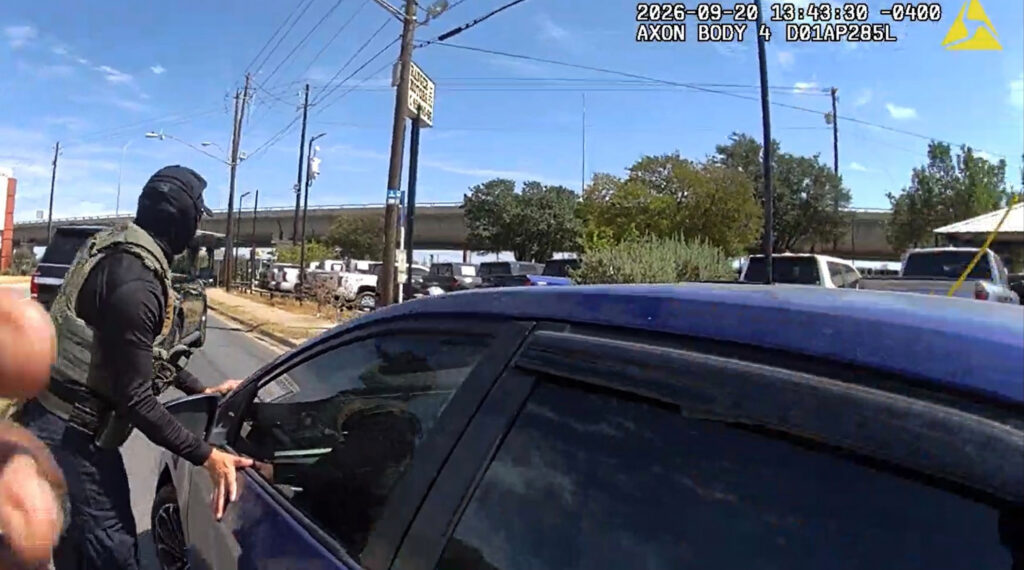
The GAO report comes amid mounting public scrutiny of ICE’s tactics in the wake of a spate of recent officer-involved shootings, including of a Venezuelan man in Austin last month. The officer who fired his weapon was a recruit who was issued a body camera but was not using it during the incident, in which Wilber Garcés Pérez, 28, was shot and wounded during a traffic stop.
DHS officials responded to the report by saying they concur with six of the GAO’s seven recommendations, including implementing “results-oriented” goals and measures to assess the effectiveness of the body camera program.
But Jeffrey M. Bobich, DHS’s executive director of financial management and systems, said in a response contained in the report that his agency did not concur with the GAO’s recommendation about automated camera activation.
Automatic activation “presents significant operational risks, including advertent or false activations during routine movement,” he wrote. “Such triggers could result in the unauthorized recording of sensitive interactions with informants or victims, or the recording of bystanders engaged in protected First Amendment activities in areas where camera use is restricted.”
DHS did not immediately respond to a request for comment Wednesday on whether it remains opposed to automated activation of body cameras for ICE officers.
ICE acting director David Venturella said over the summer that the cameras would be disseminated to every officer by the end of August following the deaths of two immigrants shot by officers who did not have cameras recording when they fired. One of those officers was a recruit who had a volatile history, according to relatives and court records.
An agency spokesman told The Washington Post in late August that DHS had enough body cameras to equip all ICE officers nationwide. But in early September, Homeland Security Secretary Markwayne Mullin said at a news conference that the cameras had not yet been fully distributed and that only officers assigned to make arrests in the field would be given the devices.
The GAO report, which was done at the request of congressional Democrats, found that through June 2026, CBP had issued approximately 11,500 cameras, nearly all of them to Border Patrol, and ICE had deployed 4,800 cameras, split between Enforcement and Removal Operations and Homeland Security Investigations.
The auditors found that CBP had not updated its plans for the cameras since 2022 and ICE had not updated its policies since 2024.
“The lack of current program plans that are clearly defined and aligned with organizational objectives makes it difficult for both component programs to plan for and communicate with stakeholders about needs to respond to changing operational requirements and constraints,” the GAO report said.
The auditors said both CBP and ICE have oversight policies, including requiring officers to provide a statement to superiors if they fail to activate their cameras during an encounter. CBP had issued one written reprimand for noncompliance with camera policies, the report said, and ICE had not issued any through September 2025.
“By implementing control activities related to camera activation, such as automated camera activation technology, ICE would have an improved mechanism to ensure that footage is captured in accordance with policy and enable the agencies to promote public confidence and provide increased transparency into operations,” the report said. “Without reliable control activities, ICE risks gaps in documentation and video evidence that can make reviews of incidents more challenging.”
The post DHS rejects watchdog’s call for ICE to use auto-activated body cameras appeared first on Washington Post.