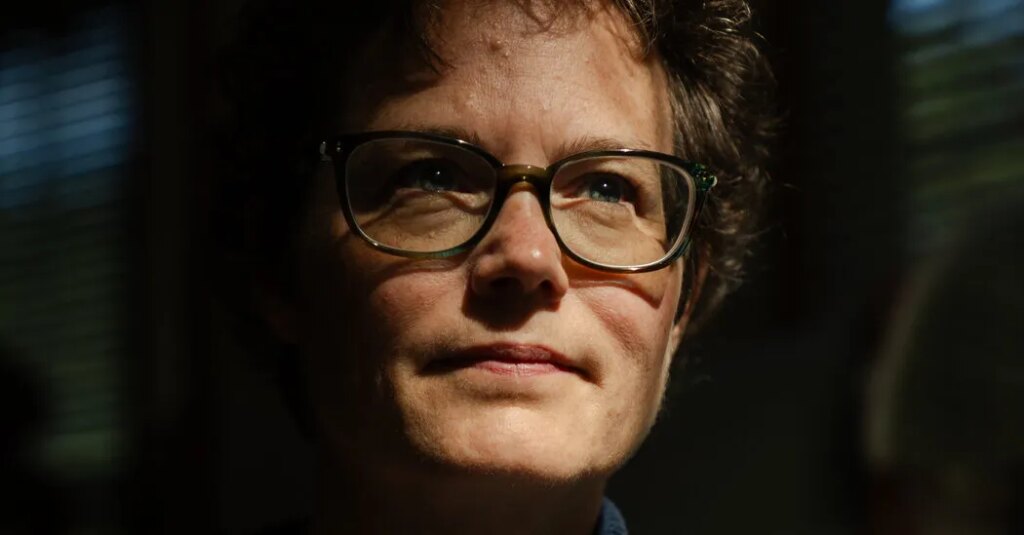
Sitting at her desk on a July evening, Shelly opened her tablet and signed onto a weekly Zoom support group meeting for lesbians coming out later in life.
She smiled as five other group members popped onto her screen. Weeks ago, these women had been strangers. Now they were among the only people who truly understood her.
Like Shelly, who is 50, they knew how frightening it felt to come out after years of hiding. Like Shelly, several of the women were still married to the men they had been with for decades. And like Shelly, they wondered: How do I do this? Am I too old for this? Will I lose everything?
The leader of the group, Anne-Marie Zanzal — a hospice chaplain turned “coming out coach” — kicked the meeting off with a roll call. Shelly had only ever talked to Zanzal through a computer screen, yet she felt totally open with her — a surprise, given Shelly’s innate New England reserve and the years she had spent compartmentalizing parts of herself. But of course, Zanzal got it too. She came out eight years ago at 52, after 27 years of marriage and four children.
Zanzal often told the women she worked with that coming out later in life might make them feel like outliers, and in many respects they are. A 2024 Gallup survey found that, as society has become more accepting of L.G.B.T.Q. people, younger Americans are coming out at younger ages; 71 percent of all L.G.B.T.Q. Americans are out by 30. Only 1 percent of L.G.B.T.Q. women come out at 50 or older, according to the survey.
Shelly listened on mute as the women shared their updates. One was preparing to take her son out for a beer to tell him she was a lesbian. One group member had recently told her husband she wanted to try being intimate with a woman.
“I want to be able to meet up physically with some people,” she told the group as she searched for the word. “With people. With a woman. I want to know what that feels like.”
When it was her turn, Shelly shared that she was working on getting more comfortable doing things on her own — a daunting task after more than two decades of marriage and motherhood.
“There are certainly spaces I’m not ready to go into,” she said. “But my biggest thing is just going into things alone.”
Shelly’s primary residence was still the house she shared with her husband in New Hampshire. (To preserve her family’s privacy, she asked that only her first name be used. Shelly’s husband did not want to participate in this article.) But a little over a year ago, she had bought a small summer home in Wells, Maine, where she was now sitting. Most weeks, Shelly spent at least a few days there.
“I decided to sign up for a kayaking tour just by myself,” Shelly told the group on Zoom. At sunset on the estuaries that lead into the Atlantic Ocean, it had been so peaceful, it felt surreal, Shelly shared. “There’s nothing out there but wildlife.” As the sun set, a bald eagle flew by.
“It was lovely,” Shelly said, shaking her head in wonder. Afterward, Shelly thought about how different she would have felt if she had been out there with her husband, pretending still to be someone she is not.
“It wouldn’t have been as lovely,” Shelly said.
“No,” Zanzal agreed.
“No,” Shelly repeated, her voice soft but firm.
Shelly closed her tablet and thought about the update she had shared with the group. The kayak tour had felt special, in part, because she had put herself first. For years, Shelly had worried about everything her family might lose if she came out; even now, she worried about ruining “a perfectly good family dynamic,” she said.
With Zanzal’s help, she was starting to accept that any unhappiness her children felt was likely to fade with time and be only a part of their story; hers would be permanent. “One of the things I thought about a lot is that if I don’t come out, if I keep living the way I have been, I am just not going to have happiness,” she said.
Still, it was not easy to accept that a part of her life was ending. For years, Shelly had what she knew many others aspired to: a nice house. Three dogs. Two active children whom she and her husband relished shuttling to dance, theater and hockey.
Now Shelly felt sad more often than she expected. She and Zanzal — who has a master’s degree in divinity from Yale University — talked a lot about grief and loss in their weekly one-on-one sessions. (Shelly had been meeting with her individually since April, paying Zanzal $400 per month for a package that also included the 16-week group Zoom course and unlimited check-ins.)
That was all normal, Zanzal told her. Grief was almost always a bigger part of coming out later in life than women anticipated, she said. So many different forms of loss piled up on top of one another: the unraveling of the life Shelly had built. The loss of some of her friends. The shattering of the identity Shelly had clung to, even if it never fully fit.
A year ago, before she had ever heard of Zanzal, Shelly was spending much of the summer in Maine with her daughter, Hayley, who had just graduated from college. Shelly’s son was still in college and living at home for the summer, heading to Maine for visits. Her husband drove to the home too, for occasional family meals and to build Shelly a front porch. They weren’t together all the time, but it was easy to think the foursome was humming along nicely, a happy family.
Then, one afternoon, as they walked on the beach, Hayley told her mom that none of her college relationships had panned out the way she had hoped. “You were only 19 when you met Dad,” she reminded Shelly, her voice wistful.
The words hit Shelly like a fist to the gut. She had grown up in what she described as an unstable household with incidents of physical and verbal abuse. Shelly had gotten married because she wanted so badly to build a steady life, and when she met her husband, she had been struck by how solid he seemed. They had always been a good team.
But as Hayley spoke, Shelly realized that she had modeled a version of life that was hollow, a mirage. “I had modeled something that’s probably not even attainable, because when you’re playing a part, you play it better,” she recalled later.
The words spilled out before Shelly fully knew what was happening: I am gay.
She had known she was since she was 9 and an aunt told her what it meant. In that moment, Shelly had felt acute relief, she told Hayley. She wasn’t the only one. But then her aunt told her gay people go to hell. Nine-year-old Shelly started having nightmares, unable to sleep through the night because she thought she would wake up in hell too.
As Shelly and Hayley continued to walk and talk, Shelly realized her daughter was crying. “I did not want to hurt you with this,” Shelly told her. “I am so sorry.”
But Hayley wasn’t crying because she was hurt. She was crying because she was overwhelmed by how lonely her mother must have felt.
She wanted to make sure her mom didn’t feel ashamed or regret for finally opening up, even if Hayley was surprised. “I think that maybe was the beginning of pushing her toward finding the life that she really does want,” Hayley said.
A month after the group session on Zoom, Shelly was back in Maine for the week. She worked in financial services, a job that kept her at her computer for hours. Here, though, Shelly could explore the quiet, grassy trails of Wells Reserve with her dog, Brandy, and walk up and down the wide, sandy shores of Wells Beach. On hot days, she slipped off her sandals and waded into the bracing Maine water. She called the cabin Camp Good Enough, but it meant more to her than the nickname implied. Here, she could display on her kitchen table the “Everyone Is Awesome” Pride Lego set that she had built at her children’s urging.
After Shelly came out to Hayley, she thought telling people she was gay would be, if not easy, at least possible. But she did not know how to do it. She hadn’t told anyone else. About nine months later, in March, she opened Google Chrome and typed: “Why is it so hard to come out of the closet when you’re 50?”
One of the first things she came across was Zanzal’s website. Shelly signed up for her newsletter and spent around $30 to join her online community for women questioning their sexuality in midlife. Eventually she sent Zanzal an email sharing her story. She felt “scared,” “impatient” and “immobile” all at once, she wrote.
Zanzal got letters like it all the time. She had been doing this work for nearly a decade, with thousands of women. Zanzal had invested heavily in search engine optimization, because she knew many of her clients found her when they were secretly — often desperately — searching online for support. She also knew from poring over her analytics that most women spent anywhere between three and seven years reading her newsletter or downloading her podcast before they ever reached out to her. She was relieved that Shelly wasn’t one.
“What you shared deserved to be said,” Zanzal wrote back, “all of it. I want you to know I read every word.”
“This is a wound that runs deep, and it makes complete sense that you are nervous.”
“What I want you to hear is this,” Zanzal continued. “You did not fail at coming out. You were failed by the people who were supposed to love you without conditions.”
The words shifted something inside of Shelly. She felt, for the first time, that she was not to blame for everything. That she was not a failure for being both gay and not gay enough. Shelly had often been critical of herself for not coming out, like during her freshman year at Brandeis when she was on the softball team with a bunch of friends who were out and proud. It would have been so easy to just say, Me too.
At 31, Shelly did come out to her best friend, Sara, a college classmate who had been her maid of honor. At dinner one night, Sara and Shelly were talking about marriage and the complications of long-term intimacy. Shelly was surprisingly short with her friend.
Sara wondered: Did Shelly really never think about different paths she could have taken? About what life might have been like had she married someone else? Shelly told her no, never, then felt instantly guilty about the half-truth.
Shortly after they left the restaurant, Shelly called Sara. What if she real reason she never thought about being with another man was because she was gay, she asked.
Sara was supportive, asking Shelly how long she had known, what her next steps would be. She wanted her best friend to feel like she could be openly gay. And for a few weeks, Shelly could almost imagine a new life.
But she was early in her career and had no real money. She was terrified of losing her children. So she told Sara she wasn’t going to think about any of it again until her children were out of the house.
Zanzal had spent a lot of time over the past weeks reassuring Shelly that this was normal too. She herself had taken 10 years to come out. Like many women — mothers especially, she said — she had come to treat everyone else’s needs as more important than her own.
Again and again, Zanzal assured Shelly that nothing she was experiencing was abnormal. Shelly told her how hurt she felt about the two hockey mom friends who had stopped inviting her to things, and the friend in Maine who had slipped out of her life after she came out. Zanzal told her she had lost friends too, as had so many of her clients.
For Shelly, it was profoundly comforting to talk to someone who could say, You know, when I was in your shoes ... Zanzal offered her a road map to a new life.
In May, while her son was driving home from college, Shelly came out to him. “My two kids have been my rocks,” she recalled later, breaking into tears. “I know that they are grieving the loss of their family unit in the way that they knew it. They are not putting a lot of that on me, though.”
At the final meeting of Shelly’s 16-week group class, in September, Zanzal asked her and the others to jot down what had changed for them since the sessions began. Shelly began typing on her iPad, surprised at how emotional she was. “I was struggling with loneliness, because I wasn’t with the right person, and while I didn’t know who that person was, I knew it was a she and not a he,” she wrote. “I had extreme amounts of anxiety and had a couple of panic attacks.”
“I thought I had ruined my own life by being in the closet,” Shelly continued, “but by coming out, I’d essentially be ruining the lives of those I loved most and those who had given me so much.”
And some of her fears had been realized: “I became gossip,” Shelly wrote. “I have had friendships change. I have been excluded from a circle that once felt like family.”
But there was good stuff too. “The people I work with opened their arms and fully embraced me in a way I just didn’t allow myself to hope for,” Shelly wrote.
Her children have been her “heroes,” she typed, “steadfast in their unconditional love for me.”
There had been another change, and it was a big one, though Shelly did not write about it, because she did not want to make the last session awkward for the other women in the group.
Weeks earlier, Shelly had found herself distracted during meetings. She tried not to smile too much at the beautiful brunette.
Zoe.
Like Shelly, Zoe was in her 50s, married, a mom. The pair had begun messaging each other outside the weekly group sessions, remarking on the similarity of their circumstances. They worked on online crosswords together. They shared playlists. They FaceTimed. Neither of them had joined the group with any thought of discovering something romantic, yet here they were with crushes.
One day, Zoe asked Shelly to visit her in Atlanta. Shelly had always suffered from a crippling fear of flying, but she called her friend Sara and told her she wanted to go. Sara was shocked — she had tried for years to get Shelly to visit her. But maybe this was part of the new Shelly. Or “Gay Shelly,” as she and Sara called her.
Gay Shelly was bold.
Gay Shelly had better fashion sense than Straight Shelly.
Gay Shelly was a flirt.
Zanzal had cautioned Shelly to go slow. She often reminded her clients that they had waited for so many years to be with a woman, and when it happened everything felt new and electric — not unlike a teenager falling in love for the first time. The same highs, but also the same lows. Shelly was navigating so much upheaval right now — could she handle it if a relationship didn’t work out?
But on this, Shelly wasn’t ready to listen. Her whole life she had been waiting. She didn’t want to wait any longer.
She booked her plane ticket to Atlanta. “Gay Shelly travels,” Shelly texted Sara. “She travels!!!”
The post Coming Out at 50 Can Be Hard. Shelly Found a Coach. appeared first on New York Times.