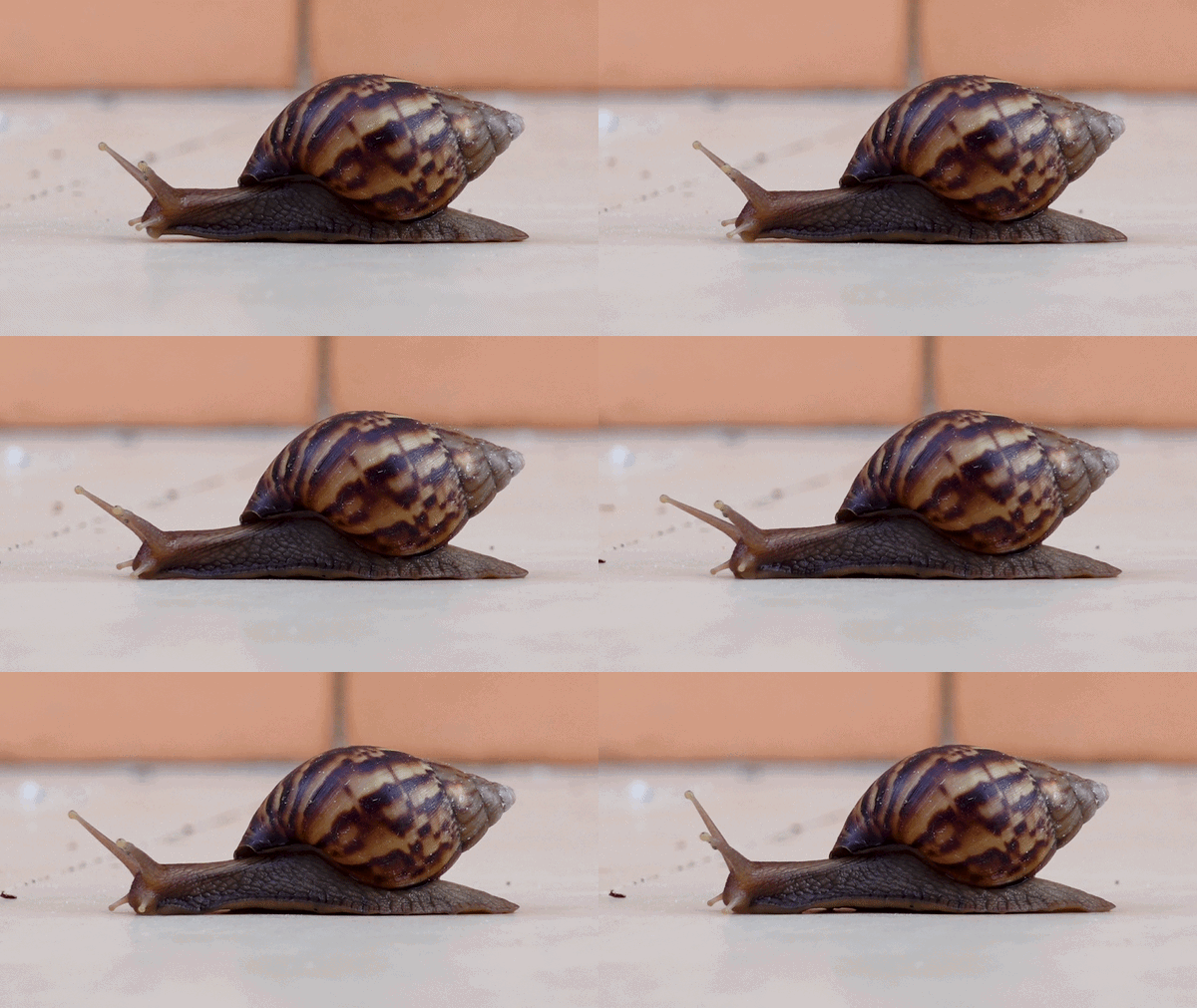
Since September, giant snails have put one Florida neighborhood on high alert. No one in a roughly 300-acre zone in the city of Hialeah, just outside of Miami, is allowed to move yard waste or even a single brick into or out of the neighborhood without explicit permission from state authorities. Teams of scientists patrol the area in search of giant African land snails, enormous mollusks with tiny teeth, a foot bigger than a 5-year-old’s, and the tendency to spread the rat-lungworm parasite, which is exactly as delightful as it sounds.
The snails, which actually grow to about eight inches in length, but can stretch—if nothing else, for headline-writing purposes—to nine inches, have worried Florida authorities since 1969. Since then, the state has spent millions of dollars fending off three infestations. One such operation took a decade to complete. Now, whenever a snail is found, inspectors from the state agriculture department’s Division of Plant Industry start patrolling. They set out bait and drench hatchling-harboring soil with anti-mollusk poison. Then they distribute mug shots to the public. (That step might seem unnecessary, given that we are talking about snails the size of chipmunks, but the experts I talked with all emphasized the importance of anti-snail awareness.) An area is considered clean only after it has been monitored and treated for three years.
This time, the problem “seems to be limited to just one city block,” Paul Skelley, a main architect of the agriculture department’s crackdown, told me. But the response is full-bore. “We are serious about this snail in Florida,” Skelley said. “When you find these cancers, you don’t want to let them fester. You need to cut them out.”
Skelley was part of the response to the last big infestation, which lasted from 2011 until 2021, and he sounds somewhat keyed up on the phone. Giant African land snails (also known as GALS) really are giant, and meaty and sweaty-looking, like a boxer’s fist just out of the glove. “When you see the whole body out moving around,” he said, “it’s unbelievable.”
Earlier this century, the International Union for Conservation of Nature declared these snails one of the worst invasive species on Earth. GALS are prevalent across a thick belt of the globe, centered on the equator, and their slime trail is widening: After expanding their range from East Africa through Madagascar, India, and the Pacific Islands, they have lately been spotted in Argentina, Beijing, and, somehow, the Italian Alps. And as climate change makes more of the world warmer and wetter, they could conquer even more territory. Skelley considers his state a firewall. If the snails spread through Florida, “they could get quite a distance up the East Coast and inland” by hitching rides with humans, he said.
Once they arrive somewhere new, GALS quickly multiply, and then make trouble just by being themselves. They love eating—beans, melons, ornamental flowers, shrubs—which is why they’re a hazard to agriculture. When cars run them over, the snails’ pointy shells can puncture tires. In search of minerals needed to grow their shells, they target stucco, eating our houses to build theirs.
All of this can happen at a scale difficult to imagine. In the past, in Hawaii, brigades of the snails have blocked roads after rainstorms, eventually creating “a sort of mush of snail bodies and slime,” Robert Cowie, a snail researcher at the University of Hawaii at Mānoa, told me. “Cars were skidding.” In Keralam, in India, where recent monsoons created the wet, humid conditions in which the snails thrive, teachers clear them daily from schools and playgrounds. In Florida, during the most recent big outbreak, Skelley’s team would purge a yard the size of a couple of parking spaces and end up pulling out maybe 2,000 snails.
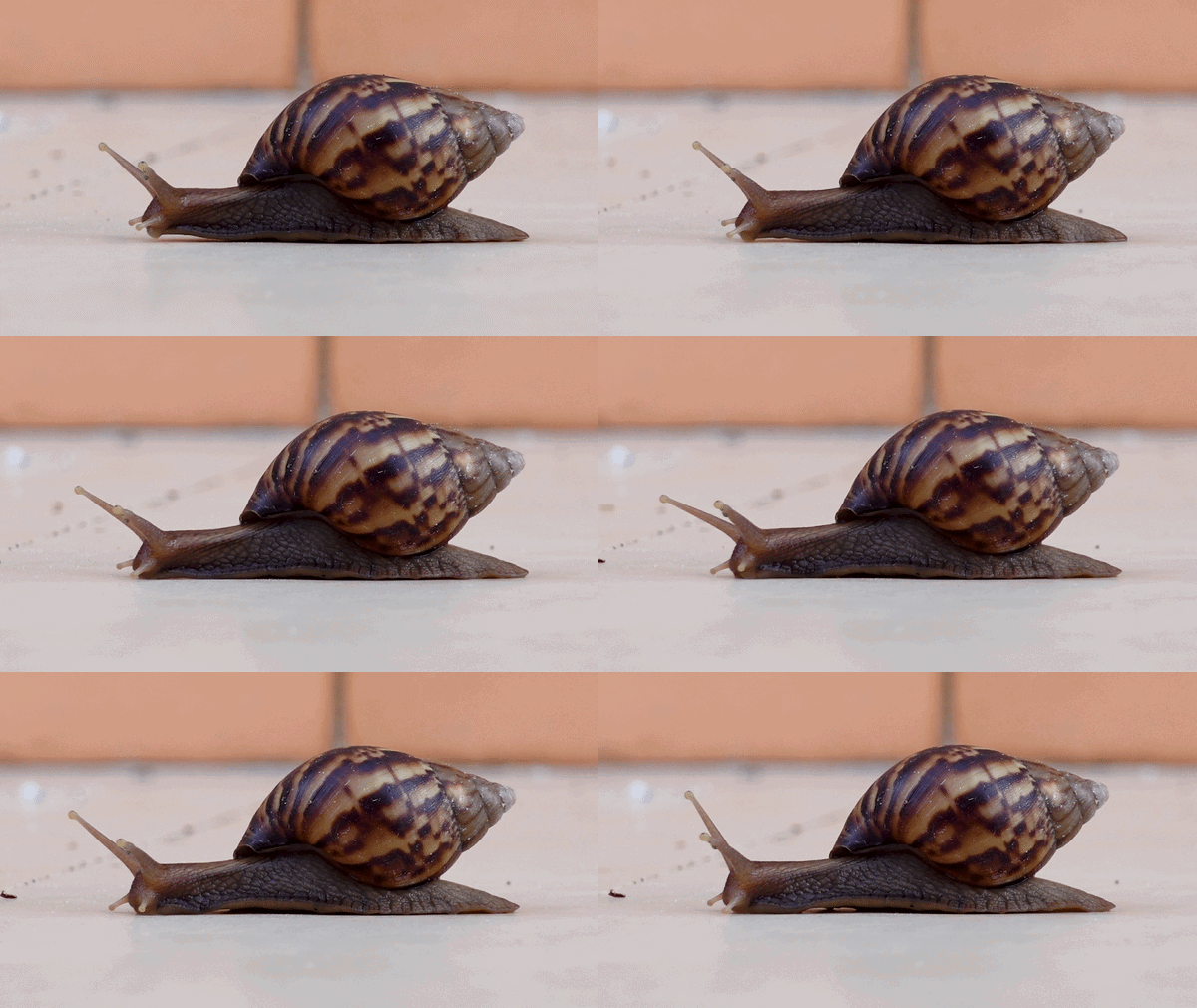
On their own, the African snails move as one would expect, but Skelley jokes that they can go up to 70 miles an hour—“as fast as humans can move them.” And humans—whether they’re taken in by the snails’ charisma and impressive bulk, or just unaware of the threat—like to move them. Florida’s first brush with GALS began in 1966, when a young boy brought three home from a vacation in Hawaii. His grandmother found them, the story goes, and put them out in her North Miami garden. By 1973, those three snails had become 18,000, which the state located and destroyed.
Harboring the snails anywhere in the United States without a permit is illegal. Still, federal, state, and customs inspectors continue to confiscate GALS from pet owners and breeders, from schools, and from the occasional religious practitioner who (allegedly) drinks their mucus. So far, Florida’s giant-snail infestations have all been in cities and suburbs, far from farmland or protected ecosystems. But “we’re scared to death that it’s going to be found in the Everglades, some national park,” Skelley said. “That’s the worst case.”
Brazil is already there. An agronomist brought the snails into the country in 1988, most likely from Indonesia, in an ill-advised attempt to create a market for giant escargot. He sold snail-rearing kits to hundreds of hopefuls, who raised GALS in their backyards. “He had a very good intention,” Silvana Thiengo, the head of the Malacology Laboratory at the Oswaldo Cruz Institute in Rio de Janeiro, told me. But unfortunately, “Brazilians are not used to eating escargot.”
The snails were soon discarded on streets and in rivers. Now Thiengo receives snail specimens from around the country, and most of them are giants. They’re in urban gardens, tempting dogs to play with them; in croplands, eating bananas, beans, and soy; in the middle of the Amazon and in the country’s massive tropical wetland, the Pantanal. She and her colleagues worry about how large numbers of giant snails might compete with native species “for food, for space, for everything.”
A particular worry is the rat-lungworm parasite, which can infect humans, pets, livestock, and wildlife. In humans, the worms burrow into the brain and can cause coma and death. Although the disease is quite rare, Thiengo and her colleagues have found that human cases of it have been ticking up in Brazil. But at this point, the snails are so widespread in the country that little can be done about them. Although Brazil once ran national anti-snail campaigns, all have been phased out.
In some cases, trying to get rid of these snails has caused more problems than it has solved—and again, not through any fault of the snails. In Hawaii, where GALS were originally introduced by a gardener who thought they would make a fun yard ornament, the Hawaii Department of Agriculture tried to control the giant-snail population by introducing more than a dozen new carnivorous snails to the islands in the 1950s. One of the new species, the rosy wolf snail, developed a taste for Hawaii’s hundreds of species of endemic land snails, or kāhuli. It ate so many that more than half of those species are now extinct.
Still, once GALS have settled into the places they’ve invaded, something mysterious tends to happen, Cowie, the University of Hawaii snail researcher, told me. Their numbers die down. And the snails themselves get smaller. Hawaii’s snails are now at “a handleable level,” he said. “Maybe not acceptable, but you can deal with it.” The state has given up fighting them.
Cowie hasn’t. After it rains, he goes out into his garden with a pair of tongs and a garbage bag. He picks them up, giant out-of-place snail after giant out-of-place snail. He can’t stop the forces—globalization, ignorance, human folly—that ferry snails from place to place. But he can stop the snails in his own yard. He considers it his responsibility to move them one last time—into his freezer, and then into the trash.
The post Nine-Inch Snails appeared first on The Atlantic.