In a closed-door meeting at the Justice Department last month, senior officials with the Office of Professional Responsibility spent two hours reviewing 78 PowerPoint slides relating to — of all things — Watergate.
The presentation focused on longstanding allegations of misconduct by the Watergate Special Prosecution Force, the team of young Ivy League lawyers whose investigation helped bring down President Richard Nixon and secured criminal convictions of his top former aides.
After The Wall Street Journal broke news of the session this month, Nick Akerman, one of the task force’s few surviving staff lawyers, denounced the presentation in an essay titled “I Helped Investigate Watergate. The D.O.J.’s Attempt to Reframe Nixon as the Victim Is Extremely Dangerous.” Mr. Akerman dismissed the presenter — a graduate, like him, of Harvard Law School — as the peddler of a “bonkers conspiracy theory” asserting that Mr. Nixon was ousted in a “plot.”
The Journal’s headline — “Decades After Watergate, Justice Department Reviews Whether Nixon Got a Raw Deal” — fueled skepticism by suggesting that Mr. Nixon, long assigned the role of irredeemable historical villain, might have been treated unfairly.
Mr. Nixon, of course, got a great deal: pardoned a month after his resignation for all crimes he committed or may have committed during his presidency. He went on to publish best-selling books, serve his successors as consigliere and travel the world as an elder statesman.
But what about all the president’s men? Did they get a raw deal?
According to a raft of scholarly work, the answer, unequivocally, is yes. By fabricating witness testimony, suppressing exculpatory evidence and colluding with the presiding judge, the Watergate prosecutors railroaded the former attorney general John Mitchell, the former White House chief of staff H.R. Haldeman and the former domestic policy chief John Ehrlichman. This does not mean these convicted officials were innocent. But it does mean they did not receive the due process that even the men around Mr. Nixon deserved.
Mr. Akerman and others suggested that the Justice Department officials convened the meeting because they hoped, indirectly, to exculpate President Trump. If the Watergate prosecutions could be exposed as corrupt, the argument goes, then so, too, could the investigation led by Robert Mueller that looked into possible ties between Mr. Trump’s 2016 campaign and Russia.
This misses the point. The role of the Justice Department’s Office of Professional Responsibility, itself a post-Watergate creation, is to review any information that suggests a department employee might have violated the law, regulations or standards of conduct.
With its political animus and early use of computers, the Watergate investigation is indeed the grandfather of lawfare. One of the jurors who pronounced judgment on Mr. Nixon’s cabinet officials described Watergate as “war between the ins and the outs.”
A case in point, omitted from the recent presentation: On Feb. 6, 1974, a task force staff lawyer, Peter Rient, sent a colleague a three-page memo titled “Material Discrepancies Between the Senate Select Committee Testimony of John Dean and the Tapes of Dean’s Meetings With the President.”
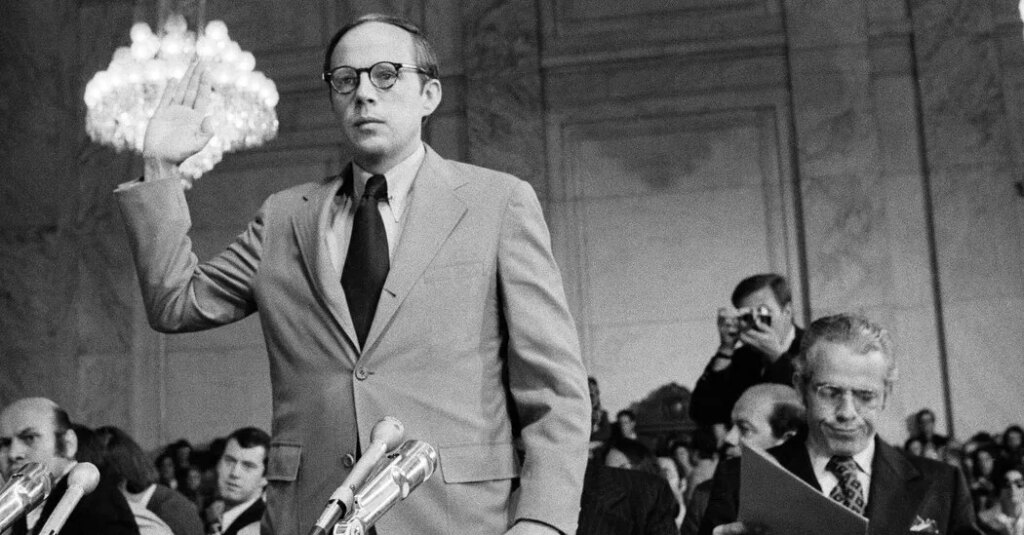
Mr. Nixon was then six months away from resigning. Mr. Dean was the young White House counsel who admitted to having managed the Watergate cover-up until, fired by Mr. Nixon, he negotiated partial immunity from the Senate Watergate committee and cooperated with the prosecutors. In exchange for leniency, Mr. Dean gave damning testimony against the president and his men.
The existence of Mr. Nixon’s secret taping system was publicly disclosed 17 days after Mr. Dean concluded his televised Senate testimony. The remaining year of Mr. Nixon’s presidency was spent litigating access to his tapes. When their contents tumbled out, the press, the courts and scholars all concluded the recordings vindicated Mr. Dean’s proclaimed “astounding memory for detail.” With his brown comb-over and owlish eyeglasses, the ex-wunderkind became, in Walter Cronkite’s words, “an all-purpose Watergate witness.”
The Rient memo was never released to the news media. The public was kept in the dark about acute problems that Watergate prosecutors had identified in the Senate testimony of their star witness.
Likewise, the Rient memo was withheld from defense counsel in U.S. v. Mitchell, the Watergate cover-up trial in which Mr. Dean’s testimony proved decisive. Having ironed out all the material discrepancies from his sworn Senate appearance, the prosecutors used Mr. Dean’s new testimony to secure convictions of Mr. Mitchell, Mr. Haldeman and Mr. Ehrlichman, once among the most powerful men in government.
A material discrepancy, in criminal procedure, means it is significant enough to affect the outcome of a case. Criminal convictions routinely get overturned after disclosure of prosecutorial misconduct less egregious than this. Mr. Mitchell, Mr. Haldeman and Mr. Ehrlichman, now dead, all served prison terms.
The Rient memo remained undisclosed until 1997, when I revealed its contents in National Review. Also disclosed in that article was a memo by the Watergate prosecutor George Frampton dated July 22, 1974 — 10 weeks before jury selection in the Watergate cover-up trial began — outlining “significant discrepancies between Dean’s anticipated trial testimony” and “that of other government witnesses or evidence.”
Mr. Frampton’s analysis showed that one meeting Mr. Dean testified to “apparently didn’t take place.” The prosecutor advised, “We probably would do well simply to omit Dean’s testimony about this.” Mr. Dean later acknowledged the discrepancies, testifying that he and the prosecutors cleaned them up before the Mitchell trial.
The Frampton memo showed that the prosecutors’ concerns extended beyond the problems that the Nixon tapes posed for their star witness. Like the Rient memo, the Frampton memo was hidden from the news media and the defense counsel in U.S. v. Mitchell.
As the Watergate prosecutors must have known, withholding these memorandums trampled the constitutional rights of their prosecutorial targets. Had lawyers for Mr. Mitchell, Mr. Haldeman and Mr. Ehrlichman had access to these analyses, they could have used them for cross-examination and probably demolished what little credibility the disbarred Mr. Dean still possessed.
It was Geoff Shepard, a veteran of Mr. Nixon’s defense team and a leading Watergate scholar, who delivered last month’s briefing. In 2013, Mr. Shepard published an article in The Atlantic that made use of previously unpublished task force memorandums to chronicle how prosecutors repeatedly met privately with Judge John Sirica, the chief judge of the Federal District Court for the District of Columbia. He had presided over the Watergate break-in trial and was determined to sit as well on Mr. Mitchell’s trial. No defense lawyers were included in these meetings — a major violation of federal criminal procedure.
Judge Sirica had a problem: Approaching 70, he would soon be forced, under rules then in place, to resign as chief judge, surrendering his power to assign cases. Mr. Shepard found memos by Leon Jaworski, the special prosecutor whose work helped secure the convictions in the Mitchell case, showing he had allowed Judge Sirica to orchestrate the contents and timing of the indictments so he could assign the case to himself.
Mr. Shepard’s findings shocked the bar. At a 2015 panel event at George Washington University Law School, the law professor Stephen Saltzburg, a former clerk to Justice Thurgood Marshall and one of the nation’s most renowned experts on criminal procedure, declared that the prosecutors’ concealment of exculpatory information in the Mitchell case and the conduct of Judge Sirica constituted “as gross misconduct as you could possibly get.”
If the Trump Justice Department officials demonstrate the courage to revisit the Nixon years, whose mythologies remain foundational to mainstream media and elite academia, they can expunge the tainted convictions secured during Watergate.
Their chief problem could be whether the rogue Watergate prosecutors are covered by the Office of Professional Responsibility. Certainly, Judge Sirica was not; any official review of his misconduct must occur elsewhere. And there is good reason to question whether the Watergate task force was ever part of the Justice Department. In 1974, Antonin Scalia, an assistant attorney general at the time, complained in writing that “the special prosecutor’s briefs are not reviewed in the department” and therefore the Justice Department would not endorse “the positions adopted by the special prosecutor.”
These are technicalities. Official review of the crooked convictions in Watergate is rooted in a wealth of newly declassified evidence and is long overdue. One need not be a supporter of Mr. Trump — or of any other target in the various investigations he has faced — to agree with Santayana’s maxim that those who fail to remember the past are doomed to repeat it.
James Rosen is the chief Washington correspondent at Newsmax and the author of books on Antonin Scalia and John Mitchell.
The Times is committed to publishing a diversity of letters to the editor. We’d like to hear what you think about this or any of our articles. Here are some tips. And here’s our email: [email protected].
Follow the New York Times Opinion section on Facebook, Instagram, TikTok, Bluesky, WhatsApp and Threads.
The post What if All the President’s Men Were, in Fact, Railroaded? appeared first on New York Times.