For Republicans, Christmas came in July.
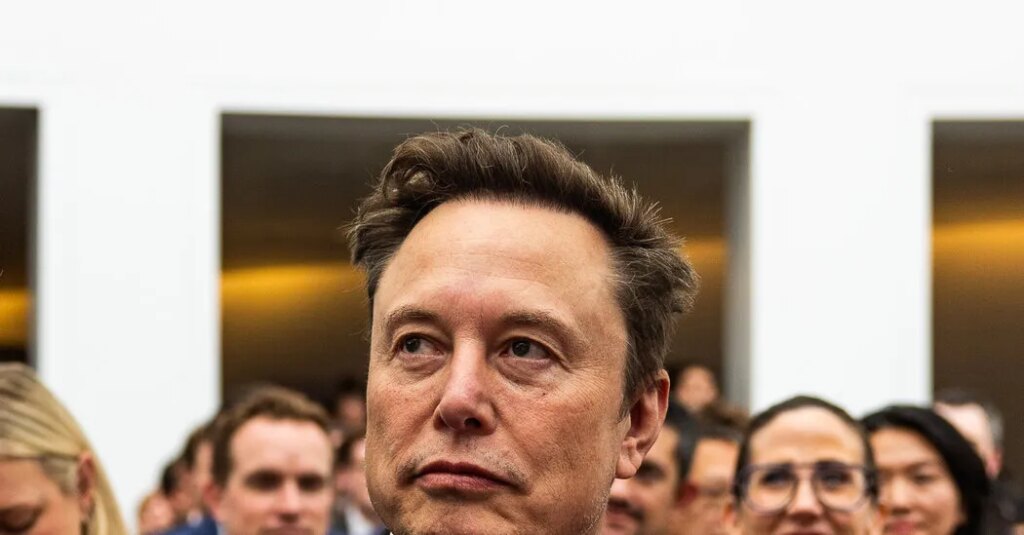
That’s when Elon Musk began funneling more than $276 million into the party’s efforts to save its majorities in Congress, my colleague Teddy Schleifer has learned.
It is a stonkingly large amount of money, and it includes, in sum, one of the biggest political donations in history: $158 million to Senate Republicans’ main super PAC, the Senate Leadership Fund.
It means that when we talk about the Republicans’ considerable outside spending advantage over Democrats in this midterm, we are talking, in large part, about Musk’s personal contributions.
And it means that a mercurial figure who once backed off political spending is back in the game.
Musk, of course, spent big on President Trump’s 2024 campaign, then joined his administration for a short-lived stint as the head of the Department of Government Efficiency. He poured cash into a Supreme Court race in Wisconsin, only for his preferred candidate to lose. A few months into Trump’s term, he was publicly feuding with the president over the One Big Beautiful Bill Act and promising to start his own third party.
I asked Teddy to join us to explain why Musk — who has been popping up by Trump’s side more frequently in recent weeks — is making his way back into politics, and how his money is shaping Republicans’ campaign strategy.
Jess: Teddy, I’m old enough to remember when, in 2025, Elon Musk said he was going to do “a lot less” political spending. Turns out he’s already spent more on the midterms than he did on the whole 2024 presidential election. Why did he change his mind?
Teddy: If you are willing to ignore a three-month anti-Trump bender from Musk in mid-2025, he’s actually been rather consistent. Toward the end of his time overseeing the Department of Government Efficiency, Musk obviously got rather nihilistic about politics and the Trump movement. But the September 2025 killing of Charlie Kirk affected him, I’ve been told, and made him angry at the left. And by November, I reported that he and Trump were largely peachy again. (Not that he ever retracted his desire to start a third party.)
He is back to where he was in 2024 — genuinely fearful of what happens to his vision of America if Democrats win. But it’s not just that Musk is a true believer. I also think Musk knows that there is a real business risk to Democrats winning in November. There could be congressional investigations into DOGE, and maybe his companies.
Is that what’s personally at stake for Musk in the midterms? Concerns about oversight?
That’s part of it. Musk is also likely to be a donor in 2028 — we report in the story that his own super PAC, America PAC, plans to spend in the next cycle — and I think he wants it known just how much he’s doing to help the party.
I also think that Musk is driven a lot by what he sees online. The Texas Senate race, which he has shown a particular interest in, is viral in a way that no other race is. He is a human being, surrounded by right-wing friends in Texas and, more importantly, inundated with digital stimuli about James Talarico, Ken Paxton and that dynamic race.
How does Musk’s spending fit into the Republican midterm strategy, more broadly?
One question I’ve had for weeks is about the provenance of the $158 million that the outside Senate Republican group is spending to help Paxton in Texas. How exactly did the Senate Leadership Fund “come up” with this money? Well, I learned as part of my reporting that this decision in late August by the super PAC was preceded by Musk sending a total of $158 million their way. That, uh, helps.
Plus it wasn’t totally clear to me, when I began calling around, how America PAC precisely fit into the Republican operation. One revelation for me was that Musk was asked by Trump’s aides to reprise his super PAC field program from 2024, and I know that Musk’s team is on regular conference calls with the Trump team and entities like S.L.F. The Trump team is counting on the Musk operation and its thousands of canvassers.
In 2025, we saw Musk standing onstage in Green Bay in a cheesehead, attempting to amp up Republicans in a Wisconsin Supreme Court race they ultimately lost by 10 percentage points. Is he taking the show on the road this year?
I think that Wisconsin loss was embarrassing for Musk and actually cast a long shadow, explaining a lot about what happened next. Musk appeared aware in private conversations after that defeat that he could be a bit of a liability to the causes he cared about, and I don’t think it’s a surprise that he is playing things much more quietly this time around.
It’s also true, based on my sources, that Musk just isn’t preoccupied with these midterms. He himself isn’t involved in day-to-day operations as he was last time. His friends tell me he isn’t paying much attention to the midterms at all. And Jess, his own X feed tells you all you need to know: He is rarely tweeting about any specific candidates, outside of Talarico. And even those are relatively rare. This ain’t 2024, or even 2025!
Get Caught Up
In Washington
-
Under pressure from the White House, Kimberly Guilfoyle resigned as U.S. ambassador to Greece. The Wall Street Journal reported last week that Guilfoyle had asked a Republican donor to pay off $100,000 on her American Express credit card.
-
Trump denied that he was close with Guilfoyle, who used to be engaged to Donald Trump Jr. “She wasn’t a member of my family,” the president said today. “She, I guess, dated my son a long time ago.”
-
Trump described his new press secretary, Katie Zacharia, as an attorney. But when a Times reporter asked today where she had passed the bar, she responded, “When I moved to China.” It’s not clear what she meant.
On the campaign trail
-
Trump is going to Alaska this evening to rally for Senator Dan Sullivan, the Republican incumbent. Vice President JD Vance went there last week, too, as Republicans try to hold on to the closely contested seat.
-
Top Republican super PACs are cutting off financial support for two House members: Tom Kean Jr. in New Jersey and Mariannette Miller-Meeks in Iowa. It’s the first instance this cycle of Republican groups abandoning incumbents.
-
Debate season rages on. There are debates tonight for the Senate races in Maine, Georgia and Iowa. We’ll have the highlights in tomorrow’s newsletter.
Quote of the Day
“This is the existential crisis of our time.”
That was Dr. Abdul El-Sayed, the Democratic Senate candidate in Michigan, talking about A.I.
El-Sayed released a platform on how he would handle the technology. His proposals include the creation of a cabinet-level agency to regulate the technology and a ban on recursive self-improvement (i.e., using A.I. to create ever-more-advanced A.I. models).
Chart of the Day
One debate, two realities
Who won last week’s Michigan Senate debate? Your answer might depend on what side of social media you were watching.
Using more than 13,000 X posts from both sides of the political spectrum, Stuart Thompson reconstructed how the left and the right tried to shape the narrative of the night.
Mailbag
Your questions, answered
Readers recently wrote in to The Morning, The Times’s daily news briefing, with their burning political questions, and our reporters provided answers. Here’s one.
Will ICE agents be at polling places? — Robert Halper, West Orange, N.J.
Alexandra Berzon, an investigative reporter who writes about election systems, said:
Although some election officials and voting advocates worry that this prospect will drive away voters, they say the law is clear: Armed federal agents are not allowed in polling places. Administration officials have spread misinformation about the voter rolls, saying they bulge with noncitizens, but the Department of Homeland Security and the Department of Justice have said there are no plans to deploy armed agents to patrol polling places. (Government lawyers, on the other hand, are often on site.)
You can read more questions and answers here.
In One Number
$5,289
That’s the annual home insurance premium in Kansas for a $300,000 house with a $1,000 deductible. It’s 84 percent higher than the national average.
Many Americans’ home insurance costs have soared in recent years, driven up by wildfires, hurricanes, floods and tornadoes worsened by climate change. In an election cycle so focused on affordability, that rising price tag has helped push reliably red states like Kansas and Florida onto the battlefield.
One Last Thing
A tale of two Portlands
A Republican super PAC trying to boost Senator Susan Collins in her tough re-election fight in Maine spent thousands of dollars to run an attack ad against her challenger, Troy Jackson, in Portland.
It’s not likely to have much of an effect. That’s because the ad was shown to more than a million viewers in Oregon — home to the other Portland.
The vendor responsible for buying the ads took the blame for the blunder and said it was refunding the super PAC. Still, Jackson’s campaign pounced, saying Collins and her allies “are so out of touch with Maine, they apparently can’t find it on a map.”
Taylor Robinson contributed to this newsletter.
The post Elon Musk Re-Enters the Chat appeared first on New York Times.