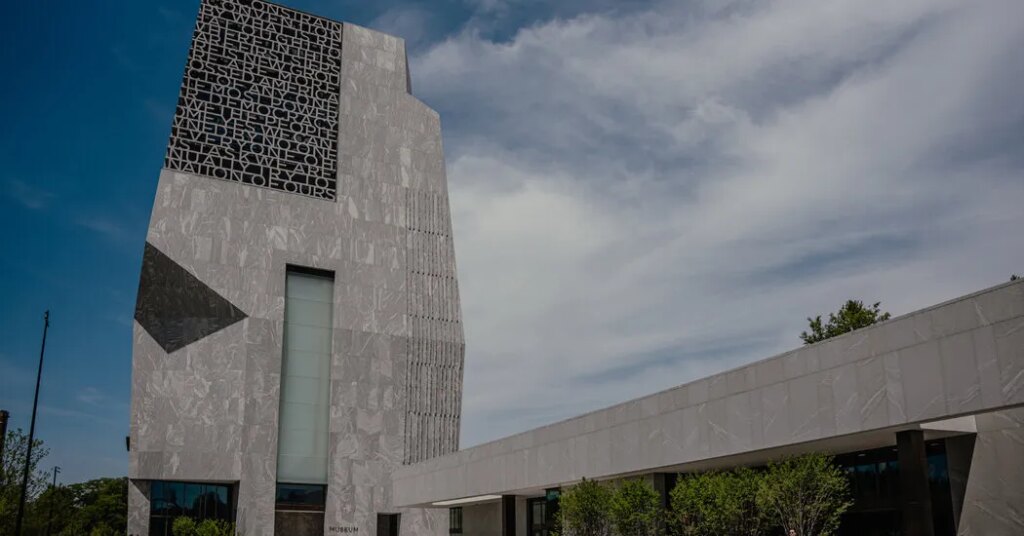
On an unseasonably warm day this past weekend, I visited the Obama Presidential Center in Chicago.
Walking past the exhibits was like going back in time to an earlier, seemingly more harmonious world. As Peter Baker wrote when it opened this summer, “it is a trip to a parallel universe, one suffused in earnest talk of hope and change, not dark warnings about American carnage.”
The jarring disconnect between the present day and the not-so-distant past felt especially true when it came to the museum’s treatment of climate change.
As The Times reported at the end of his two terms in office, President Obama made efforts to protect the natural world a signature part of his time in the White House.
References to this work are scattered throughout the museum’s four floors of exhibits. There are charts that show American emissions falling during his presidency. There is a commemoration of the 2015 Paris Agreement, in which most nations on Earth pledged to try and limit overall global warming. Environmental justice gets a moment, as does Alaska.
It all makes for a stark contrast to the past couple of years, during which President Trump has gutted pollution regulations, attacked renewable energy and promoted fossil fuels.
Toward the end of the museum’s exhibits, there is a four-minute video featuring Obama addressing the issue directly.
He starts by crediting his mother with instilling in him an early passion for the natural world. “She was the kind of person who would wake me up to see a full moon if it was particularly spectacular,” he recalls in the video.
His childhood in Hawaii also played a role in shaping his understanding of the natural world. “You can’t help, if you’re surrounded by all that natural beauty, to feel protective of it, to want to preserve it,” he says.
Obama touts some of his wins on the climate front, including efforts to promote investments in clean energy, protect public lands and establish national monuments.
He calls the signing of the Paris agreement “one of the proudest moments of my presidency,” but says that while the deal was an important step, “we still have so much more to do.”
Obama notes that during his eight years as president, “the effects of climate change in the United States were being felt directly by more and more people, affecting our water, the food we eat, the rate of respiratory illnesses and the overall health of children, especially in underserved communities.”
Left unsaid is the fact that in the nearly 10 years since he left office, the effects of climate change have only become more severe, or the fact that global temperatures are rising at an alarming rate and are likely to exceed the threshold targeted by the Paris agreement.
Also left unsaid is anything about President Trump. There is no mention of the United States’ withdrawal from the Paris Agreement, or the current administration’s repeal of the scientific determination that underpinned the government’s legal authority to combat climate change.
The closest the exhibits come to addressing the sweeping setbacks to Obama’s climate agenda is to note that “some in Congress and in the fossil fuel industry blocked comprehensive legislation.” And that “as a result, many of President Obama’s climate actions were done by executive authority and could be overturned after he left office.”
The video address closes with Obama acknowledging the power that young activists have in the climate movement.
“A lot of them are frustrated that adults in positions of power haven’t done enough to address the climate crisis,” he says. “That’s why my message to young people begins with acknowledging that you are right to be frustrated. Folks in my generation certainly haven’t done enough to deal with a potentially cataclysmic problem that you stand to inherit.”
Then, in a classic Obama turn, he tries to pivot from the possibility of global calamity to the power of hope.
“But I also want to share some advice that my mother always used to give me,” he says. “If you’re feeling anxious or angry or depressed or scared, don’t turn away. Instead, get busy. If we work hard enough, for long enough, the victories will add up, and if we stay with it, we will get this done.”
How Hurricane Isaias surged in intensity in a few hours.
Hurricane Isaias was the first Atlantic hurricane of the season, and over the weekend it became the first to hit the mainland United States in two years. The storm surged into a Category 3 on Friday, a remarkable increase in strength considering it only became a hurricane on Wednesday night.
The phenomenon of a storm growing so powerful so quickly is known to meteorologists as rapid intensification. It happens when a hurricane’s maximum sustained winds increase by at least 35 miles per hour within a 24-hour period (roughly a two-category jump on the Saffir-Simpson Hurricane Wind Scale).
El Niño, a global weather pattern that is reaching record strength this fall, typically creates a unfavorable environment for storms in the Atlantic. It has led to remarkably few tropical storms this year and, until Isaias, no hurricanes.
But Isaias survived that environment, drawing on the Gulf of Mexico’s abundant ocean heat to rapidly intensify. — Judson Jones
More climate news from around the web:
-
Wired reports on a first-of-its-kind simulation that offered a glimpse of what happens when geopolitics takes charge of solar geoengineering.
-
Tourists have long discarded objects into Yellowstone National Park’s hydrothermal features. Park staff try to remove as much as they can, but some litter leaves lasting effects, according to an article in National Geographic.
-
Climate Action Tracker has updated its analyses for North America, and the news isn’t great. The independent scientific project now classifies the United States’ climate action as “critically insufficient” and Canada’s as “highly insufficient.”
Read past editions of the newsletter here.
If you’re enjoying what you’re reading, please consider recommending it to others. They can sign up here.
Follow The New York Times on Instagram, Threads, Facebook and TikTok at @nytimes.
Reach us at [email protected]. We read every message, and reply to many!
The post President Obama’s Climate Legacy appeared first on New York Times.