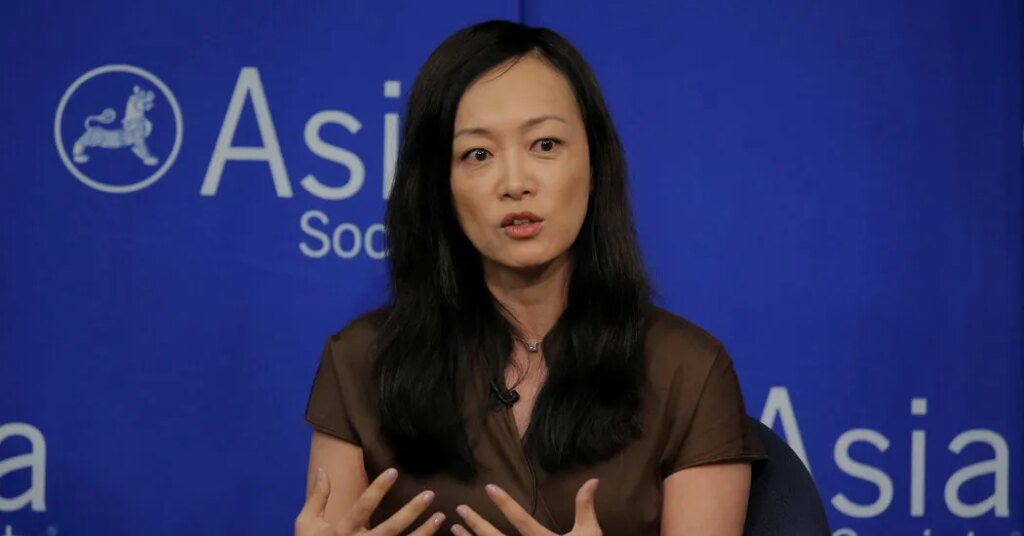
The Justice Department has agreed to drop criminal charges against a former Central Intelligence Agency analyst who was accused of covertly working for the South Korean government and receiving luxury gifts in return.
As part of a deal reached with federal prosecutors in Manhattan, Sue Mi Terry, who was a senior fellow for Korea studies at the Council on Foreign Relations, will not face jail time.
The deal, which amounts to the government walking away from a high-profile case involving foreign influence, is an unexpected development. It comes mere weeks before Ms. Terry was set to go on trial in Federal District Court in Manhattan on charges of working as an unregistered foreign agent of South Korea.
She had maintained her innocence, and her lawyer had said she was being prosecuted for doing the typical work of a prominent scholar of international relations in Asia.
In a statement, Lee Wolosky, a lawyer for Ms. Terry, said she had served her country “loyally for many years” and was pleased with the outcome. “We have consistently maintained that her interactions with South Korean officials were conducted in furtherance of U.S. interests and her work as a leading American specialist on North Korea and East Asia,” Mr. Wolosky said.
In a two-page letter filed on Tuesday, federal prosecutors in the Southern District of New York did not provide an explanation for reaching a deferred prosecution agreement with Ms. Terry, other than that the interest of the United States and Ms. Terry would be “best served” by such a deal.
When she was arrested in 2024, prosecutors said Ms. Terry received luxury goods, dinners at Michelin-starred restaurants and other perks from the South Korean government in exchange for doing its bidding.
That work, prosecutors said, ranged from writing opinion articles that promoted South Korea’s stance on North Korea to arranging meetings between U.S. government officials and South Korean intelligence agents.
By making the deal, Ms. Terry admitted to aiding South Korean intelligence officers in a number of ways, including by providing them her notes from a meeting with the U.S. secretary of state. She also admitted to receiving lavish gifts.
Ms. Terry is also barred from speaking with South Korean intelligence officials for the next year.
The case against Ms. Terry was one of dozens brought by the Justice Department in recent years to combat foreign influence in American government. The prosecutions have included efforts to rein in the Chinese government’s suppression of overseas dissidents, as well the bribery conviction of former Senator Robert Menendez of New Jersey.
Her prosecution had faced criticism from some organizations. Last year, lawyers from the American Civil Liberties Union and the Knight First Amendment Institute filed a brief in Ms. Terry’s case, arguing that the indictment “threatens to punish her for constitutionally protected speech on a matter of public concern.”
Ms. Terry had also worked at the National Security Council and the National Intelligence Council, and was called to testify before Congress about North Korea. And prosecutors produced instances of Ms. Terry’s work that they said was secretly promoting South Korean policy priorities, spanning the world of diplomacy, journalism and national security.
She is married to Max Boot, a Washington Post columnist, with whom she wrote a 2023 article about the improving relations between South Korea and Japan. That article, titled “South Korea takes a brave step toward reconciliation with Japan,” was written at the behest of Seoul, prosecutors said. Mr. Boot was not accused of wrongdoing.
According to the indictment, Ms. Terry first started working as a foreign agent in 2013, five years after leaving the C.I.A.
The work started when she was contacted by a South Korean agent who was posing as a diplomat to the United Nations in New York City, prosecutors said.
Prosecutors said that Ms. Terry worked with multiple handlers from South Korea, who bestowed gifts that included a Dolce & Gabbana coat worth $2,845, a Louis Vuitton handbag worth $3,450 and at least $37,000 to a gift account at her think tank, which she controlled.
By 2014, she was on the radar of the F.B.I., who brought her in for a voluntary interview during which she was “visibly nervous” as agents questioned her about her connections with South Korean intelligence officers.
Nine years later, Ms. Terry was interviewed again by the F.B.I. She admitted to agents that she had resigned from the C.I.A. instead of being fired because the agency had “problems” with her contacts with South Korean officials.
The post U.S. to Drop Charges Against Ex-C.I.A. Analyst Over Aid to South Korea appeared first on New York Times.