The 500-pound Russian bomb first appeared as a tiny blip on Yevhen Ovcharov’s live military map: a red speck gliding over the Ukrainian border and above the villages beyond.
Then he saw it hurtling toward his hometown, Sumy.
Yevhen was a Ukrainian soldier deployed 300 miles from home, on the eastern front. It was 9:45 p.m. on July 3 when he reached for his phone.
His wife, Nataliia Ovcharova, answered quickly. Don’t worry, she told him. She and the girls were fine and happily walking home from the park. Their 13-year-old, Veronika, was trailing slightly behind with a friend. Their youngest, Milana, who was 5, was beside her.
At 9:46, the call was cut off.
Yevhen called back once, twice, three times.
For six minutes, he heard nothing.
At 9:52, his phone rang. It was Veronika. She screamed that she was covered in blood. Milana, she said, was lying completely still on the ground.
“No one is helping,” she sobbed. “Dad, please come save us.”
Yevhen ran outside and jumped in a car to start the four-hour drive home.
This summer was Ukraine’s deadliest and most violent period since the first weeks of Russia’s invasion in 2022. Russian attacks killed more than 1,100 Ukrainian civilians from June to August, according to an estimate by the United Nations. Another 7,000 were wounded.
Russia preyed on Ukraine’s air-defense shortages, bombarding cities far from the front line with waves of drones and ballistic missiles that it knew Ukraine could not intercept.
Yevhen had been sent to fight in the eastern region of Donetsk, but his hometown in Ukraine’s northeast was the center of another Russian military push. Russia terrorized residential areas there with drones and glide bombs that it produces in large quantities.
Glide bombs have leveled cities across the country’s eastern and southern regions for years. The only way to stop these World War II-era weapons is with planes that shoot Russia’s fighter jets down before they drop the bombs. Ukraine still does not have the means to do that. In July, Russia launched a record 8,300 glide bombs. And at 9:46 p.m. on July 3, one landed in Sumy.
Veronika was 8 years old when the war started: old enough to understand that everything was changing but young enough that her parents still protected her from what they could.
Still, she could see how much her mom worried about her dad, a career police officer who was fighting in the infantry. Nataliia often asked Veronika to pray for him. As the oldest daughter, she told her, she had a special bond with her father. This was an important responsibility for Veronika, who often felt left behind by the attention on her sister, who was just a baby when Russia invaded.
“She was stressing a lot,” Veronika said of her mother. “When Dad was not reachable on the phone, she was panicking.”
Veronika didn’t worry like that. She got used to the explosions and the hum of Russian drones and the years that passed without her dad, who kept deploying to different parts of the front line.
When he had time off, Yevhen would come home and walk with her and Milana to the park for ice cream. Once, he arrived with a kitten he had found, a striped male with folded ears, whom he had named Max. The girls fell in love.
Veronika was growing up fast and took care of Milana while their dad was away and their mom expanded her beauty business, using the third bedroom that would one day be Milana’s to style women’s eyebrows and lashes.
The more time the sisters spent together, the less their age difference seemed to matter. “I could still talk to her about anything,” Veronika said. Milana was small but fiercely protective of Veronika. Once, she even threw a phone charger at a boy she saw bullying her sister. Veronika felt proud.
In May, Veronika turned 13. War or no war, she was thrilled by the idea of her first teenage summer: the freedom to roam the neighborhood with her large friend group. Her dad’s scheduled time off in July. The photo shoot her mom had booked for when they would all be together again. The trip they planned to a water park three hours away.
It would be Milana’s first time going anywhere. The girls couldn’t wait.
Yevhen got into the passenger seat of his friend’s car. While one friend drove, another, in the back, told him to hold on despite his panic.
Yevhen called everyone he knew in Sumy as they drove. The story about his family’s whereabouts kept changing. They were here, they were there.
It was past 2 a.m. when he arrived at the hospital. He rushed to the front desk and asked for the mother and daughter brought in a few hours before. The receptionist told him they weren’t there.
He ran outside and saw an ambulance.
“What happened to the woman and child who were wounded tonight?” he asked.
“They died,” the driver replied.
Veronika cut through the woods, slipped through a fence and walked down the bank of the shallow river until she reached a large rock. It was gray and smooth, with a curve that made it feel almost like a chair.
It had been two months since her mother and sister died, and she was 600 miles from home, the farthest she’d ever been. The sky was bright, and the mountains stretched into the sky.
The police had sent her and her father to this property nestled in the Carpathian Mountains a few weeks earlier. It was where Ukrainian police families like hers — with relatives who were wounded, dead or in need of a rest — could start to recover. There were no air-raid sirens, no explosions, no threatening hums from drones.
Veronika found the spot in the river on her own, when she wandered away from the wood-paneled building and the psychologist who kept asking how she felt. Away from the gym where her dad was always working out to manage his grief, and the pile of stuffed animals they had brought from home that reminded her of her sister. She returned to it nearly every day.
Veronika couldn’t think too much about her sister. When she did, her vision blurred, her heart pounded. She felt sick. She had learned that this is what doctors called a panic attack. She’d had three since that night in July.
The days passed slowly. She had visited the tourist markets and waterfalls and even climbed the tallest mountain in Ukraine, where visitors left messages for friends and relatives killed in the war.
But she was lonely and bored now. She wanted to go home.
She returned to scrolling on her new iPhone, the one she secretly wished for on this trip and that her dad bought her the very same day. She clocked 18 hours of screen time on it in a single day, most of it on TikTok. She tucked an AirPod into her right ear. She didn’t bother with the left ear: She hadn’t been able to hear out of it since the blast.
There was a necklace in her pocket, one that her mother had given her on her 13th birthday in May. She had not taken it off until the week before when a boy at the retreat pulled the chain and snapped it. She still wanted to keep it close to her as she waited for it to be fixed. The charm was thick and round and had words engraved along the edges.
“Dream, Act, Love. Daughter, you can do everything. I’m proud. I love you — Mom.”
While Veronika would sneak away to the river, Yevhen split his time between the gym and the psychologist’s office on the third floor. He made protein shakes to regain some of the strength he had lost to grief. He insisted sometimes on dragging Veronika away from her phone and taking her for hikes.
He didn’t want to sit still. When he sat for too long, he remembered too much, and ugly thoughts surged to the front of his mind. The thoughts told him that there was no point in living, that there would be no justice for his family.
The psychologist was helping him learn to push these thoughts away. To make plans instead. He was only 38. He knew he had to forge a path forward.
The first days after the deaths had been a blur of rage and stress. Yevhen broke the news to Veronika at the hospital and then slept by her bedside. Her legs and arm were pocked with bits of Russian shrapnel that later would cover her in purple scars. Her left ear drum had exploded from the shock wave.
At home, he took a blue Stitch stuffed animal that Milana had loved and stuck it in his bag. He decided to carry it with him everywhere.
He also searched for the police officer he heard had tried to save Milana. He wanted to ask him: Did you really do everything you could?
They met at the scene of the strike. The officer, Dmytro Zuienko, told Yevhen that he had been on a patrol and rushed there just after the explosion. He and a colleague performed CPR on Milana for 15 minutes, even after others moved away, afraid that another strike might be coming. Milana’s face, he told Yevhen, was stuck in his mind for days.
The officer went home that night, he said, his clothes soaked in blood, and told his wife that a girl had died in his arms who was only a few years younger than their own daughter.
Yevhen knew the officer was telling the truth. But he couldn’t forget the words Veronika screamed that night: “No one is helping.” If he had been there, would he have gotten to Milana faster than the officer? He couldn’t stop himself from asking that question again and again.
A few days later, Yevhen walked again to the spot where Natalia and Milana had been killed. He had dreams of transforming this road into an alley that would honor children killed in the war. But on this day, he planned only to leave candles at the makeshift memorial that neighbors and friends had built.
The sidewalk was covered with impact marks. The windows on the grocery behind were still boarded up. Flowers and stuffed animals adorned a broken tree.
When Yevhen looked up, Mykhailo Fedorov, the defense minister at the time, was walking toward him. Mr. Fedorov was in Sumy on that July day and had asked to visit the place where he heard a Russian glide bomb recently killed a mother and child.
Neither knew the other would be there.
Yevhen introduced himself, and the two men embraced. Yevhen’s story devastated Mr. Fedorov, who also had a young daughter. Both saw the chance meeting as an opportunity: Maybe Yevhen’s new mission could be to tell the world what happened to his family, to show everyone why Ukraine needed more air-defense systems, more planes. Maybe Yevhen could stop this tragedy from happening to anyone else.
They exchanged numbers. Later, at the police retreat, Yevhen thought about this idea constantly. It motivated him to stay alive.
Yevhen and Veronika left the mountains overnight on Sept. 14 and drove through winding roads in darkness. By morning they were in Kyiv, standing outside the children’s hospital where Aliona, one of the friends Veronika was walking with on July 3, was still a patient.
Aliona was 16. Russian shrapnel had maimed her legs. She’d already had 20 surgeries, and more were planned. Her doctors said she might never walk normally again.
Veronika burst through the door. She and Aliona held each other. Yevhen hugged Aliona’s mother, Iryna. They were old friends who shared another heavy grief: Iryna’s husband had died from cancer while Yevhen was on the front line.
“I missed you,” Aliona whispered to Veronika. “I want to go home.”
The girls compared scars. Veronika gave Aliona a teddy bear she had chosen from the mountain market and showed her the necklace the boy broke. Aliona tried to fix it. “I loved your mom,” she said when she read the charm’s message. She took a deep breath and covered her face with her hands.
The conversation turned back to the night of July 3.
Iryna was the first one there after the attack, she told Yevhen. She ran through dust and debris and found two men tying tourniquets around Aliona’s legs. She was sure her daughter was dead. She screamed. And then Aliona blinked. And when Iryna looked up, Veronika was standing there watching, her legs bloody, her face confused.
Veronika interjected to remind Iryna about her jean shorts. “They were bloody halfway up, if not more,” she said. “My sneakers were completely covered in blood, and my socks were covered in blood, too.”
“Veronika — imagine — she gets up and sees all of this. Everyone and everything,” Iryna said. “Aliona was lying facing upward, so she didn’t see it.”
As her mother talked, Aliona started to cry. Veronika did, too. In the next bed over, another teenage girl, wounded in a different strike on Sumy, sat and listened silently.
That afternoon, after Mr. Fedorov stopped by the hospital in Kyiv to visit Yevhen and the girls, and after a doctor checked Veronika’s ear and made plans for a future surgery, Yevhen and Veronika started the drive back to Sumy.
Yevhen’s mind was racing with plans. Mr. Fedorov, who had been fired in July but remained deeply involved in defense issues, suggested that morning that Yevhen should speak to officials in Sweden.
The Swedish government had promised jets to Ukraine to help shoot down planes before they could launch glide bombs, he said. Maybe Yevhen’s story could drive home the urgency and help the planes arrive sooner.
Yevhen agreed. It would the first step in his mission.
In Sumy, he and his daughter returned to an apartment that was too quiet and still. A pile of toys lined the back of the couch. Milana’s dollhouse sat nearby on the floor.
In Yevhen and Nataliia’s room, Milana’s bed was still pushed up against her parents’, the word “Princess” printed on its footboard. Yevhen took Stitch out of his bag and placed it on Milana’s pillow.
Veronika ran outside. She hadn’t told her friends when she would be back, and she decided to surprise them.
She hid behind a car, one hand on her mouth to muffle her giggles. She tilted her head to listen with her good ear and caught the sound of a faraway hum. “Is that an F.P.V.?” she asked. Satisfied it was not a Russian drone, she settled back into position.
Then she saw a group coming. She jumped out from her hiding place and onto her best friend, Uliana.
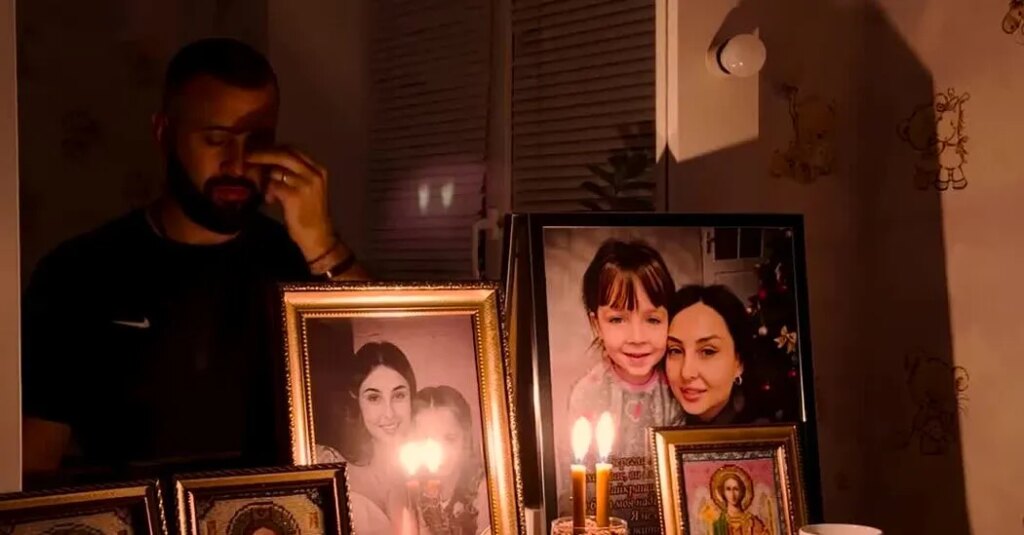
Just like that, Veronika was 13 again. She pulled a stuffed sheep she had bought in the mountains from her pink backpack and shoved it into Uliana’s hands. She showed off the new pink shorts and Nike sneakers her dad had bought her in Kyiv and held out her new iPhone. Her friends looked at her things with a hint of envy. No one talked about why she had been gone. At home, Yevhen retreated to the room where he had arranged a shrine to his wife and younger daughter. He lit candles, touched their photos and bowed his head in prayer. In the room next door, Veronika and Uliana were now planning a sleepover. They squealed and giggled and ignored the Russian drones packed with explosives that buzzed just outside their window.
The next day, Yevhen stood in the cemetery, tidying Milana and Nataliia’s graves.
So many toys were piled up from visitors paying their respects that some had started to fall to the ground. “Daughter, Daddy loves you,” he whispered. “He doesn’t forget about you.” An explosion shook the city. “They probably hit the checkpoint behind us,” Yevhen said, barely looking up. He touched the signs above the graves with his wife’s and daughter’s names and then, crying, kissed them. He thought again about his new mission.
“Let the world see what Russia did to my family,” he said as he walked to the car. “I want to tell Europe and the United States that our kids also want to live.” He looked back at his wife’s and daughter’s graves. “They also wanted to live.”
On Sept. 21, Yevhen and Veronika drove west again, back to Kyiv.
They boarded a morning train to Budapest, where they spent one night before they caught a flight to Stockholm. Mr. Fedorov had arranged the trip, and a Ukrainian businessman, Oleh Horokhovskyi, paid for it.
The Swedish defense minister had agreed to meet them. They were going to describe to him what happened to their family. They knew that sharing their story would not change its ending. They wanted to tell it anyway.
Nataliia Novosolova contributed reporting from Kyiv.
The post A Father’s Mission Is to Show the World ‘What Russia Did to My Family’ appeared first on New York Times.