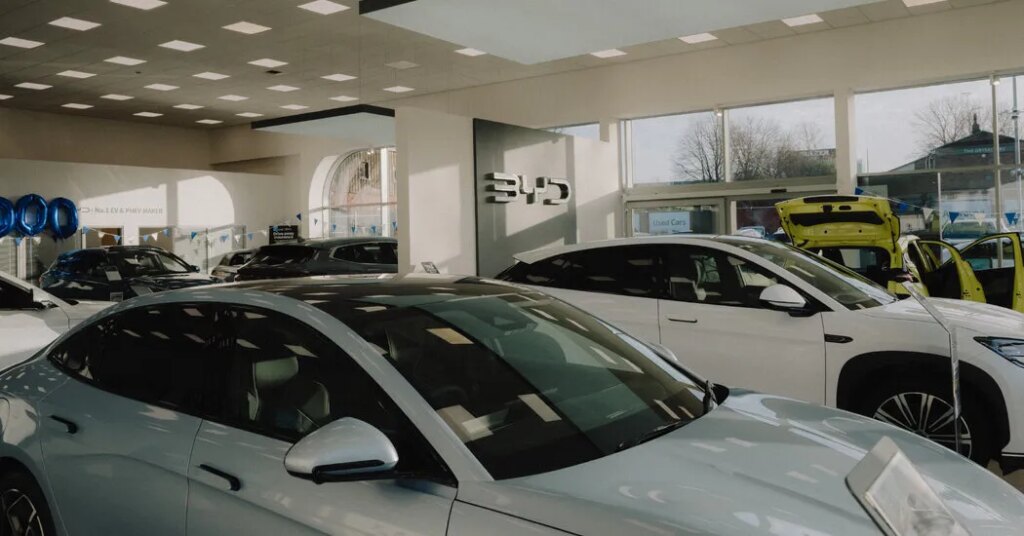
BYD, China’s dominant maker of electric vehicles, aims to open so many outlets in Germany that no one has to travel more than 20 minutes to buy one of its cars. One of its Chinese rivals, Xiaomi, sees Germany as the foundation of its European expansion plans, after selling 700,000 cars back home.
Germany is the birthplace of the automobile and the home of Volkswagen, BMW and Mercedes-Benz. These days, it is also a top destination for Chinese companies selling cars at a considerable discount to European vehicles.
“Customers don’t care if it’s a Chinese car or a German car,” said Ferdinand Dudenhöffer, a German auto analyst and former executive at Porsche and other companies. What they do care about, he said, is the price.
Shut out of the United States by tariffs, Chinese automakers have focused on other overseas markets — and Europe is a prime target. Low-cost Chinese car brands are enticing customers across the continent as surging gasoline prices drive interest in electric vehicles. Chinese cars account for about one in every 10 cars sold in Europe, up from one in 100 five years ago.
Chinese brands are rapidly gaining ground on leaders like Volkswagen. BYD’s sales in Europe have more than doubled this year. Sales of another popular Chinese manufacturer, Chery, have grown even faster. The company’s Jaecoo 7, known as the “Temu Range Rover” in a nod to the Chinese bargain-shopping app, was Britain’s best-selling vehicle in September. Xiaomi plans to add to the competition after teaming up with eight dealers in Germany.
It’s a love-hate relationship, however. Consumers increasingly want to buy Chinese cars. Policymakers are trying to stem the flow. The European Union reached a deal with Beijing on Friday that European officials said could halve the number of hybrid gasoline-electric cars that China sends to the bloc in the next four years.
The agreement could help ease the pain for European carmakers, though much about implementation remains unclear. Cheaper imports from China are threatening the industry, which contributes about 7 percent of the E.U.’s economic output. The E.U. industry chief, Stéphane Séjourné, has warned that the sector is in “mortal danger.” Germany’s auto industry group has predicted the loss of up to 225,000 jobs by 2035.
The E.U. has faced growing pressure to impose tougher measures to shield industries from what companies see as unfair competition. Left unchecked, Chinese carmakers could triple their share of the European auto market to as much as 30 percent by 2035, said Harald Hendrikse, a managing director at Citi Research.
In taking on China, Europe faces a conundrum: How can the region protect its industries while keeping prices affordable? Efforts to insulate the sector would come with a cost.
“There’s no free lunch in protectionism,” said David Bailey, a professor and industrial policy expert at University of Birmingham. “European and British automakers may gain some breathing room, but consumers could face higher prices and less choice, especially at the lower end of the market.”
For example, one proposal being considered would steer public spending toward European companies, prioritizing battery cells made in the region. But such a rule could raise the price of an electric car by 2,100 euros, or more than $2,300, according to researchers at Bruegel, a think tank in Brussels.
“Who will potentially lose from all of this?” asked Simone Tagliapietra, a deputy director at Bruegel. “I would say the middle class. They need to buy cars, right? And pushing up the cost with such provisions might be costly and even prevent them from accessing technology that, given the current energy crisis, is existentially important for Europeans.”
In 2024, the European Union imposed tariffs as high as 45 percent on Chinese electric cars to try to counter Beijing’s subsidies. But the bloc spared hybrid vehicles, which were then still a small segment of the market. Chinese manufacturers pivoted, boosting exports of hybrids, which are subject to only a 10 percent tariff.
Chinese hybrids have since poured into Europe, accounting for more than a fifth of the category’s total sales and pushing policymakers to consider wider trade restrictions. In Poland, Hungary and Romania, Chinese companies have gained more than half of the plug-in hybrid market, according to Dataforce, which tracks the auto sector.
History shows restricting supplies of those Chinese cars would probably increase prices, which over time could benefit the country’s manufacturers in Europe. In 2013, China agreed to reduce the number of solar panels that it shipped to Europe. In turn, Chinese manufacturers raised prices, pulling in larger profits that they could invest in research and new factories.
Today China dominates the world’s solar industry.
Chinese companies have their eye on the long term, seeing this period as a “bridge” toward making cars on European soil, said Matthias Schmidt, an industry analyst in Germany. He pointed to Leapmotor’s production partnership with Stellantis and BYD’s plan to produce cars in Hungary.
Chinese companies still see significant opportunity in Europe, even if new trade measures slow their advance. Spain is among the countries where they have seen strong demand and taken advantage of an increasing appetite for electric and hybrid vehicles. Electric cars have caught up with gas-powered vehicles, and electrics and hybrids together make up more than two thirds of the European market.
At the end of last year, Spain had about 600 dealerships selling Chinese brands. By the end of 2026, that number will likely grow to 1,000, according to Faconauto, a dealership association in Madrid. The market share of Chinese brands in Spain has risen fivefold in three years to about 15 percent, led by BYD and MG, the iconic British automaker now owned by a Chinese state-run company.
“For the Spanish people, this is very good,” said Marta Blázquez, Faconauto’s president.
Chinese brands have retained a significant edge on price compared with their European peers, though the gap has narrowed from a discount of as much as 30 percent in recent years, she said. The Center for European Policy Analysis in February estimated that the average starting price for a BYD electric vehicle in Europe ranged from €30,000 to €45,000, compared with prices closer to €50,000 for European E.V.s.
In Germany, even though Chinese car brands remain smaller players, they’re growing quickly. BYD said it planned to expand to as many as 300 dealerships by the end of the year. After more than doubling in 2025, sales of Chinese cars in Germany have continued to surge this year, according to Inovev, a consulting firm in Paris.
Stefan Bratzel, director of the Center of Automotive Management in Germany, invoked Frank Sinatra in explaining the importance of the country for Chinese car companies. The way they see it, “if you can make it there, you can make it anywhere.”
The post Europeans Have a Love-Hate Relationship With Chinese Cars appeared first on New York Times.