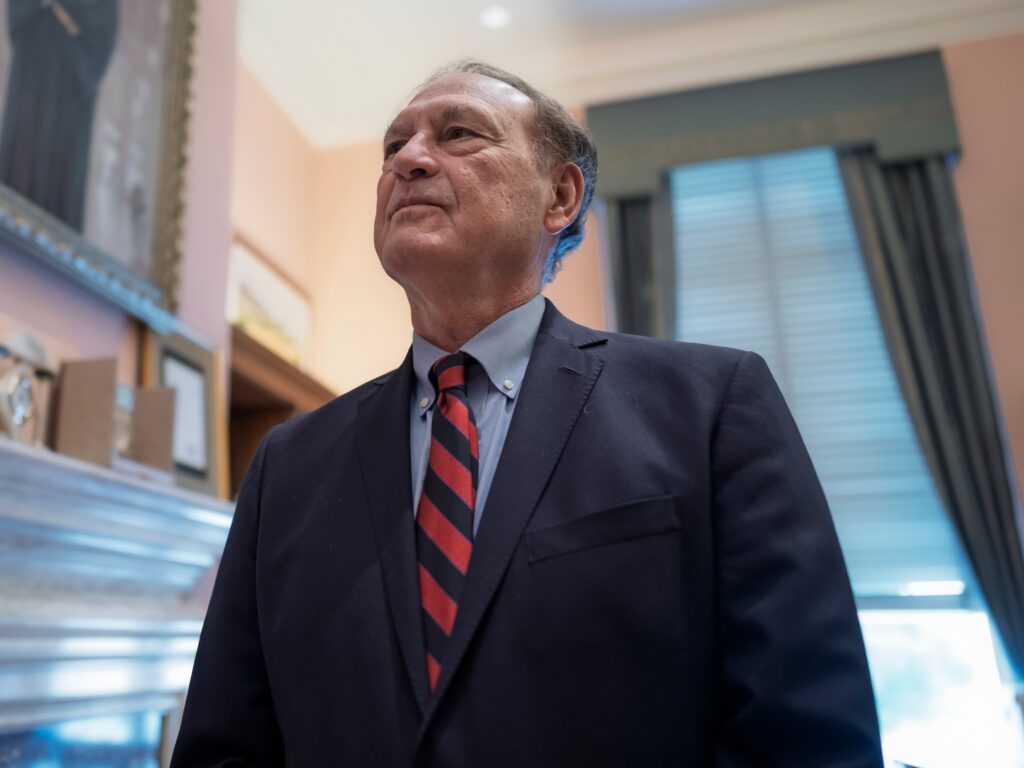
One chapter of Justice Samuel A. Alito Jr.’s new collection of speeches, “So Ordered,” complains that Supreme Court watchers often blur the line between their policy preferences and the Constitution’s meaning. “The Constitution does not always mean what we would like it to mean,” the justice writes. “That is exactly what is meant by the rule of law, though the popular media often obscure that fundamental point.”
That statement, adapted from a 2010 speech, is a strong one. Alito isn’t just saying that judges should sometimes arrive at results they don’t like; he’s saying that this separation between judging and politics is the essence of the rule of law. It’s a classic expression of “originalism” — the theory that the Constitution should be interpreted according to its meaning at the time it was adopted.
But in another chapter, adapted from a 2025 speech, Alito aggressively questions the separation he had earlier championed. He says something that just-the-law originalists don’t like to admit: Real-world originalism “was spurred by opposition to the results produced by certain judicial decisions.” Alito doesn’t mention Roe v. Wade — the 1973 ruling that found a right to abortion not contemplated by the Constitution’s framers — but that is the prime example.
In other words: Though originalists often claim to be agnostic about political results of decisions, and take pride in doing so, that has never been the whole story. Originalism gained widespread purchase on the political right in the late 20th century in part because of its potential usefulness for reversing liberal policies. “I sometimes think,” Alito continues, “that young originalists believe that the theory grew out of a seminar attended by philosophers who took no notice of current events. That is a false picture.”
With that candid appeal to originalism’s political origins, Alito suggests that modern originalists should also have a bias toward legal outcomes they favor. They should be willing to discuss “the value of the results that their decisions produce.” This sensitivity to results, he says, is essential to preserving originalism’s legitimacy: “Unless originalism is widely viewed as generally producing good results, it is hard to see how it will be able to survive as anything other than a minor academic curiosity.”
Viewed as producing good results by whom? Alito is careful with his words, but because most conservatives are originalists and most originalists are conservative, the implications are not hard to flesh out. Strictly originalist constitutional interpretation, which rejects the judicial creation of new rights, was a good fit with conservative politics for a generation. Now that Roe has been overturned (in a 2022 decision authored by Alito himself) and the political parties are confronting new issues, the connection is not as clear to ordinary conservatives as it was before. Sometimes originalism can get in the way of the right’s ambitions. And if originalism is abandoned by conservatives, it will have few champions remaining.
Alito is determined to keep the marriage together. But that requires a more political approach to judging. Take executive power. Alito’s speeches — specifically, his speeches before President Donald Trump’s second term — identify the sidelining of Congress by an imperial executive branch as a principal threat to the Constitution. The chapter entitled “Cracks in the Constitution,” adapting a 2017 speech, says most law today “is made in a way never mentioned in the Constitution. It is promulgated by unelected officials of the executive branch in the form of federal regulations.”
As an example, Alito cited climate regulations imposed by the Obama administration’s Environmental Protection Agency without clear congressional authorization. Alito — again tracking traditional originalist thought — takes care to frame his constitutional doubts about these regulations as unrelated to his policy preferences. “Whatever one thinks about climate change and the regulation of greenhouse gases, at least one thing is beyond dispute: Our national response to greenhouse gases is a matter of great importance. In a healthy republic, this issue would be publicly debated. The voters would make their views known, and the basic policy choices would be made by the people’s elected representatives. But that is not what has happened.”
That is sound as far as it goes. The Constitution’s framers envisioned Congress as the prime mover of public policy, but increasingly the executive branch has taken that role and run into Supreme Court resistance. In the context of coronavirus restrictions, Alito’s book decries the notion that “whenever there is an emergency, executive officials have unlimited, unreviewable discretion.”
But how has Justice Alito responded to the second Trump administration’s assertions of executive authority on matters “of great importance”? Not with the same concern for protecting legislative prerogatives that some of his earlier speeches and decisions imply.
When the Trump administration claimed authority to impose tariffs at any level on any import from any country so long as the administration claimed an emergency that it said was unreviewable by courts, the Supreme Court rebuked the president with a 6-3 vote in February. But Alito joined the dissent. When the administration tried to change the category of immigrants whose children were entitled to citizenship without new legislation on the subject, the Supreme Court rebuked it with a 6-3 vote in June. Alito dissented in an opinion that blasted lax immigration enforcement.
When the U.S. Postal Service tried to regulate mail-in voting in new ways after Trump couldn’t convince Congress to change election law, the court rebuked the administration in an unsigned opinion last month. Alito dissented (he and Justice Clarence Thomas are the only two members of the court to disagree with the result in all three of these cases involving the Trump administration). Alito’s dissent on mail-in voting never brings up the concern he evinced in his book about “unelected officials of the executive branch” making consequential policy changes, as opposed to Congress.
The justice’s apparently asymmetric concern about executive overreach isn’t necessarily indefensible. After all, Alito said in his 2025 speech that judges should consider the results of their decisions and “check their work” if the results would be senseless. As a political conservative, Alito is surely more likely to think that left-wing uses of executive power are senseless than right-wing uses of executive power. (Through the Supreme Court’s Public Information Office, Alito declined my request for an interview.)
It’s hardly radical for a judge to let politics influence his decisions about the proper separation of powers between the branches. The Supreme Court’s liberal justices rule as predictably against the Trump administration’s controversial executive actions as they did in favor of the Obama and Biden administrations’ actions (which often had a more technocratic flavor). But liberal jurisprudence has never claimed as strict a separation between law and politics as originalism typically has.
Despite its fairly reliable conservative and liberal blocs, the Supreme Court still has a political middle — currently made up of Republican appointees — that keeps the court’s decisions from consistently favoring one party or the other. Strong conservatives sometimes criticize the court’s political middle, and especially Chief Justice John G. Roberts Jr., for hedging to avoid a political backlash. One Alito speech from 2024 took aim at this tendency, declaring that judicial decision-making “for the purpose of winning popular approval is doomed to fail, because if the public detects what we’re doing — and eventually it will — we will lose the very respect we are seeking.”
Yet Alito’s project doesn’t seem entirely different. He is also mindful of the policy consequences of his decisions. He’s simply worried about a different audience. If Roberts is allegedly looking for ways to avoid infuriating the country’s political middle to preserve the legitimacy of the court, Alito is looking for ways to avoid infuriating the country’s political right to preserve the legitimacy of originalism. There’s room for both tendencies on a powerful court in a polarized democracy trying to protect its political flanks.
But Alito’s insistence at one point in the book that judges “cannot compromise principle or rationalize any departure from what they are obligated to do” rings increasingly hollow. Judicial realpolitik is part of the American tradition, and Alito is a prime conservative practitioner. If anything, the separation between politics and judging is likely to collapse further in the coming years.
The post What is Alito trying to say about originalism and the Supreme Court? appeared first on Washington Post.