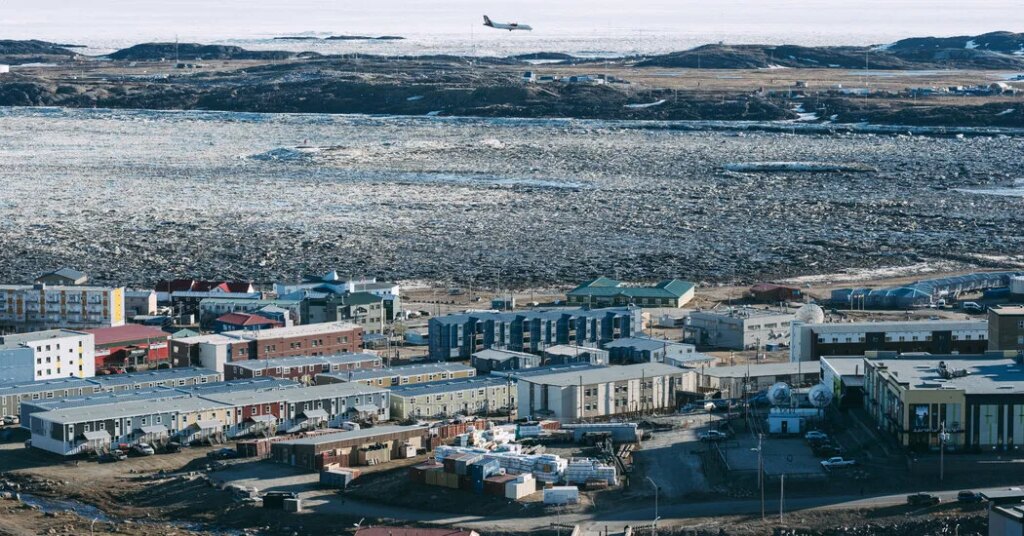
Louise Flaherty grew up in a treeless Arctic hamlet so far north in Canada that seasons were marked not by falling leaves or budding flowers, but by the polar night in winter and the midnight sun in summer. Yet reading government-supplied textbooks as a child, she imagined her world quite differently.
“I remember drawing pictures at home of myself as a blond kid, with blue eyes, next to an apple tree,” said Ms. Flaherty, an Inuit woman who is now 57. “My culture wasn’t visible, our language was not visible, in the literature that we were reading in school.’’
Ms. Flaherty changed that. Twenty years ago, she helped establish Inhabit Media, a publishing house in Iqaluit, the only city in the Canadian Arctic. Inhabit’s catalog now includes a generation’s worth of stories written by Inuit authors in English and the Inuit language — a revolution for a people with a rich oral tradition but not a written one.
Inhabit’s birth and eventual expansion into film and television reflects the head-spinning cultural change experienced over three generations by the Inuit, the Indigenous inhabitants of Canada’s Arctic. Ms. Flaherty’s grandparents led nomadic lives; members of her parents’ generation, born nomads, were forced into settlements and residential schools by the Canadian government. Ms. Flaherty’s generation began dealing with the outside world on the Inuit’s own terms.
“In the blink of an eye, we went from stone age to space age,” Ms. Flaherty said at Inhabit’s office in Iqaluit. “We had to adapt so fast.’’
Perhaps nowhere is that attempt to adapt more intense and complicated than in Iqaluit, which was selected in 1999 as the capital of the newly created Inuit territory of Nunavut. Inuit from hamlets across Canada’s Arctic have since gravitated to Iqaluit, fueling the revival of their traditions and also the emergence of young writers and artists.
At the same time, Iqaluit’s urban-like lifestyle — daily traffic jams, an expanding supermarket, a growing presence of non-Inuit from southern Canada among its 8,300 residents, even an incipient bus system — has pulled Inuit away from their traditional connection to the land. Many arrive in Iqaluit with different dialects and end up speaking English instead.
The diminishing use of the Inuit language and of traditional knowledge has raised profound questions about Inuit identity.
“How Inuk am I?” said Saima Romito-Kalluk, 22, who grew up in Iqaluit and Toronto and does not speak the Inuit language. “You feel embarrassed not to know it.”
A painter and filmmaker, Ms. Romito-Kalluk explored that question in a short animated film, “Isunngannguaq,” about a young girl who transforms into an Arctic seabird and is torn between her two identities.
“It’s based on a song my great-grandfather wrote, which I learned while making the film,” she said, noting that the connection felt especially strong because she was his namesake, following an Inuit tradition of naming children after relatives.
Cassidy-Ann Netser explores her identity through printmaking and embroidery about home life. She moved from a small Inuit community to Iqaluit in primary school and began speaking mostly English. She left for university in Nova Scotia in 2018 but returned to Iqaluit three years later to focus on her art — and to reflect on her place in the world.
Shortly after, she made a print of a man in a kayak holding a paddle — out of the water — after her first kayak trip.
“That was me trying to figure out both my place in the Western world but also in my culture and my hometown,” she said of the piece, which she titled “Connected.”
This search for identity is, in large part, the legacy of Canadian government policy. For decades, Inuit children were separated from their families and sent to distant residential schools, where they were discouraged from speaking their language and pressured to assimilate culturally. Government officials slaughtered Inuit sled dogs in many communities, reinforcing efforts to force Inuit into permanent settlements.
By the 1970s, most Inuit lived in hamlets with schools. But schoolbooks offered little reflecting their culture or language. Communities began demanding change.
“I remember growing up reading school board newsletters that were handwritten in English and Inuktitut,” said Rebecca Hainnu, 50, the deputy minister of education for the government of Nunavut.
In the 1980s, parents in her hometown, a hamlet called Clyde River, were unhappy that the Inuit language was not taught in schools.
“The entire community came into the school, picked up all the school students, and took them out in protest,” Ms. Hainnu said. Officials relented by creating a weekly 30-minute religion class taught in the local Inuit language.
By the early 2000s in Iqaluit, as teachers rose in the school system, one of the first Inuit principals began incorporating traditions, like having students watch the butchering of a seal in the school gymnasium. Instead of shame, Inuit began feeling pride in their customs and language, said Vinnie Karetak, a well-known writer, filmmaker and actor who moved to Iqaluit in 2002 in his 20s.
“That carried over to other stuff, like theater, television and film,” said Mr. Karetak, who stars in “North of North,” a television comedy series that is filmed in Iqaluit and features actors from the city. The series — financed by Netflix and the Canadian Broadcasting Corporation, in partnership with the Aboriginal Peoples Television Network — focuses on a modern Inuit woman trying to rebuild her life after a failed marriage while navigating traditions and language. It returned for its second season this fall.
The revival of traditions also shaped publishing. Inhabit Media’s original goal was to preserve Inuit oral tradition in written form.
“Every time an elder passes away, that’s a whole library or a whole encyclopedia that just disappeared,” Ms. Flaherty said. “So trying to capture their stories was very important.”
Writers at Inhabit moved beyond preservation to creating new stories and reinventing old ones. Jamesie Fournier grew up on traditional Inuit stories told by his mother, who was born in an igloo, sent to residential school and later worked as an interpreter. Mr. Fournier, 42, was especially drawn to macabre tales, which he has since reinterpreted in several books of horror.
“They’re stories from our culture, which we need to be able to retell,” Mr. Fournier said. “When I work with kids, I tell them that those stories are now yours. You can do whatever you want with them.”
Mr. Fournier recently helped lead a writing workshop in Iqaluit for young Inuit from hamlets across the region. Randy Angilirq, 20, came from Igloolik, about 200 miles above the Arctic Circle. He began writing in his early teens, blending Inuit myths with stories inspired by his favorite TV show, Disney’s “Gravity Falls.” He now wants to write a modern retelling of an Inuit legend about a raven, though he knows some elders in his hamlet believe such stories should remain unchanged.
“I’m kind of nervous to try to publish a story like that because of what the elders might say,’’ Mr. Angilirq said.
That concern is less pronounced in Iqaluit, which has become a crucible for the revival and reinvention of Inuit traditions.
A 2010 documentary about facial tattooing among Inuit women — a practice that was once banned by Christian missionaries — helped sparked its revival across Inuit communities. The filmmaker behind it, Alethea Arnaquq-Baril, helped create “North of North.”
“What I really love about series or films nowadays is that they show Inuit in a modern setting — who we are — that doesn’t freeze us in a time space of the past,’’ said Ippiksaut Friesen, who starred in the 2024 season of the HBO crime series “True Detective” and also works in animation, illustration and traditional tattooing.
Only after moving to Iqaluit could Erica Jacque, 24, begin searching for her Inuit identity.
Ms. Jacque learned tattooing and other Inuit traditions after moving four years ago from her hometown, Postville, a community of a couple hundred people in the Inuit region of Newfoundland and Labrador.
“People trust you a lot to just do your own thing when it comes to art here,” Ms. Jacque said in her home studio overlooking downtown Iqaluit. “It’s really good here for art.”
The post What Does It Mean to Be Inuit Now? appeared first on New York Times.