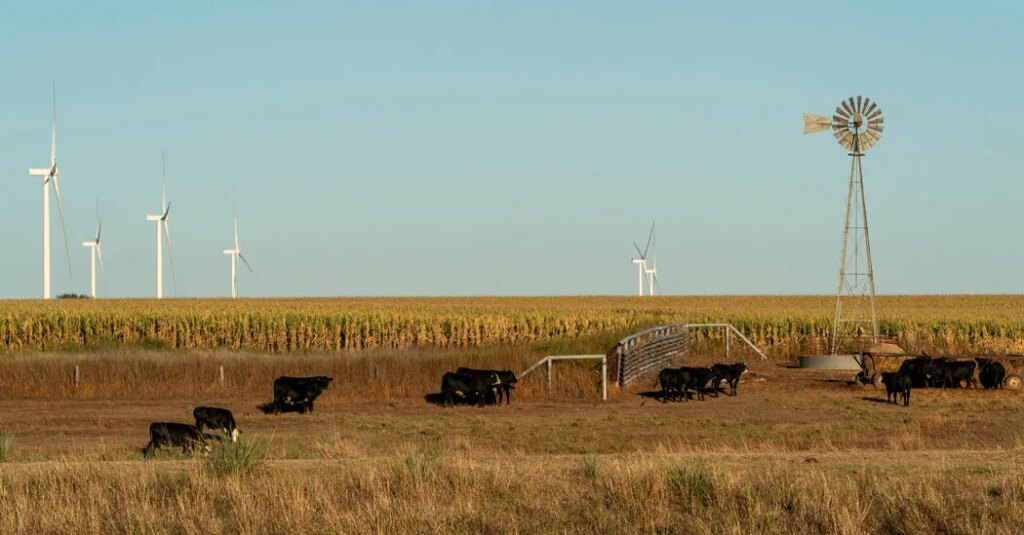
Across the Great Plains, a region that Republicans have dominated for a generation, Democratic and independent candidates are polling well and expanding the electoral battlefield.
States that seldom swing could determine control of Congress. Governorships are up for grabs. Commercial breaks during college football games have become montages of attack ads.
The close races have turned the region’s challenges, like soaring diesel costs and the struggling cattle industry, into top-tier national issues. Democrats, who have long struggled to connect with rural voters, are now focused on turning angst over President Trump’s policies into support for their candidates. And Republicans are pouring advertising money into Kansas and sending Mr. Trump to stump in Oklahoma and Nebraska, proof that voters have real races on their ballots.
“They’re in trouble,” said Judy Vohland, a former Democratic Party chair in the conservative Central Nebraska county where Mr. Trump spoke last week. Otherwise, she asked, “Why the hell would you come out to Grand Island, Nebraska?”
Whether Republicans’ new vulnerability translates into losses is highly uncertain. The party has decades’ worth of voter good will and political infrastructure in the region, and Democrats have a tarnished brand and limited resources.
Still, Democrats and independents see an opening.
When Lynne Walz, Nebraska’s Democratic nominee for governor, held an event last week in a county that Mr. Trump carried by nearly 50 percentage points in 2024, there were more attendees than chairs to seat them. She was introduced by a former Republican state senator from the area who said he could not recall ever voting for a Democrat, but that he planned to cast his ballot for Ms. Walz rather than Gov. Jim Pillen, the Republican incumbent.
“There’s a lot of Republicans out here taking a look,” said the former senator, John Stinner, who described Ms. Walz as someone who worked across party lines in the Legislature.
Competitive campaigns for governor and Senate have positioned Kansas and Nebraska as bona fide battlegrounds, while Texas and Plains-adjacent Iowa also have several close races. So unsettled is the landscape that even some contests in dark-red Oklahoma and South Dakota have entered the periphery of flippability.
National Democrats recently added the Oklahoma City-area seat held by Representative Stephanie Bice to their target list, and the party is even eyeing the governorship. In South Dakota, the independent candidate Brian Bengs has released polls showing him within striking distance of Senator Mike Rounds, the Republican incumbent.
The weaker party in Washington often has a strong midterm election, and Democrats made some inroads on the Plains at the midpoint of Mr. Trump’s first term. But the breadth of this year’s battleground is energizing the Democratic base, and revealing erosion in parts of Mr. Trump’s coalition that once appeared unshakable.
Ryan Horn, a Republican strategist from Nebraska, described a “double- or triple-whammy” of steel tariffs, energy prices and fertilizer costs that had hurt farmers, testing the strength of the Republican base on the Plains more than in other regions.
“Farmers and ranchers who have been very reliably Republican, I think there’s a number of them that are thinking, ‘I want to use my vote to try to get some change,’” Mr. Horn said.
In Dodge City, Kan., a deeply Republican area with a large meatpacking industry, Jaquan Graves said he voted for Mr. Trump in 2024 thinking that he would boost the economy. Mr. Graves said he had repeatedly been disappointed by the president.
When Immigration and Customs Enforcement officers descended on his small city last month, alarming even some of the president’s most loyal allies in agriculture, Mr. Graves said he delivered meals to neighbors who were scared to venture outside.
“When ICE raided Southwest Kansas, right then and there, I knew that I had messed up,” said Mr. Graves, a political independent who ran unsuccessfully for City Commission last year. He said he would vote for Democrats this year for governor and Senate.
To flip votes in Republican territory, Democrats must overcome skepticism about their policies, especially on social issues. At Ms. Walz’s event outside Gering, in Nebraska’s Panhandle, Sylvia Coffey told the candidate that she wanted to “make sure that girls are in girls’ restrooms and lockers, and boys are in boys’ restrooms.”
In an interview, Ms. Coffey, a retired farmer and Republican who voted for Mr. Trump three times, said she also had concerns about the president’s rhetoric and low teacher pay. Although she still planned to vote for the Republican incumbent for Senate, she said she was leaning toward voting for Ms. Walz for governor.
“I think people are wanting changes,” she said.
Across the state in suburban Omaha, Michael Tiedeman, the chairman of the Sarpy County Republicans, said he was optimistic that Republicans would hold onto statewide offices, even as he acknowledged that some voters were frustrated during the second Trump administration.
“It takes time,” Mr. Tiedeman said. “Eighteen months is not enough time to enact an agenda and policy and start providing on campaign promises.”
Mr. Tiedeman’s county includes a portion of Nebraska’s politically mixed Second Congressional District, which Democrats are optimistic about flipping this year.
In Nebraska last week, Mr. Trump signed an executive order aimed at easing diesel costs, defended his decision to go to war in Iran and expressed confidence about the upcoming election.
“We’re going to beat them big,” Mr. Trump told the crowd in Grand Island, where he appeared alongside Mr. Pillen, the governor. “This is the most important midterm election.”
Recent history suggests that Mr. Trump’s confidence might be justified. Going straight north on the Plains from Oklahoma to North Dakota, Republicans hold all 10 U.S. Senate seats, four of five governorships and 13 of 14 U.S. House seats. (Two Kansans, Gov. Laura Kelly and Representative Sharice Davids, are the Democratic exceptions.)
Republicans also have an opportunity to expand their grip on the Plains this year, with Ms. Kelly barred by term limits from seeking re-election in Kansas. Recent nonpartisan polls have shown Kansas’ Republican nominee for governor, State Senator Ty Masterson, leading the Democratic candidate, State Senator Cindy Holscher, in a close race.
The Plains turned bright red only recently. For much of the 1990s, both of Nebraska’s senators were Democrats. In the 2000s, Oklahoma had a Democratic governor, and both of North Dakota’s senators were Democrats. The Democratic leader in the U.S. Senate, Tom Daschle, was from South Dakota.
But the nationalization of politics and Democrats’ positions on social, climate and agricultural issues torpedoed their competitiveness in statewide elections.
Republicans now routinely win 80 to 90 percent of the vote in some rural Plains counties, often offsetting Trump-era Democratic gains in suburbia.
“To a certain extent, and with good reason, Democrats were becoming perceived as more elitist,” said Mr. Daschle, the South Dakota Democrat who served as his party’s leader in the U.S. Senate before narrowly losing re-election in 2004.
Mr. Daschle said his party’s opportunity to start building back on the Plains this year was real but daunting.
“We’re not out of the woods when it comes to branding,” he said. “We have a big problem that way, and we have to redefine ourselves as Democrats.”
In many races this year, the choice of candidates reflects an awareness of that reality.
In Kansas, Adam Hamilton, a Methodist pastor hoping to become the state’s first Democrat in the Senate since the 1930s, has led or been even with Senator Roger Marshall in recent polls. In Nebraska and South Dakota, Democrats are not fielding a candidate for U.S. Senate, instead allowing independent candidates to challenge Republican incumbents.
And when Ms. Walz introduced herself to voters in Gering, she started by reminiscing about her childhood on a hog farm and talking about her Christian faith.
Asked in an interview about the Democratic brand and any issues where her views diverged from the party platform, Ms. Walz demurred.
“Honestly, I don’t pay attention to national party platforms,” Ms. Walz said. “I pay attention to what’s happening here in Nebraska. I really do. And I think that makes me not a party person.”
The post Republicans Held Onto the Great Plains for Years. Now They’re Nervous. appeared first on New York Times.