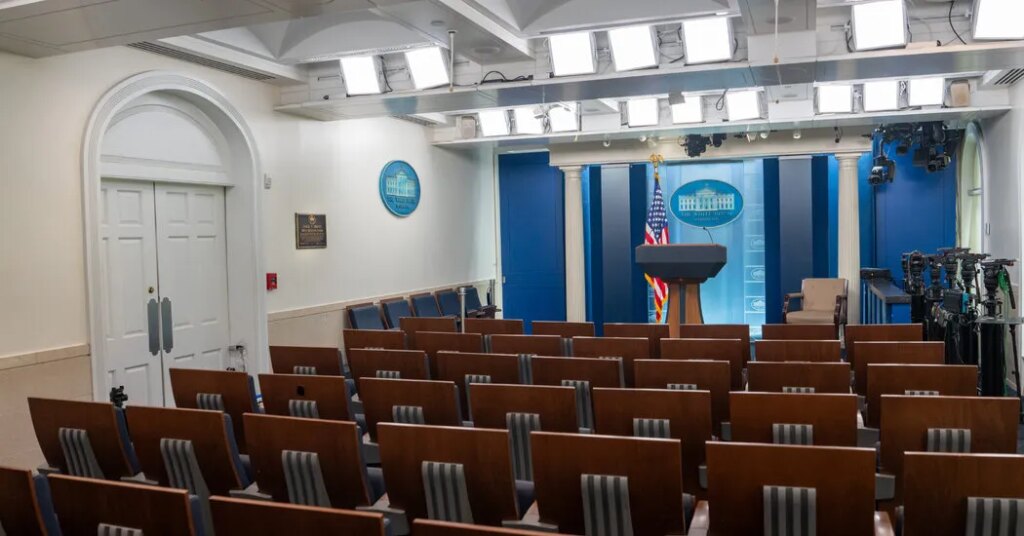
The Justice Department is investigating whether the major television networks — ABC, CBS, CNN, NBC and Fox News — violated federal antitrust laws when the group briefly suspended their pooled coverage of President Trump, according to six people with knowledge of the department’s action.
Officials from the Justice Department contacted networks on Friday and demanded communications and materials related to the White House TV pool, the people said. The pool is a longstanding system where the networks share the responsibility of providing footage of the president and distributing it to other news outlets.
Last month, the networks collectively suspended their pool footage of Mr. Trump for several days after the president barred CNN journalists from the White House grounds, which prevented CNN from participating in the pool. Video footage of some major events, including Mr. Trump’s greeting of President Xi Jinping of China, was not carried by any major news station.
In a statement on Saturday, a Justice Department spokeswoman, Emily Covington, described the five networks as having “proudly boycotted covering White House events.”
“Group boycotts among commercial competitors can violate the Sherman Act,” a core antitrust law, Ms. Covington wrote. “The Antitrust Division is simply investigating to determine whether these news organizations have violated the antitrust laws.”
The inquiry by the Justice Department is a profound escalation of the Trump administration’s ongoing battles with the White House press corps. It also follows a pattern of the Trump administration using the levers of government against its perceived foes in the media. The Justice Department has subpoenaed reporters from The New York Times and seized a laptop from a Washington Post journalist.
Officials at the Justice Department have discussed a potential investigation into the TV networks for at least a week, according to another person familiar with their deliberations. The investigation, which is still in its early stages, is being overseen by the department’s civil division, led by Stanley Woodward, the associate attorney general and a former White House lawyer.
In its letters on Friday, the Justice Department demanded copies of communications among network officials that concerned pool coverage of Mr. Trump, along with any communications about Mr. Trump’s revocation of CNN’s access to the White House grounds, according to two people with direct knowledge of the documents.
The White House did not respond to an inquiry on Saturday. Representatives for the five networks did not comment.
Organized boycotts can be considered anticompetitive if they are aimed at achieving commercial objectives, but not if their primary objective is political speech, said William E. Kovacic, a former chairman of the Federal Trade Commission.
“The critical ingredient in successful antitrust cases is to demonstrate that there is unmistakably a commercial motive and that the commercial motive predominates,” Mr. Kovacic said. “And I don’t think they would ever be able to do that here.”
The administration’s latest skirmish with the media began when Mr. Trump, lamenting what he described as “purposely negative stories,” barred CNN, Politico and MS NOW from the White House on Sept. 18.
The three news organizations sued, calling the president’s action a violation of their First Amendment rights. The administration argued that access to the White House was a “privilege.”
A federal judge temporarily blocked the ban and restored the outlets’ access. But while CNN’s journalists could once again enter the White House campus, Trump administration officials continued to block the network from acting as the TV pool when the president travels on Air Force One.
The other major networks ended the suspension and resumed their own pool duties on Sept. 25. But on the days when CNN has been blocked, the TV pool has gone dark.
The collective action by the quintet of TV networks has irritated Mr. Trump. Last month, when the networks declined to show footage of some of his events with Mr. Xi, the president complained on social media that some news channels “refused to cover one of the Biggest and Most Beautiful Events to take place in many years.”
The Trump administration has previously turned to antitrust law to crack down on collective action by companies and nonprofits during Mr. Trump’s second term.
Last year, the Federal Trade Commission investigated whether a dozen advertising and advocacy groups violated antitrust law when they coordinated boycotts by advertisers who were seeking to avoid hateful online content. The ad companies ultimately settled with the F.T.C.
Antitrust law is aimed at protecting consumers from the negative consequences of companies amassing too much power and colluding to curb competition in the marketplace.
Members of the press corps have argued that access to the White House and their ability to cover the president’s events is an issue of First Amendment rights.
The post Justice Dept. Is Investigating TV Networks Over Trump Pool Coverage appeared first on New York Times.