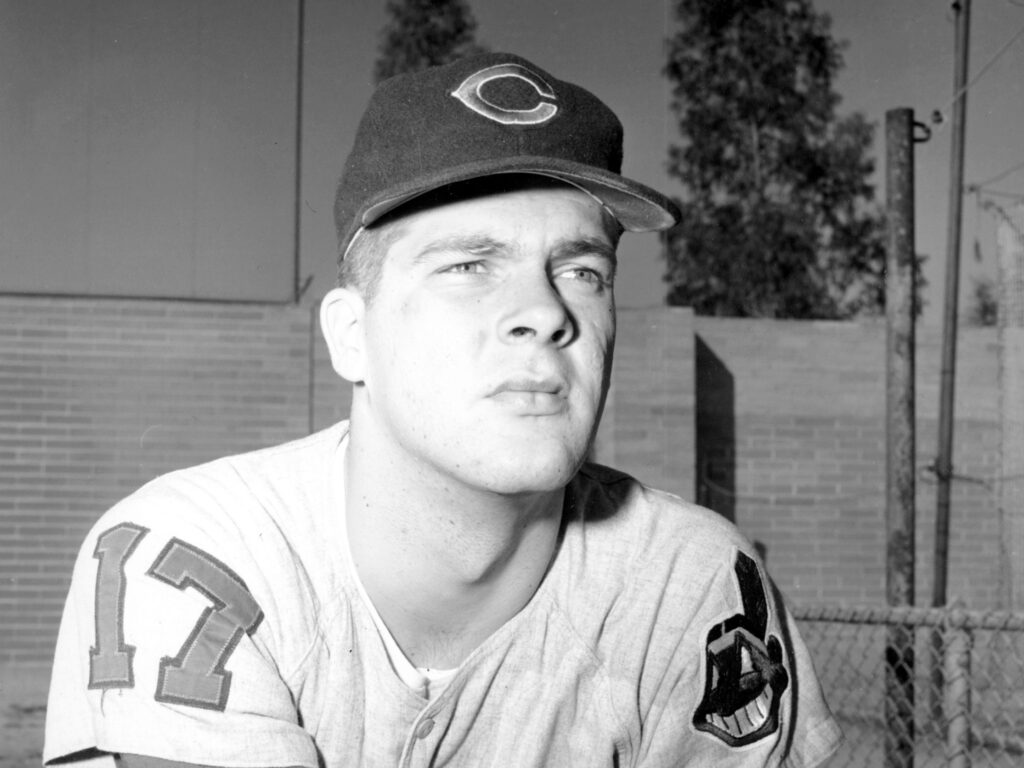
In the 1960s and early ’70s, Sam McDowell, a six-time all-star pitcher with the Cleveland Indians, was “the biggest, most hopeless and most violent drunk in baseball,” as he said years later. His legacy was one of self-destruction, an elite major leaguer who drank himself out of the game, squandering his potential for greatness.
Then he found redemption. Five years after leaving baseball in an alcoholic haze, he finally quit drinking in 1980. Eventually he returned to the sport as a certified sobriety counselor, aiding active and former players for three decades, and he was credited with saving lives. He even got a World Series ring, in 1993, when he was an addiction consultant to the champion Toronto Blue Jays.
“I vowed … to help athletes with all my heart and soul,” he wrote in a 2022 memoir. “I had experienced the pain of losing a great career, and I would be damned if I would allow another player to throw away his if I could do anything about it.”
Mr. McDowell, who died Oct. 5 at 84, earned the nickname “Sudden Sam” for how quickly his scorching fastballs zipped past hitters. With the Indians (now the Guardians), he led the American League in strikeouts five times in six years, notched a 20-win season and, in 1970, finished third in voting for a Cy Young Award, given to the league’s top pitcher.
His death, at home in The Villages, Florida, was confirmed by his son, Timothy McDowell. In addition to his son, survivors include his wife, the former Eva Simova; a daughter, Deborah Liebling; two siblings; two grandsons; and a great-granddaughter.
At 6-foot-5 and 190 pounds, Mr. McDowell had a fluid, deceptive left-handed delivery. Long after Mr. McDowell’s playing days, The Washington Post’s Shirley Povich wrote that Sudden Sam, when at his best, had been “in many ways a valid counterpart to the National League’s pride, Sandy Koufax,” arguably the greatest pitcher of his generation.
By his own account, though, Mr. McDowell devoted more effort to planning his drinking bouts and breaking curfew on the road than he did to honing his craft.
In most of his 11 seasons with Cleveland, his admitted philandering and booze-soaked carousing — which occasionally resulted in bar fights and arrests — angered team officials, who saw superior talent being wasted. Despite Mr. McDowell’s stellar strikeout totals, he could be as out of control on the field as he was off it: He led the majors in walks five times in seven years, and in three of those seasons, he also led the American League in wild pitches.
“My arm was that of a man among boys,” he wrote. “My head and heart were those of a boy among men. My immaturity was battling my talent. … And my talent was losing.”
A Notable Life
This article is part of A Notable Life, an obituary feature telling the stories of remarkable people every Saturday. Read more from the series here:
After her son came out, she helped propel South Carolina’s gay rights movement
Judy Markey, whose trailblazing radio show caught ‘lightning in a bottle,’ dies at 82
Mr. McDowell was traded to the San Francisco Giants in 1971, then had brief stints with the New York Yankees and Pittsburgh Pirates before being released for good in 1975. Struggling financially, a father of two with his first marriage in ruins, he spent the remainder of the decade binge drinking and posting new stats: By his reckoning, he was arrested seven times for public drunkenness or disorderly conduct from 1976 to 1980, the year he sobered up.
After a month in a rehab facility, and after working as a volunteer aide to a psychiatrist specializing in substance abuse, Mr. McDowell got an associate’s degree in sports psychology and addictions from the University of Pittsburgh. He later opened a counseling service for athletes and became a consultant to seven big league franchises.
In 1987, he joined the newly formed Baseball Assistance Team, set up by then-Commissioner Peter Ueberroth to help current and retired players facing financial or mental health crises. In his memoir, “The Saga of Sudden Sam,” written with Martin Gitlin, Mr. McDowell described the epiphany of self-awareness he experienced in recovery and the pleasure he took in guiding others out of the despair he’d once known.
Cases involving alcohol or drug abuse, emotional anguish or family strife “were turned over to me before my retirement” in 2016, he wrote, adding: “It was my job to find a solution. … I was responsible for talking players through nineteen live suicide threats and others in which the athletes were considered suicidal.”
He told the Miami Herald in 1983, “I’ve been lucky, because I believe very seriously in my heart that this had to be, that my calling in life is what I am right now.”
Mr. McDowell said that after the sitcom “Cheers” debuted in 1982, starring Ted Danson as bar owner Sam “Mayday” Malone, a skirt-chasing former big league pitcher and recovering alcoholic, he heard from a friend of his with inside knowledge that the show’s writers had loosely based the character on him. The supposed connection is a long-held popular belief, but the Athletic this week quoted a “Cheers” co-creator as saying that, while the writers admired Mr. McDowell, he was not their inspiration.
“I would say I’m better with women than he was,” Mr. McDowell once quipped to the Pittsburgh Tribune-Review.
Born Sept. 21, 1942, in Pittsburgh, Samuel Edward Thomas McDowell was a self-described “joyless boy,” one of six siblings in a household often beset by money problems. His father, who worked in a steel mill, drank heavily, he said, and his mother became an alcoholic in middle age.
“I simply plodded along as the black sheep of the family,” chronically lying and misbehaving and always craving attention, he recalled. As he later figured out, “The mixture was one part narcissism, one part depression, one part low self-esteem,” all of which festered as he got older, accelerating his descent into addiction.
As a teenager, he was a standout multisport athlete, but his parents barely acknowledged it. “Their philosophy was that praise weakened rather than strengthened offspring,” he said. Yet baseball scouts took notice. After graduating from high school in 1960 and fielding contract offers from more than a dozen big league teams, Mr. McDowell signed with Cleveland for a $75,000 bonus. Three years later, amid early performance struggles as a professional, his mental health woes deepened.
“I was gripped by a sense of hopelessness,” he wrote on the opening page of his memoir, describing the moments leading up to a suicide attempt in the offseason.
In 1964, his breakout season, Mr. McDowell finished with 11 wins, six losses and a solid 2.70 earned run average, and the following year he made his first all-star team. By 1971, though, General Manager Gabe Paul “had grown weary of and frustrated with my drunken escapades and bailing me out of jail.” Sudden Sam, then 29, was traded away, marking the beginning of the end of his days on the mound. Overall, in a career spanning a decade and a half, he compiled a won-loss record of 141-134 with a 3.17 ERA in 425 appearances.
“Baseball couldn’t take me anymore,” he once told the Post-Standard newspaper of Syracuse, New York, “I couldn’t take me anymore.”
Nor could his family in Pittsburgh. It was there, in April 1980, after he passed out drunk on his mother’s kitchen floor, that he resolved to confront his demons.
“The final crossroads had been reached,” he recalled. “Did I want to live or die? I wanted to live. But did I want to live desperately enough to act?” Within a few weeks, he was bound for the Gateway Rehabilitation Center and all the happiness ahead of him: a clear mind and sense of purpose, a new marriage and healthier relationships with his son and daughter, and a rewarding second act as a counselor, a resurrection that made him proud, he said.
“Life is a journey, and mine at one time was stormier than most,” Mr. McDowell wrote in 2022. “But now I sail in peaceful waters. It feels wonderful.”
Grieving a loved one? Tell us what made them special.
The Post is publishing reader-submitted obituaries as part of a weekly feature, What We Remember.
Last week’s installment included a pastry chef who motorcycled nude across Canada.
The post He called himself the ‘most violent drunk in baseball.’ Then he found redemption. appeared first on Washington Post.