Tanmay Koli, 20, rode a train for two days by himself to come to his nation’s capital. He found his way to a Sikh temple to sit for a while and eat. Then he headed out into the streets of New Delhi with two other young men, who, like him, had come by train from their own hometowns far away.
On Saturday, all three of them, strangers until just a few hours ago, sat together on a curb staring at barricades and a phalanx of security forces. They were nervous, they said, but they wanted to be here.
“They’re stealing votes,” Mr. Koli, said. He had come from Pune, a city to the south.
“Democracy is not safe,” said his new friend, a 28-year-old man who, fearing reprisal, gave only his first name, Om. He had traveled from Chandigarh, a city to the north.
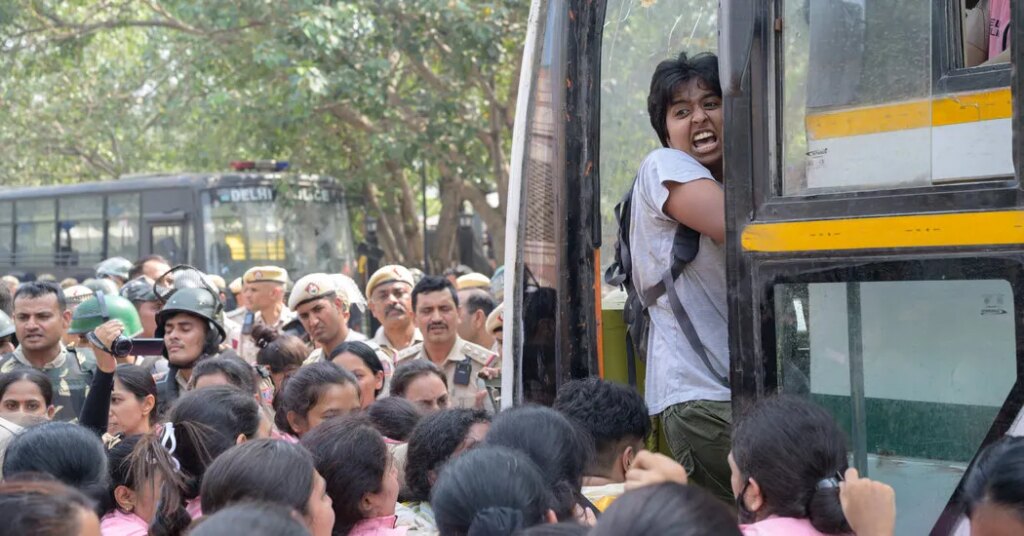
They were among the scores of young Indians who arrived in Delhi to protest the erasure of millions of people from voter rolls. To keep them away, the police canceled several trains, closed dozens of metro stations and filled the center of the capital with yellow barricades, buses and security forces bearing shields and batons.
In interviews and in social media posts, the would-be protesters, many of them supporters or leaders of the Gen Z-focused Cockroach Janta Party, expressed outrage and frustration at the heavy-handed measures to snuff out the demonstration before it began.
Abhijeet Dipke, the founder of the party, was intercepted by the police as soon as he landed in New Delhi on Saturday, he and the group said. On Instagram, he uploaded video of officers boarding the aircraft to detain him. So, too, were his two fellow Cockroach leaders, Saurav Das and Ashutosh Ranka, the party said in a statement.
“This is dictatorship,” Mr. Dipke is heard saying as an officer approached his seat.
Ratna Singh, who leads the Cockroach Janta Party’s legal team, said more than two dozen police officers surrounded her car, trapping her inside. In a video shared by the group, Ms. Singh says the police told her they wanted to take her to her house and hold her there. When she asked them for a warrant, the police said: “We have orders from above.”
“I am not getting out of the car, and they are not leaving this space,” she says in the video.
Nearly 300 would-be protesters were holed up on Saturday inside a Sikh temple about a mile and a half from Jantar Mantar, the site where the demonstration was supposed to be held. Most of them had arrived during the night, but the road to the site was barricaded by the police.
“I am here to protest against not just the corruption with our votes, but also the corruption in the education system,” said Lucky, 23, who would only identify himself by his first name for fear of reprisal. He had traveled 14 hours by train from his village in Bihar, a state to the east.
“I don’t think they will shoot us or kill us,” he said. “At most, they will take us to jail — and I am ready for that.”
Closer to Jantar Mantar, a group of women sat on the curb, waiting for other protesters to arrive.
“Look at the situation, how our country is treating us,” Nada Haseen, 22, said. “We are asking for our basic right — to vote, and for that we are fighting, in a very nonviolent form of protest, which is allowed in our constitution.”
“Aren’t we children of this nation?” she added.
The post Blocked by Police, India’s Youth Voice Their Fury appeared first on New York Times.