She lived her childhood in a slum without sewage or water, attended a school for only children of Indian descent, and knew that her skin color prohibited her from going to the beach her father would drive past during the Christmas season.
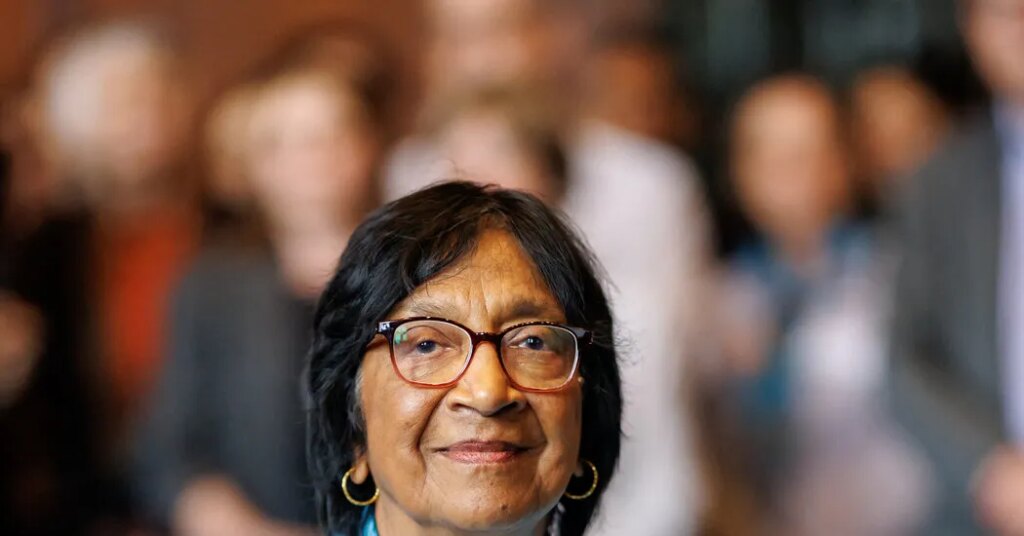
Navi Pillay, 85, was aware from a very young age growing up in apartheid South Africa what it meant to be stripped of her humanity, she explained in an interview with the Australian Broadcasting Corporation in 2019.
But she also described a pivotal moment that helped her rise from under the thumb of racism: Parents in her community in the coastal city of Durban pooled their money to send her to university, after her high school principal said she had potential.
That opportunity began a barrier-breaking career that led Ms. Pillay to becoming a lawyer, a judge on multiple international courts, the human rights chief of the United Nations and, on Friday, a Nobel Peace Prize laureate.
In announcing the prize, the Nobel committee said that Ms. Pillay had been “instrumental in ensuring that war crimes, crimes against humanity and genocide are prosecuted.” She becomes the fifth South African to win the award, joining the ranks of the country’s most vaunted figures including Nelson Mandela and Archbishop Desmond Tutu.
While much of Ms. Pillay’s global recognition comes from human rights work she has done abroad, her experiences in South Africa have indelibly shaped her life, and she has remained deeply invested in her home country’s sometimes-fragile democracy.
“I see this award as the voice of the majority of the world,” Ms. Pillay said in an interview with the South African state broadcaster on Friday. She added that a majority of South Africans “want the rule of law, they want the independent judiciary to be respected.”
Navenethem Naidoo, known as Navi, grew up in a community designated for Indians in southern Durban that was constantly under the threat of being declared a white area, which would have meant forced removal, said Saths Cooper, a friend and client of Ms. Pillay’s who is also of Indian heritage and grew up in Durban.
“We’d talk about the threats that were there but that our spirit is not going to be cowed by that kind of thing,” Mr. Cooper said, adding that they were determined to engage with communities far and wide to overcome the isolation that the apartheid government tried to impose.
Ms. Pillay’s father was a bus driver who wanted to ensure that she and her six siblings were not confined to menial labor, Mr. Cooper said. She was among the many young Indians in Durban who took up the struggle and embraced Black identity, in part countering the apartheid framing of people of color as “nonwhite.” Mr. Cooper said it was “a tool for mental liberation to identify as Black rather than a ‘non.’”
She studied law at what is now the University of KwaZulu-Natal. Because it was segregated, Black students had to attend classes at night, said Jessica Neuwirth, a human-rights lawyer and activist who has known Ms. Pillay for four decades. During the day, Ms. Pillay would go to the library, where she found books about the Nuremberg trials, helping inspire her fascination with international justice, Ms. Neuwirth said.
After earning her law degree in 1965, Ms. Pillay worked under a prominent anti-apartheid attorney of Indian descent, N.T. Naicker. She did much of his field work, like meeting with clients, because the apartheid regime had confined him to his home.
Ms. Pillay struggled to get hired by a law firm because of racial restrictions but eventually opened her own practice. She represented anti-apartheid activists and won critical rulings with creative approaches, Ms. Neuwirth said.
When the apartheid government locked up her husband, Gaby Pillay, who was also a lawyer, for political activities and cut off his access to the outside world, Ms. Pillay used his power of attorney to file an action on his behalf, Ms. Neuwirth said. She ended up winning an order prohibiting his torture.
In one case, she introduced the findings of the American psychiatrist Louis Jolyon West to argue that anti-apartheid activists who were tortured could not give credible confessions. The court sided with her argument, Ms. Neuwirth said.
Ms. Pillay was able to win due process rights for inmates on Robben Island, where high-profile anti-apartheid activists like Mr. Mandela were sent to solitary confinement.
She represented Mr. Cooper and several others after they were arrested for agitation during strikes in Durban in 1973. She allowed them to take an active role in shaping their defense rather than dictating their strategy, Mr. Cooper said. Consulting with the defendants and other activists who had faced similar charges, she crafted an effective, unified defense, Mr. Cooper said, and they were acquitted.
The apartheid government later put Mr. Cooper under house arrest. Though he was not a practicing Hindu, Ms. Pillay advised him to apply for an exception to go to temple, which was granted, Mr. Cooper said, and he got about three hours outside every Sunday.
Even as Ms. Pillay made strides as a lawyer, she faced constant indignities. In the Australian Broadcast Corporation interview, she described how, as an Indian lawyer, she had to use a separate entrance and sit at a different table from the white lawyers.
“I mean, what confidence can clients have in us when they could see that we were held in inferior position in the courtroom?” she said.
She recalled going to a magistrate’s office to speak with him, and when she entered he had his feet on the desk. “So you’re talking to the dirty soles of his shoes,” she said. “That’s what I mean about how humiliating it was.”
Ms. Pillay’s struggle to maneuver within a racist system applying unjust laws in some ways helped her develop the persistence she needed, she has said in interviews. She said in a podcast interview last year that she would keep filing legal motions even if they had little chance of succeeding because she believed that was the only weapon she had to fight the system.
“It was clear to me the only thing I can do is keep going, seeking justice,” she said.
She rose to international prominence shortly after apartheid ended in the 1990s, as a judge on the tribunal on the Rwanda genocide, which broke new ground in prosecuting the crime of genocide and treating mass rape as a form of genocide.
Ms. Pillay later served as a judge on the International Criminal Court, the U.N. High Commissioner for Human Rights, and a substitute judge of the International Court of Justice.
She has also remained engaged in matters at home.
Ms. Pillay chaired a commission that looked into the challenges of migration in South Africa and presented a report to the government. With the United Nations, she launched an L.G.B.T.Q. equality campaign in South Africa. She was part of a tribunal that probed corruption in South Africa and made damning findings against the country’s leaders.
In 2021, she gave a lecture on human rights at Stellenbosch University and offered a searing critique of what she saw as some of South Africa’s failures to stand for human rights.
The Nobel Prize could bring new scrutiny to Ms. Pillay in part because of the bold stance she has taken on the plight of Palestinians. She chaired a U.N. commission last year that concluded that Israel had committed genocide in Gaza. Her receipt of the Nobel drew a strong rebuke from Israel’s prime minister, Benjamin Netanyahu.
But given where she came from, Ms. Pillay is unlikely to be deterred by critics, Mr. Cooper said.
During apartheid, Ms. Pillay had “a complete understanding of the dangers,” he said. “But also the practical ways to overcome those dangers.”
Zimasa Matiwane contributed reporting from Johannesburg.
The post An International Career Forged by the Struggles of Apartheid appeared first on New York Times.