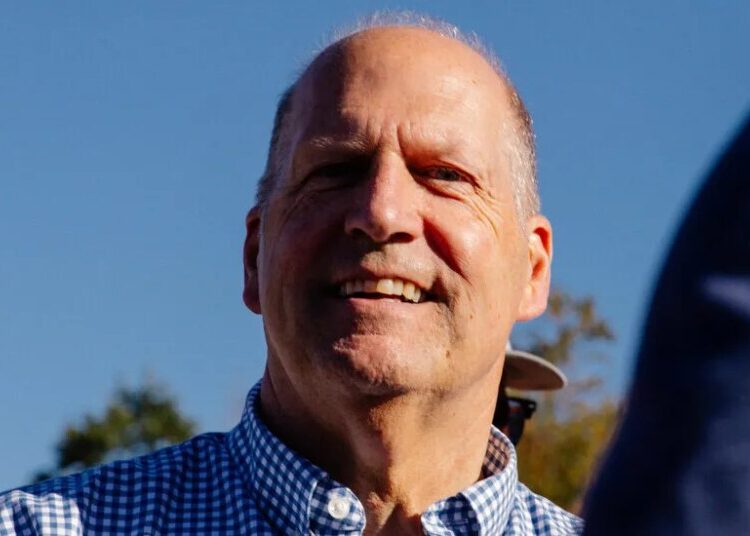
Before the conviction, Son Huynh said he was never one to miss an election.
Like most American children, Huynh, a California native, was taught about the right to vote in school. His parents had emigrated from Vietnam, and he spent some of his early years there before moving to Virginia when he was about 13. Voting was a major point of pride for him.
“I love this county, and I love to vote,” said Huynh, 29.
During a dark period in his early 20s, he struggled with substance abuse and bouts of homelessness, “constantly stealing stuff from people, stealing stuff from stores,” Huynh said.
He racked up charges and said he often preferred spending time in jail because he knew he would at least have access to food and a place to sleep.
“I didn’t know where my next meal was coming from,” he said. “I didn’t have a roof over my head.”
What Huynh wasn’t thinking about then, he said, was that a felony conviction in Virginia would strip him of the right to vote.
But that’s what happened, part of a controversial Virginia tradition dating to the years after the Civil War. Virginia’s constitution bars felons from voting unless their “civil rights have been restored by the Governor or other appropriate authority,” an uncommonly strict practice that critics have called a vestige of the Commonwealth’s Jim Crow era.
In September last year, Huynh pleaded guilty to grand larceny, a felony, for stealing a car in Arlington, according to court records.
When he committed that crime, “I didn’t even think for a second about losing my voting rights,” Huynh said.
But after his conviction, he realized what it cost him.
Now, just weeks away from Election Day, he stands to regain his access to the ballot.
A federal court ruling earlier this year upended the state’s long-standing approach, and Virginia officials have now changed the rules for a large number of Virginians in Huynh’s position, legal experts said.
In January, ruling in a lawsuit filed by the American Civil Liberties Union of Virginia and other groups, Senior U.S. District Judge John A. Gibney Jr. said Virginia had — for 150 years — been violating a federal law barring broad disenfranchisement of people with felony convictions.
That 1870 law had readmitted Virginia to the Union, and it said the state could not change its constitution to revoke a citizen’s right to vote “except as a punishment for such crimes as are now felonies at common law.”
Those common-law crimes, which are derived from custom and court precedent, rather than statute, were: arson, burglary, escape and rescue from a prison or jail, larceny, manslaughter, mayhem, murder, rape, robbery, sodomy, and suicide.
To comply with Gibney’s order to stop violating the 1870 law, Virginia officials initially created long lists of modern-day felonies they believed aligned with those common-law crimes and either automatically disqualified or could disqualify someone convicted of one of them from voting.
On the automatically disenfranchised list were crimes including carjacking and grand larceny, the crime for which Huynh was convicted.
But in August, Gibney said the state had not widely restored voting rights as he had ordered. “The Commonwealth inexplicably believes it can disenfranchise citizens for convictions of up to 284 statutory felonies,” he wrote. In fact, he continued, “the Commonwealth can only disenfranchise for ‘convictions of [eleven] common-law felonies.’”
Last month, Virginia officials took major steps to comply, saying they would only disenfranchise people convicted of three felonies: murder, voluntary manslaughter and involuntary manslaughter. Those people would still need to appeal to the governor for their rights to be restored.
For people such as Huynh who committed other felonies, the state now says they can simply register to vote. The deadline is Oct. 23, according to the Virginia Department of Elections.
Election officials sent mailers to newly qualified voters and updated registration materials to reflect the shift in the state’s approach.
Those officials say the people registering should answer “yes” on the part of the form asking whether they have been convicted of a felony. And they should note whether their rights have been restored, the department says.
Election officials will then cross-check that information with records from the Virginia Department of Corrections. Only felons who are out of prison or jail are eligible, officials said.
Top Virginia officials, including Gov. Abigail Spanberger (D) and Attorney General Jay Jones (D), have advocated for expanded ballot access. Before the latest policy change, Spanberger said her administration had restored voting rights to 100,000 Virginians with past felony convictions this year.
A constitutional amendment on the ballot this fall could further transform Virginia’s voting landscape by automatically restoring voting rights after a person is released from prison.
“Between this lawsuit and the constitutional amendment, we are taking big steps” to get to universal suffrage, said Vishal Agraharkar, deputy legal director for the ACLU of Virginia. “We think that these two efforts kind of complement each other and will help get there.”
Attorneys with the Campaign Legal Center have worked with the Virginia Department of Elections to help spread the word. The ACLU of Virginia sent letters to registrars across the state in recent days to try to ensure the rights of newly eligible voters are protected.
“This is a huge sea change in eligibility,” said Robyn Bitner, managing legal counsel for strategic litigation at the Campaign Legal Center. “We wanted people to know this is real. You do have the right to vote.”
Huynh is sober now and working in fast food. He learned he would be able to cast his ballot again from voting rights advocate Chris DeRosa.
The two first met while Huynh was in the Arlington County Detention Facility. DeRosa often visits the facility with fellow volunteers from the Arlington-Falls Church chapter of Spread the Vote, a program of the National Civic League. They also share information about voting rights at homeless shelters and residential treatment programs in Northern Virginia.
“Sometimes, when we ask, ‘Would you like to register to vote?,’ a lot of people will often say: ‘I can’t vote. I have a felony,’” said DeRosa, a retired special-education teacher who also volunteers with the League of Women Voters. “They’re very up-front about it.”
When she visited the jail, Huynh said he got her contact. After he was released, he reached out.
“I called her, and told her that I needed everything,” he said, referring to the documents he would need to start his life again.
DeRosa, 75, helped him acquire a new passport, social security card and ID, Huynh said, clearing the path for him to get a car and eventually start a new job. The two have stayed in touch about voting.
This year, the legal back-and-forth proved to be a challenge for advocates like DeRosa, who educated themselves on legal developments and tried to keep people up-to-date amid the uncertainty.
“It has been an exercise in pivoting from one set of information to another,” DeRosa said.
She said the latest move by the state, limiting to three the number of crimes that lead to disenfranchisement, has helped make their message clearer and boosted interest in registration among those she talks to.
The volunteers’ new refrain: “You can probably vote now.”
Until recently, those were not words Huynh expected to hear.
“I never thought I’d be able to get the chance to vote again,” he said.
Losing that right was painful, he said, along with the other struggles of being a former felon. Although he says he’s hungry for a better life, Huynh has not been able to secure a promotion at work, despite managers who are willing to give him a shot. “I can’t pass the background check,” Huynh said.
He is nearing the end of his time in a drug rehabilitation program, which he sought and is part of his probation.
While in jail, Huynh took classes on reentry planning and anger management, according to a letter he wrote to a judge.
“I realized, like, why [do] I got to live that life,” Huynh said in an interview. “I could just be out here working hard and saving money, so I can live a better life for myself and for my family.”
Getting his vote back “will bring a lot of joy for me,” he said.
Next week, Huynh will submit his registration form in person, he said. On Election Day, he’ll be at the polls.
The post After a felony, Virginia took away his vote. A court win is giving it back. appeared first on Washington Post.