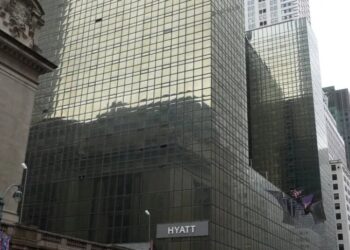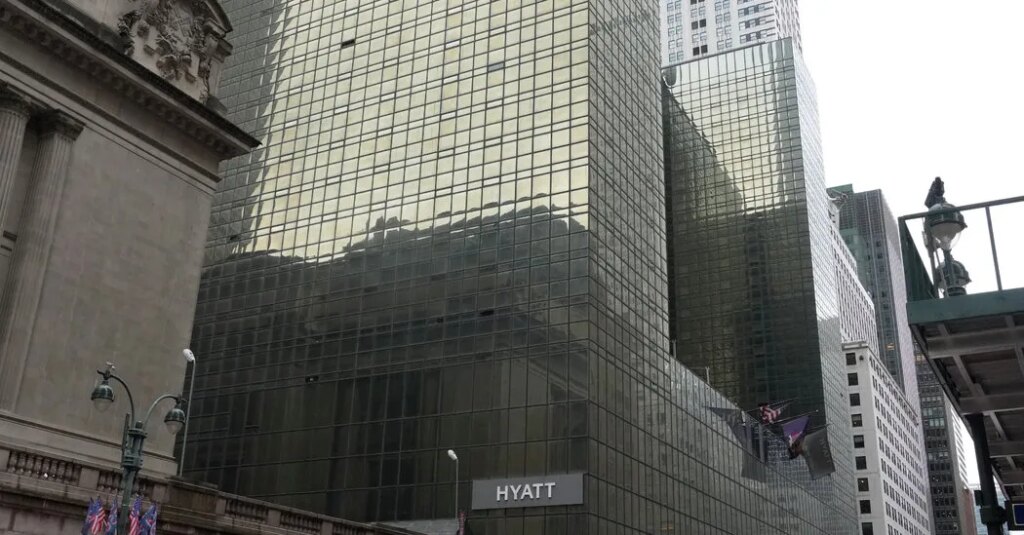
A new supertall tower that will be built next to Grand Central Terminal will feature three public terraces with plenty of seating, greenery and views over Midtown Manhattan.
But it will not have what many New Yorkers want most of all — a public bathroom.
In a metropolis with too few places to go, many community leaders and advocacy groups are now calling on city officials to require public bathrooms in privately owned public spaces like the high-profile tower at 175 Park Avenue. They say that bathroom access is a basic human right and that it has been largely overlooked in the city’s efforts to create hundreds of public spaces in some of the most crowded neighborhoods.
“It’s great to have public spaces, but you can’t spend long there if there isn’t a bathroom,” said Alison Wilkey, the director of government affairs and strategic campaigns at the Coalition for the Homeless.
Citywide, there are 1,064 public bathrooms, mainly in parks and libraries, though only 973 of them are operational — or roughly one for every 9,035 New Yorkers, according to a City Council analysis last year, which noted that “this shortage impacts public health, equity and quality of life.”
Public bathrooms are generally not required in the city’s network of privately owned public spaces, which includes plazas, arcades and small parks. Only 14 of these roughly 600 spaces have them. In some cases, where the public space was indoors, a bathroom was required under separate building code requirements. Other property owners added bathrooms voluntarily, or through agreements with city officials over a specific site.
Many bathroom advocates point to Bryant Park as a model for a public-private partnership. The city-owned park has gleaming bathrooms — with attendants, fresh flowers and classical music — that serve an average of 3,000 people a day, said Daniel Biederman, president of the Bryant Park Management Corporation, which runs the park. The cost to operate them is more than $380,000 annually, which is paid with revenue from the park’s programs and activities.
“We joke: A lot of people come to the restroom and then they say, ‘Hey, I might as well stay in the park, too,’” Mr. Biederman said. “It sends the message that this is going to be a good park experience and they should hang around.”
City officials said that the tower at 175 Park Avenue, which will have offices, stores and a hotel, went through a public review before it was approved in 2021, and that community leaders did not raise concerns at that time about bathroom access. The project is expected to move ahead in early 2027 with the demolition of the existing building at the site.
While city officials did not rule out requiring bathrooms in these kinds of public spaces, they said that any proposal would require more detailed study and, in any case, would most likely apply to future projects.
“Public restroom access is a recognized need across the city, and this administration is committed to expanding access across all five boroughs,” said Sahiba Kaur, a spokeswoman for the Department of City Planning.
In September, Mayor Zohran Mamdani announced he was deploying 17 free bathrooms to busy plazas and high-traffic areas in a one-year, $4 million pilot program. And last year, the City Council passed a law that calls for a long-term strategy to expand the city’s network of public bathrooms, with a goal of having at least 2,120 public bathrooms by 2035.
Carlos Moreno, an associate professor, researcher and author of “The 15-Minute City: A Solution to Saving Our Time and Our Planet,” said that public bathrooms were an essential part of urban life. In Mr. Moreno’s vision of a more livable and sustainable city, residents have everything they need within a quick walk, including grocery stores, restaurants, transit stops, schools — and yes, even public bathrooms.
“I think that bathrooms should be one important aspect of the common good,” said Mr. Moreno during a recent visit to Manhattan. “It’s one of the daily essential needs for each one of us to have access to a bathroom when we need it.”
Since the 1960s, a city program has given private property owners the right to build larger towers in return for establishing public spaces with required amenities, including seating, lighting, drinking water fountains, public art, and in larger spaces, a restaurant, cafe or food kiosk.
However, in past years, some property owners have sought to keep homeless people, skateboarders and others out of these spaces by locking gates or putting in so-called hostile architecture like metal bars across benches and sharp metal teeth along walls.
In response, city building officials have regularly inspected these privately owned public spaces since 2017. If they find the space is illegally closed or missing required amenities, they will issue violations to the property owner, which carry fines of up to $25,000. Since 2023, they have issued 104 violations.
City planning officials said they had focused on making these spaces more accessible and welcoming over the years by improving basic amenities, updating designs and responding to changing public needs. They added that “restrooms have always been allowed on a voluntary basis.”
Jerold S. Kayden, a professor of urban planning and design at Harvard University and author of “Privately Owned Public Space: The New York City Experience,” said that bathrooms should be part of the discussion for any new privately owned public spaces. He added that city officials could analyze the costs of adding bathrooms and possibly offer larger incentives to help offset them.
“Everybody recognizes that it’s a heavier lift than providing landscaping or movable chairs,” Mr. Kayden said.
David Sigman, a developer who is a member of Manhattan Community Board 5, which covers a swath of Midtown Manhattan, said that many property owners were reluctant to provide public bathrooms because of the additional cost of building and maintaining them as well as concerns that they could be misused for bathing or sleeping by homeless people. Many buildings also have retail tenants like restaurants that prefer bathrooms be reserved for their customers.
Since 2022, the community board, which has advisory powers, has adopted resolutions requesting access to public bathrooms at 16 privately owned public spaces in its district, according to Julie Chou, an architect and a member of the community board. Only three sites have agreed to do so.
Ms. Chou, who has extensively researched the city’s bathroom shortage, said that these public spaces were an untapped resource that could significantly expand bathroom access. She said that they were part of larger buildings that already have bathrooms as well as maintenance and security staff, and could potentially offer a more cost-effective solution than building free-standing bathrooms.
The tower at 175 Park Avenue, which is being developed by RXR and TF Cornerstone, will have outdoor terraces that sit directly above Grand Central. David Garten, a spokesman for RXR, said the project would bring many public benefits such as more than $550 million to modernize the Grand Central subway station below the site, including by building new connections to the commuter rail lines.
“After undergoing extensive public review and unanimous approval, 175 Park Avenue will add about half an acre of new public terraces, with seating, landscaping and public art, along with major pedestrian and transit improvements around Grand Central,” Mr. Garten said.
The sprawling Grand Central transit hub has nine public restrooms — five for women and four for men — in the downstairs food court, and in passenger areas for the Metro-North Railroad and Long Island Rail Road, according to the Metropolitan Transportation Authority.
But community leaders and advocates counter that the tower at 175 Park Avenue received lucrative development rights in return for its public spaces and should also be required to provide on-site bathrooms instead of sending visitors to navigate the crowded maze at Grand Central.
Will Woods, 43, a Manhattan resident who was formerly homeless and has Crohn’s disease, said that he usually avoided Midtown because he couldn’t just hold it. He’s had close calls trying to make it to the bathrooms in Grand Central in time. “I’ve got to get all the way to where the bathroom is,” he said. “You know, I’ve got to maintain my dignity, and hopefully, I don’t bump into somebody.”
Ms. Chou said that public bathrooms were not just an optional amenity but should be seen as necessary infrastructure — like elevators — to make the city accessible to everyone.
“This is human needs,” she said. “175 Park could provide a beautiful bathroom like Bryant Park’s, like that caliber.”
The post A New Tower Will Have Lots of Public Space but No Public Bathrooms appeared first on New York Times.