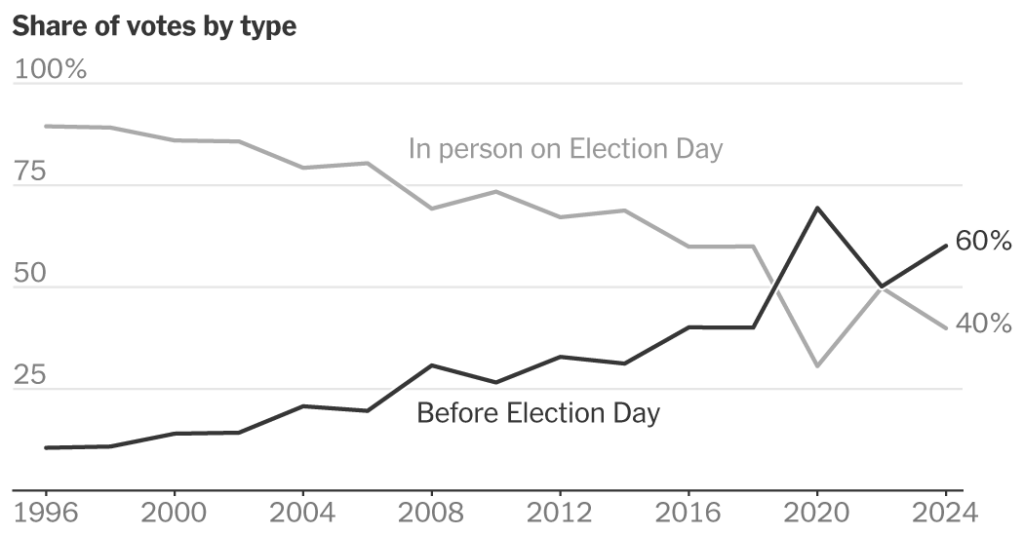
Voting before Election Day has become more and more common in recent years. In 2024, more than 80 million voters took advantage of this option, a majority of the entire turnout.
In the weeks before Election Day, data on which voters have cast an early ballot, either in person or by mail, is a frequent topic of analysis. Is the early electorate older or younger than in past elections? Is it more Democratic or more Republican? Is the election a record for early voting in a certain state?
These analyses can be intriguing, and they come with the authority of being real data from a live election, but there are limits to what early votes can tell us, especially about the outcome of a race. This year, there may be more uncertainty than ever around mail-in voting after President Trump’s attempts to influence the process, one of which resulted in an executive order that was blocked by the Supreme Court.
Even if early voting continues without many changes, it will come with a series of challenges to analyzing the data.
It can’t tell you whom someone voted for.
The most common way to assess the partisanship of early voters is by looking at their party registration. That method largely falls apart in the 19 states where party registration is not recorded, including battlegrounds such as Michigan, Texas and Georgia.
Even when party registration is available, it is an imperfect proxy for how people vote. Many Americans registered to vote decades ago and have not updated their registration, so party statistics often lag behind changes in a state’s political makeup. New Hampshire, which has consistently voted Democratic in presidential races, has more registered Republicans than Democrats. In Louisiana, where the Republican candidate has won every presidential election this millennium, registered Democrats outnumbered registered Republicans until this year.
Even if we could know the party registration statistics of the final electorate, including both early and Election Day voters, they would not be a reliable indicator of results. A look at various recent elections in Florida, for example, reveals that ballots cast in early voting favored Democrats in some elections and Republicans in others.
And in both the 2024 presidential and the 2022 U.S. Senate elections, an average of publicly available poll results was closer to the election result than the proportion of Democrats or Republicans who voted across all methods.
Early voters differ from Election Day voters.
Even if we knew whom early voters were going to vote for, it would be challenging to predict election results because early voters differ systematically from Election Day voters.
People who vote early tend to be some of the most highly engaged. Irregular voters, including younger adults, are more likely to wait longer to return their ballots or to cast a ballot on Election Day. This can make it hard to interpret early-vote data in both primary and general elections.
Before the New York City congressional primaries in 2026, prognosticators pointed to the fact that the average age of Democratic voters was older than it was during the 2025 mayoral primary — a troubling sign for candidates endorsed by Mayor Zohran Mamdani. But young voters picked up the pace during the end of the early voting period and came out to vote on Election Day, propelling multiple primary wins for progressive candidates.
Early votes in recent years have tended to favor Democrats over Republicans in general elections. The 2024 presidential election in Pennsylvania provides a stark example: Even though Kamala Harris won the early vote by 31 percentage points, Election Day voters favored Mr. Trump by 15 percentage points. He won the state by two percentage points.
The difference in vote choice between advance and Election Day voters is not the same across states or even across years within the same state. It can depend on who qualifies to vote by mail, whether early in-person voting is offered, how long the early voting process lasts and whether news late in the process favors one candidate.
The early vote is not a monolith.
A further challenge to pre-election analyses of early in-person voting comes from the fact that early voting periods last weeks in most states. The composition of the early ballots often shifts throughout this period.
With mail ballots, those returned well before Election Day may not be representative of the total mail-in votes because voters from one party may wait longer to send their ballots. In the 2024 election in New Jersey, for example, registered Democrats made up 66 percent of voters who returned their mail ballots between Sept. 25 and Oct. 1. In the week leading up to Election Day, however, that figure was 49 percent.
The changes over time in partisanship of mail ballots are also not consistent from one state to another. In 2024, while Nevada and Pennsylvania had large shifts in partisanship over time, it remained relatively flat in North Carolina.
It’s hard to make comparisons with the past.
Although a few states have had large-scale early voting for decades, most started more recently. In 2000, 26 states required a reason for any form of early voting and just 14 percent of voters nationwide cast their ballots early. Today, all but three states have no-excuse mail or early in-person voting, and 60 percent of votes in 2024 were cast using one of these two methods.
As a result of this change, few past elections can be used as benchmarks against which to compare early-voting trends.
When are early votes useful for analysis?
Despite its limits as a predictor of results, early-voting data can still be helpful.
Voting trends from early ballots can provide information about what to expect as votes begin to be reported.
If, for example, early votes in a particular election are overwhelmingly cast by registered Democrats, we can also expect absentee vote reports on election night to favor the Democratic candidate. The New York Times uses lists of voters who have cast early ballots, along with modeling of their likely vote choice, to build estimates of early-vote results that inform the Needle, our election night model.
In states where race calls stretch for days after the election, shifts in the partisanship of mail ballots over time can indicate what to expect in the ballots counted after Election Day. During the California primaries in 2026, for example, the share of ballots returned by registered Democrats climbed in the two weeks before Election Day.
These “late mail” votes, which are counted in the days and weeks after Election Day, can prove decisive in close races. In the primary election for Los Angeles mayor, Spencer Pratt, a Republican and former reality TV star, appeared to be in second place on election night, but Nithya Raman, a progressive Democrat, pulled ahead as more than 200,000 of these Democratic-leaning “late mail” ballots were counted over the next five days.
The post Why Overanalyzing the Early Vote Can Be Misleading appeared first on New York Times.