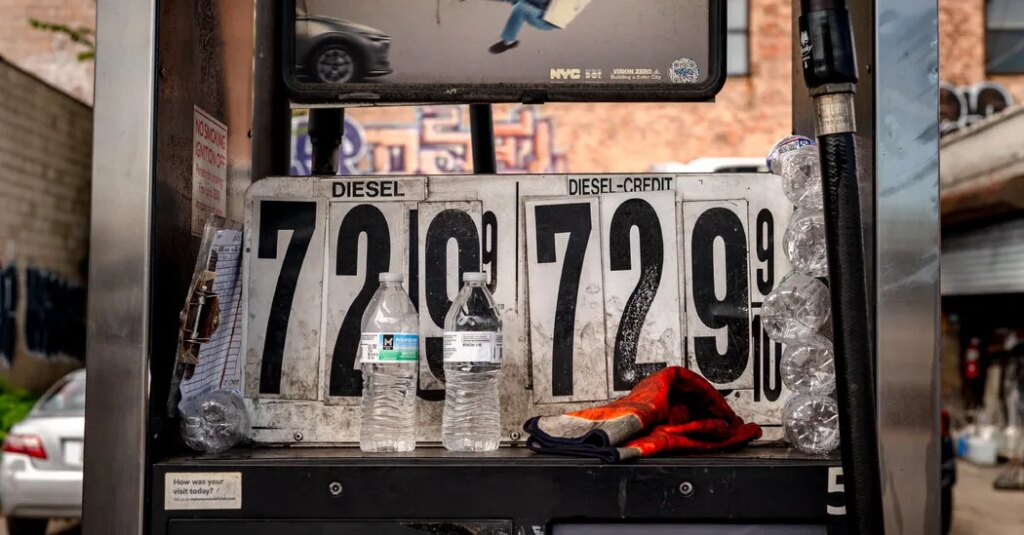
President Trump said on Friday that he had reached an agreement with President Vladimir V. Putin of Russia to immediately import Russian diesel fuel to the U.S. market, despite a Russian ban on exporting fuel.
It was not immediately clear if Mr. Putin had signed off on that deal. But minutes after Mr. Trump’s announcement, the Treasury Department said it was lifting sanctions on Russian diesel exports “to allow the supply of Russian diesel to the global market.” The announcement gave Russian energy producers a general license to sell diesel fuel until April.
Russia, a crucial supplier of diesel to the rest of the world, said last week that it was extending its ban on diesel exports until the end of October, amid punishing Ukrainian strikes on oil refineries and other fuel infrastructure. Those attacks, and the export ban, have kept fuel prices high ahead of the midterm elections. Mr. Trump has recently criticized Ukraine for the strikes, saying they were driving up prices.
But Mr. Trump said in a social media post on Friday that Mr. Putin had approved shipping potentially millions of tons of diesel fuel in the coming months.
“It was agreed,” Mr. Trump said, “that Russia will immediately supply over 300,000 Tons of Diesel Fuel to the American and Global Marketplace, another 500,000 Tons during the month of November, and 1,000,000 Tons immediately thereafter. Additionally, based on the condition of their Diesel Refineries, Russia will then deliver, within a short period of time, 3,000,000 Tons of Diesel Fuel.”
The return of Russian diesel to international markets would be a win for Mr. Putin, who has sought for years to break the ice on U.S. sanctions against Moscow’s energy sector.
Despite suffering from the most acute gasoline crisis in decades, Moscow still has an excess supply of diesel. But Edward Fishman, a senior fellow at the Council on Foreign Relations, said he doubted that Russia could supply as much diesel fuel as Mr. Trump said it had promised.
“The reason Russia imposed an export ban was that Ukrainian strikes had degraded its refining output, necessitating fuel rationing for domestic use,” Mr. Fishman said. “This strikes me as classic Putin — empty promises aimed at sowing further divisions in the trans-Atlantic alliance.”
It is the latest effort by the Trump administration to ease sanctions on Russia in a bid to lower energy prices. At the beginning of the war with Iran, Treasury Secretary Scott Bessent lifted sanctions on Russian oil that was at sea, saying that it would add hundreds of millions of barrels of crude to global markets, and would curb prices.
Alan Rappeport and Ivan Nechepurenko contributed reporting.
The post Trump Says He Will Import Russian Diesel Fuel Amid High Prices appeared first on New York Times.