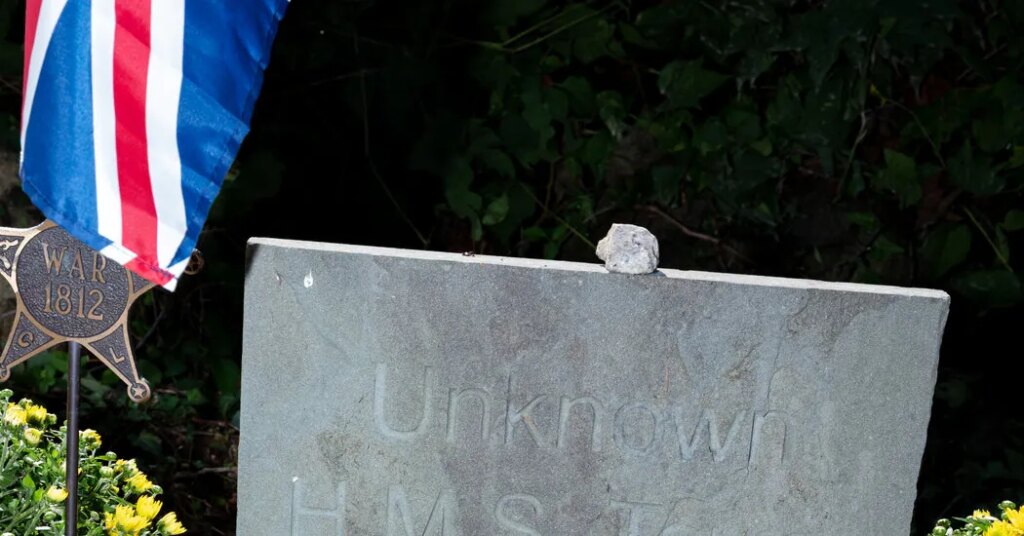
Jon Fuller kept thinking about the fallen sailor. He had just a rough sketch of the man — a crewman on a British ship, killed by a troop of scheming Yankees on the coast of Connecticut during the War of 1812, and buried in an unmarked grave. But the man’s name was lost to history.
“I was very curious,” Fuller said. “I was wondering who he was. Did he have a family? What was his history?”
Fuller, 66, works in retirement planning at a financial services firm. His Massachusetts home is cluttered with shells and cannonballs of various diameters, mostly from the Civil War, bought in antique shops or on eBay. He keeps one cannon under a table in the living room, and another by the front door. His prized swords are stored in an umbrella stand. He’s dabbled in re-enacting — wearing a replica uniform from the French and Indian War — but had to stop after getting heat stroke at a recent event.
He also has a family home in Groton Long Point, Conn., less than a mile away from the beach where the unknown sailor had died.
So when Fuller ran across an article detailing the sailor’s killing during the War of 1812, he decided to try to identify the man, and maybe even mark his grave: “I thought that would be a pretty neat thing to do.”
The exact details of what happened on that August day, two years into the war, are sometimes debated, but the consensus is that it began with a trick. A small group of local men sailed from the Mystic River into Fishers Island Sound on a vessel that appeared to be carrying valuable cargo. Militiamen lay in wait, hiding on the shoreline.
A British warship — the aptly named H.M.S. Terror, which days before had unleashed a bombardment on the nearby village of Stonington — took the bait, and dispatched a small boat to chase. Once in range, the Americans burst out from hiding and opened fire, killing a Scotsman from the British boat. They are said to have buried the enemy sailor in the northwest corner of Packer Cemetery in Mystic, underneath an apple tree.
Fuller thought he might have some luck at the Mystic Seaport Museum. But they didn’t have answers. He reached out to the British Royal Navy. They said they could make a researcher available at a cost, but the price was prohibitive. Instead, he got the help of a friend, Chris Malone, who took a slab of stone to a local garden center and paid around $200 to have it engraved: “Unknown H.M.S. Terror August 13, 1814.” An archaeologist helped him pinpoint the burial site. He recalled placing the stone there around 2019.
At least once a year, Fuller visited the grave and played “Scotland the Brave” from his phone.
“I was somewhat happy just to leave him as ‘Unknown,’” he said, “just for the sheer sake of perhaps I’d meet him in heaven someday if I’m lucky enough to go there.”
Then one day, a visitor to the gravesite changed everything.
Encountering a Mystery
Grace Cleere grew up near the Fort Griswold Battlefield State Park in Groton, Conn. Her family did not have much money, and vacation centered around national parks and historical sites.
“I got it in my blood early on,” she said.
Cleere worked at historical sites and societies in Connecticut before spending much of her professional career in Washington, D.C., writing for various government agencies including the Naval Observatory. But she always made room for side quests, especially those of the historical variety. Once, she said, she made hundreds of calls to return a late World War II veteran’s dog tag to his daughter.
“I never lost sight of the fact that you could bring history into anything,” she said.
After she retired, Cleere moved into an old sea captain’s home in Mystic, where shipyards once produced the whaling barks, clipper ships and schooners that powered 19th-century maritime New England. Cleere was strolling through Packer Cemetery when she came upon a gravestone which, compared to its 19th-century neighbors, was strangely austere. It had none of the usual lichen, and its lettering was inexplicably modern for markings to record the final resting place of an unknown sailor from a British ship.
“I said, ‘Terror,’” Cleere recalled. “‘That’s the ice ship that went down in 1848!’”
The Terror had a tumultuous history after its service in the War of 1812, during which it shelled Fort McHenry in Baltimore and its “bombs bursting in air” became part of “The Star-Spangled Banner” that immortalized American resolve.
Later refitted to forge through Arctic waters, the ship was selected by the British Admiralty to find the Northwest Passage, a trade route that would slash transit times and expand access to Asian markets.
The doomed 1845 expedition, led by Sir John Franklin, resulted in the loss of the Terror and the H.M.S. Erebus, plus all 129 crew members. The ships sank after being abandoned, their wrecks discovered just years ago.
Cleere was entranced by the mystery of the anonymous seaman.
“When there’s a puzzle anywhere,” Cleere said, “I don’t give up until I try to crack it.”
There was an emotional element to her fixation, too. Her father had been a Navy submariner. Growing up in New England, she felt close to tragedies like the U.S.S. Thresher’s sinking.
“I’ve always had a soft spot for dead soldiers and sailors,” she said, adding that she put poppies out every year on D-Day.
For years, Cleere’s research into the identity of the man in the unmarked grave did not get very far. Finally, a friend of hers named Roger Hutchins, a retired college administrator in the U.K. with a research background and an interest in genealogy, agreed to search the British Admiralty records, which are held by the National Archives in Kew, London, and cataloged online.
“I thought it was a bit of a wild-goose chase,” Hutchins said. But before long, he sent Cleere a package in the mail with a stack of photocopied archival documents.
One was an excerpt from the muster roll from the Terror. It listed the only fatality suffered during the ship’s action off the Connecticut coast in August of 1814. His name was William Adamson.
“‘My God,’” Cleere recalled saying, “‘this is our man.’”
Mysteries Solved
Adamson, likely born in 1771, made his living as a sailor. In 1807, his marriage registration shows, he wed Christian Thomson at the parish church in the Scottish fishing village of Pittenweem. She was already pregnant with their first child.
Adamson shows up in the British naval records that same year. Hutchins speculates he was conscripted against his will, in part because he was newly married and building a family.
Either way, Adamson wound up a quarter gunner on the Terror.
“The emotional side of it is thinking, what extraordinary bad luck for that man,” Hutchins said. “But also there’s no doubt, and I know Grace feels this as well — there’s a feeling of real pleasure in being able to identify him.”
One mystery still remained: Who had erected the gravestone that triggered Cleere’s quest?
Then, earlier this year, Elizabeth Boucher, a collections manager at the Mystic River and Noank historical societies, texted Cleere about a monument in Groton Long Point, not far from Packer Cemetery, that appeared to reference the conflict she had been talking about.
The plaque, which adorned a large rock along East Shore Avenue, memorialized the skirmish, elevating it perhaps a bit by calling it the “Battle of Groton Long Point.” (The original article Fuller read had referred to it similarly.)
Cleere recalled contacting someone with the Groton Long Point Association, the body that governs the area; they did not know who installed the monument. But she was able to get a listing of members, with phone numbers.
Cleere started dialing and quickly reached Fuller. The commemorative rock was his work. And, he said, he was also responsible for the gravestone in Mystic. Cleere was dumbfounded.
“‘Who gave you permission?’” she recalled asking. He said no one had: “‘I just did it.’”
Honoring the Dead
Having identified the dead man, Cleere set out to plan a ceremony, and to find Adamson’s family. Using various naval, census and vital records along with the genealogy websites Scotland’s People and Ancestry.com, Hutchins traced a sixth-generation Adamson descendant, Claudia Chagnon, to Lynchburg, Va.
Chagnon did not know much about Adamson beyond his name when Cleere and Hutchins found her. She was thrilled.
“How in the world did you find all this out?” she asked by email. “And connect him to an unmarked grave?”
As for attending the ceremony, she wrote: “Which cemetery and what time?”
And so it was that Chagnon found herself this past August among the estimated hundreds of people gathered in Packer Cemetery for a ceremony honoring her distant relative. A new plaque listed his name. Bagpipes, fifes and drums played into the retreating fog. People left offerings of tobacco, rum and Scottish shortbread. Fuller and local historians spoke.
Unlike the unsettled stories of the skirmish that had killed him, the day’s message to Adamson was unequivocal.
“Shipmate,” said Brian LeGare, the executive officer of the Naval Submarine Base New London, “after 212 years, you are unknown no more.”
The post His Unmarked Grave Lay Forgotten for 200 Years. They Had to Fix That. appeared first on New York Times.