Prime Minister Benjamin Netanyahu led Israel’s denunciations on Friday of the decision to award the Nobel Peace Prize to Navi Pillay, a human rights lawyer who was drawn into the international spotlight last year when a United Nations commission she chaired found that Israel was committing genocide against Palestinians in Gaza.
In a statement, Mr. Netanyahu called the decision by the Norwegian Nobel Committee misguided and said it had “lost its moral compass.” He also condemned Ms. Pillay’s work, accusing her of being prejudiced against Jews.
The Israeli foreign ministry, in a post on social media, denounced it as “the grotesque weaponization of an award to legitimize anti-Israel hatred and prejudice.”
Danny Danon, Israel’s ambassador to the United Nations, also questioned the integrity of the award. Honoring Ms. Pillay with the prize, he said through a spokesman, would damage “the credibility of the Nobel Committee,” and “tarnish the legacy of the distinguished laureates who have received this honor throughout history. Winning the Nobel Prize will not make her false conclusions about Israel any more truthful.”
While the prize’s announcement included only a brief mention of her work on the commission’s investigation into the war in Gaza, Jorgen Watne Frydnes, the chair of the Norwegian Nobel Committee, said the work had played an important part in the decision.
The September 2025 finding by the panel, the U.N. Commission of Inquiry on the Occupied Palestinian Territory, is among its most sweeping about the Israeli government’s conduct in the war and drew fierce criticism from Israel. The commission’s report said that some of Israel’s most senior leaders had “incited the commission of genocide.”
Last October, Ms. Pillay, a South African, said in a statement that “the actions of the Israeli government have consistently pointed toward a singular, harrowing objective — the systematic destruction of Palestinian life in Gaza.”
Israel has repeatedly rejected allegations of genocide from scholars and human rights groups.
When the commission’s findings were released, Israeli officials quickly disputed them and criticized the panel’s members. The country’s foreign ministry called the commission’s three members “notorious for their openly antisemitic positions” and “Hamas proxies,” referring to the Palestinian militant group that led the attack on Israel on Oct. 7, 2023. Isaac Herzog, the Israeli president, called the commission “morally bankrupt” and said it “obsesses over blaming the Jewish state.”
Ms. Pillay rebutted the criticism at the time. “I would prefer that our critics tell us: Where did we go wrong?” she said. “Which piece of that evidence is false, and why?”
Ms. Pillay brought extensive legal expertise on genocide to the inquiry. She spent eight years as part of the International Criminal Tribunal on the 1994 genocide in Rwanda, as a judge and then as the president. It was the first tribunal to interpret the definition of genocide set out in the U.N.’s 1948 Genocide Convention and the first to convict a defendant for the crime of genocide.
In June 2024, more than a year before the genocide finding against Israel, Ms. Pillay’s commission issued a report that accused members of Palestinian armed groups of committing war crimes during the Oct. 7, 2023, attack on Israel from Gaza, which it said involved a pattern of sexual violence.
In late 2023, South Africa, one of the most vocal critics of Israel’s war in Gaza, brought a case before the International Court of Justice, the U.N.’s top court, accusing Israel of committing genocide. Israel dismissed the claim as lacking factual or legal basis. The case remains active.
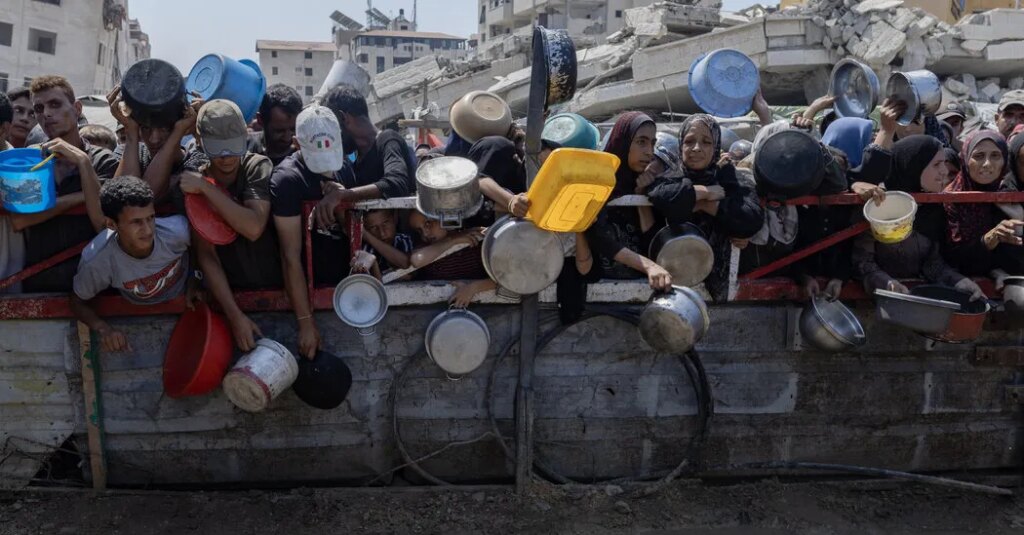
Hamas-led gunmen killed about 1,200 people in the Oct. 7 attack, according to the Israeli authorities, and took about 250 more back to Gaza as hostages, in the deadliest day of violence in the country’s history. Israel responded with a devastating war in Gaza that has killed at least 74,000 people, according to local health officials, who do not distinguish between civilians and combatants, and leveled much of the enclave.
Nick Cumming-Bruce contributed reporting.
The post Israel Denounces the Decision to Award the Nobel Peace Prize to Navi Pillay appeared first on New York Times.