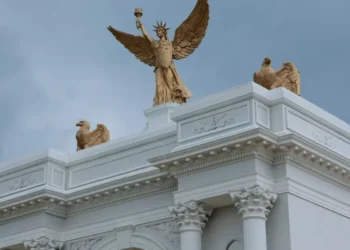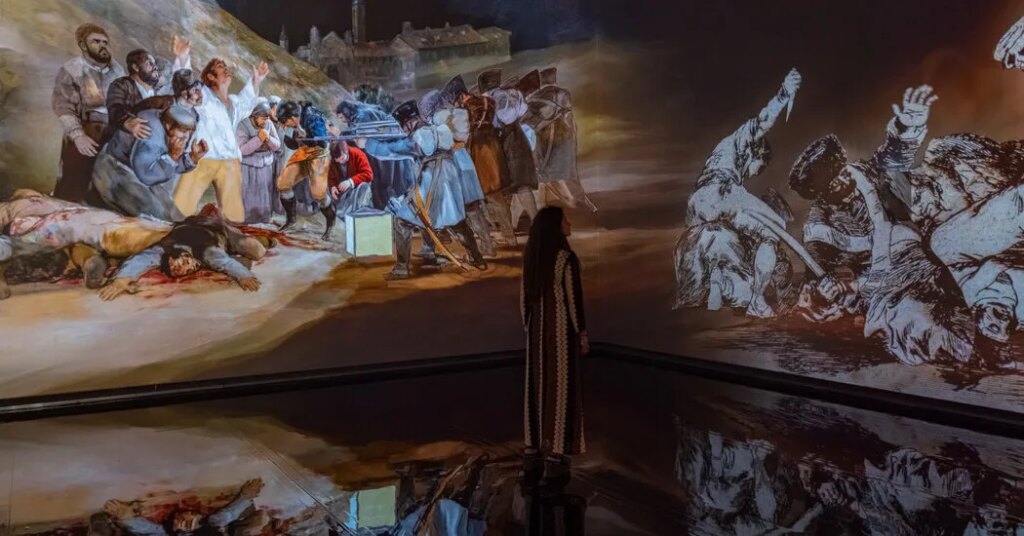
The new facade of the Goya Museum in Zaragoza, Spain — which reopens Friday after an ambitious remodeling and extension — features 126 slabs of limestone engraved with stark images of firing squads, winged beasts, Inquisition victims wearing witches’ hats, and aristocrats portrayed as donkeys riding on the backs of peasants.
They are larger-than-life copies of fragments of Goya’s “The Caprices,” “The Disasters of War,” “The Follies” and “Bullfighting,” series of prints that chronicled a period of violent social upheaval, persecution and regime change in Spain more than 200 years ago.
They are the stuff of nightmares. Yet they seem eerily relevant in Europe today.
“We live in turbulent times, like those witnessed by Goya,” said Luis Fernández-Galiano, the curator of the museum’s inaugural exhibition, “Only Goya. The Art of Seeing,” which runs through Jan. 10.
Goya’s critical response to the world he lived in is not limited to the prints, which, laid out in rows of dimly lit glass trays in a windowless exhibition hall, are the beating heart of the museum. It is the artist’s entire body of work — his portraits, cartoons, Black Paintings, even his frescoes — that are modern in essence, Fernández-Galiano said.
“Through his gaze, he teaches us to think,” he added. “He tries to make us confront uncertainty.”
Francisco de Goya y Lucientes was born in 1746 in a village about 30 miles south of Zaragoza. He grew up in the city, where his father worked as a gilder. He attended school there and later — before moving to the court of Charles III in Madrid — eked out a living for himself and his family by accepting commissions.
Nowadays, locals affectionately call him el genio: the genius.
The Goya Museum’s permanent collection is housed in a 16th-century palace, connected to the monumental facade through a system of luminous ramps, corridors and staircases, all designed for the reopening by Sebastián Arquitectos. Sergio Sebastián, the architect, said that it was important to emphasize “the duality between tradition and modernity.”
On the ground floor, through the columns of a Renaissance patio, is the entrance to the inaugural exhibition. It is a celebration of Goya’s portrayal of the pain, and the joy, of the human condition.
The show includes 39 oil paintings and two tapestries that are on loan from private collections and some of the world’s leading museums, including the Baltimore Museum of Art, the Uffizi Gallery in Florence and the National Gallery in London.
At the exhibition’s emotional core are three head-to-toe canvases of powerful Spanish women that reveal more about the sitters than their appearance or social standing.
In “María del Pilar Teresa Cayetana de Silva Álvarez de Toledo, 13th Duchess of Alba,” a.k.a. the White Duchess, she flaunts her influence and land by posing outdoors and pointing to the sand she stands on. In “The 12th Marchioness of Villafranca Painting Her Husband,” the respected academic and intellectual asserts her status by sitting for Goya while working on a portrait of her own. And in “María del Rosario Fernández, ‘La Tirana,’” an actress who frequented fashionable salons oozes self-confidence.
At a preview of the exhibition this week, Cristina Rubio, the museum’s deputy director, drew attention to “the long, quick, loose brushstrokes on La Tirana’s shawl” and “the intricate detail at the hem of her dress.” Goya, she said, was not only “fascinated with human psychology, but was a master of texture and fabric, too.”
Fernández-Galiano, the show’s curator, described the three works as “admirable testimonies of the affection, intelligence and empathy with which Goya depicted women.”
Then come the men of the era: royalty, statesmen, industrialists, a general and an archbishop. The commissary of the Holy Office, who later denounced the Inquisition from exile, is here, too, as are family members, friends and Enlightenment proponents from Goya’s intimate circle.
His early tapestry cartoons, mostly of the working classes, feature in a section titled “Lights and Shadows.” Typically produced to adorn the walls of royal residences, the cartoons have pleasant motifs often in rural settings, of people dancing or playing Blind Man’s Buff, a popular game at the time.
“The Injured Mason,” however, is dramatic rather than comic. Depicting a builder who has fallen from a scaffold, it denounces the lack of regulations to ensure construction workers’ safety.
“Goya’s works depict the society of his time with criticism, and some images are no different to modern-day situations,” said José Luis Rodrigo, the director general of Fundación Ibercaja, which owns the museum.
The museum’s reopening coincides with the 150th anniversary of the foundation’s bank, Ibercaja Banco. It also commemorates the 250th anniversary of the bank’s precursor, the Royal Aragonese Economic Society of Friends of the Country. That Goya was a member is hardly surprising: The society’s mission was to promote local businesses, industries and farms; encourage saving; and foster education and culture in keeping with Enlightenment values that were dear to Goya.
“Of the old masters,” Fernández-Galiano said, “Goya’s message is the most relevant to the modern day.”
The post At a Revamped Museum, Goya’s Nightmares Seem Scarily Relevant appeared first on New York Times.