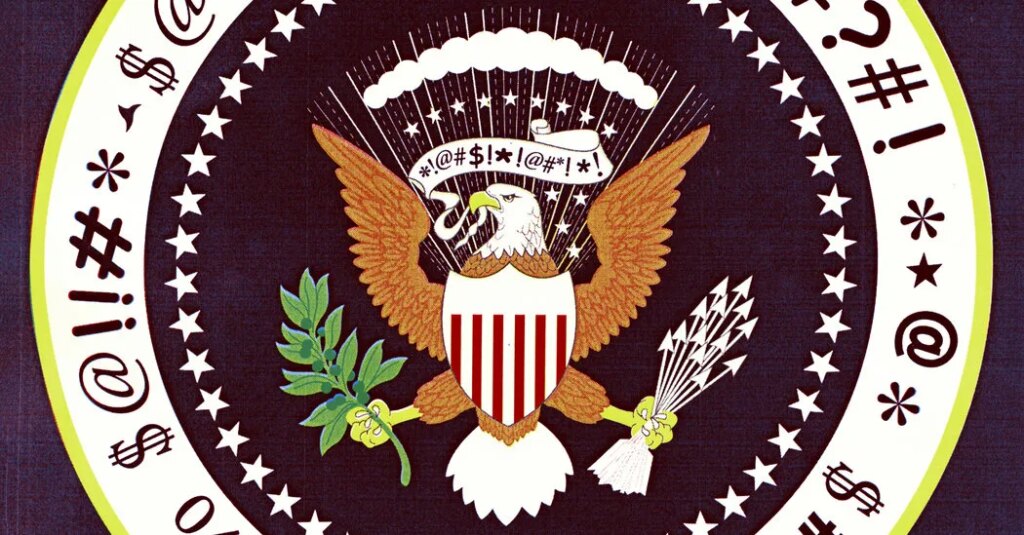
President Trump has been especially potty-mouthed lately. In his second term, he has used significantly more profanity in public than in his first, according to an analysis by The Washington Post in May. Just last week we were treated to him telling interviewers from Time, “You haven’t asked me one positive question” — but dropping an F-bomb to modify “positive” — and at a rally in Ohio calling Democrats “dumb son of a bitches” and saying he was “working my ass off.”
At that same rally he made another gluteal reference of a more pugnacious nature when he said that a Republican victory would “shove it up” Democrats’ something or other.
Some have argued that the uptick in Trump’s lexical filth is a symptom of cognitive decline, a disinhibition suggestive of dementia. I doubt it. The increase in his use of profanity is what you would expect, given how language works.
When we use language, we often want to get and keep people’s attention. But the words and expressions we use to do that can lose their force over time. They require freshening up. This is how you get nonsensical words like “irregardless,” where “regardless” alone should do the trick but the “ir-” gets tacked on for added punch — the extra rhythmic oomph of “irrespective.” “Advance warning,” “close proximity” and “final outcome” are similar cases: redundancies from a logical point of view, but useful for vividness.
Trump has always been fond of “damn” and “hell,” which were part of his populist shtick from the outset. So we would have predicted that he would progress to more piquant profanity.
In this way, Trump’s public speech retraces the evolution of popular profanity over the past hundred years. In the early 20th century, religion-related terms like “hell” were people’s “hit your thumb with a hammer” words. A woman having repeated trouble with her glasses in the 1929 film musical “Glorifying the American Girl” keeps saying “damn it!” — as did film stars in blooper reels from that era. But by the 1960s, things had changed. My parents’ “hit your thumb” profanity of choice began with an “s.” To me (born 1965), that is a tad tame, and I go for the F-bomb, which is common among people my age and younger.
Profanity is all about escalation. “Damn” is reinforced as “goddamn,” with “bull” modifying the S-word and “mother” serving an analogous purpose for the F-bomb.
That said, it’s highly unlikely that Trump will turn up the volume much more when it comes to bad words. In English, profanity comes in three stages of shock value. Stage 1 is blasphemous words. “Damn” and “hell” were once considered such strong drink that in the 19th-century opera “H.M.S. Pinafore,” the captain prides himself on never saying “damn” (or hardly ever, he admits). Today, in our less pious age, those are mild expletives at best.
Stage 2 is sexual or graphic words about the body, and Trump revels in those. We will recall a notorious comment of his about grabbing women by a certain body part and his scatological characterization of countries such as Haiti and El Salvador. But these sorts of words, which are used publicly today much more than in the past, now qualify more as salty or tasteless than genuinely taboo.
Stage 3 is racial and other slurs against groups. Though Trump has been accused of using the N-word, he has long avoided using slurs in public. We can, of course, expect him to push the envelope. Indeed, just this week he used an anti-transgender slur when referring to Annie Andrews, the Democratic nominee for the Senate in South Carolina. But it’s notable that Andrews, who has expressed support for transgender youth, is not transgender herself. I’m willing to bet that Trump wouldn’t use that slur in public to refer to a transgender person like Sarah McBride, the congresswoman from Delaware, just as I wouldn’t expect him to use a homophobic slur to publicly attack a gay opponent.
Today, it is such words that qualify as truly profane. We often think of slurs as distinct from swear words, but it’s an indication that they are, in fact, today’s profanity that even someone as heedless of etiquette, decorum, restraint and reflection as Trump has tended to avoid them.
Because the Stage 1 and Stage 2 words are now more naughty than profane, Trump uses them to thumb his nose at propriety. In this, he is like an 11-year-old, snapping towels at people in the locker room — and snapping them ever more to get a rise out of the people looking on.
Yet he does not typically risk Stage 3 profanity. Amid his staggering megalomania and chronic logorrhea, Trump, if only for pragmatic purposes, maintains a twinkle of — of all things — decorum.
The post Trump’s Speech Is Getting Filthier appeared first on New York Times.