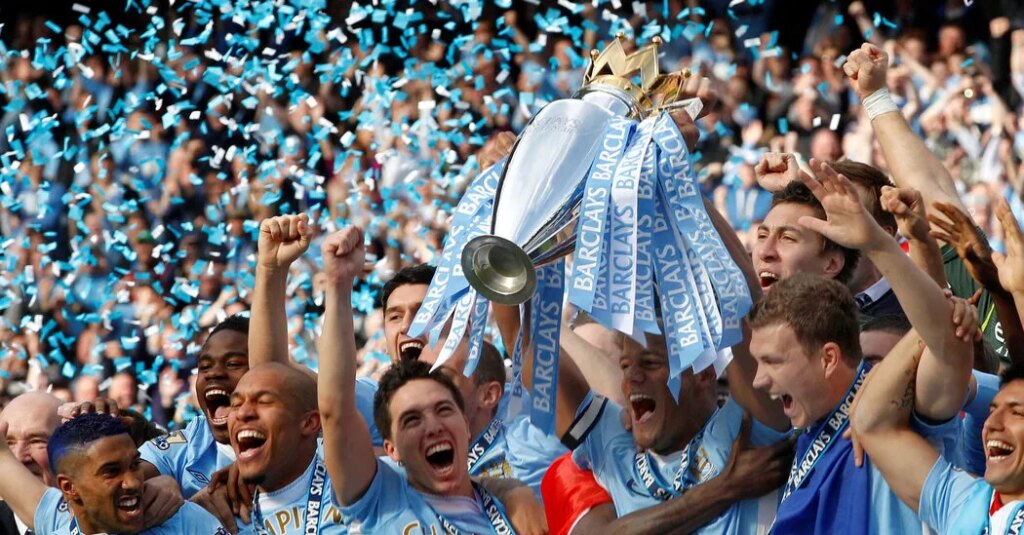
Manchester City first came to my attention after we moved from Berlin to Cardiff and my then-8-year-old son, an avid football fan, declared that Man City was now his team. It was 2024, and the club had just won its fourth consecutive Premier League title — unheard of. That was clearly enough for my Welsh son to set aside any misgivings he might have had about supporting an English club.
Those titles don’t look so shiny now. Last month, an independent commission found Man City had broken more than 100 of the league’s financial rules. It said the team, whose majority owner is Sheikh Mansour bin Zayed Al Nahyan, the vice president of the United Arab Emirates, spent hundreds of millions of pounds it wasn’t allowed to spend, on players it could never have otherwise afforded. (Man City is appealing the ruling.)
I spoke to my colleague Tariq Panja, our global sports correspondent, about the biggest financial scandal in football history.
The Man City scandal is about more than football
So Tariq, let’s talk about the scandal at Man City. Full disclosure: My 10-year-old is a Man City fan.
He’s not the only one! Kids love a winning team, and this generation of kids only know Man City as a winning team. But historically this was Manchester’s second team. It really wasn’t known for any great success — until Sept. 1, 2008. That’s the day Sheikh Mansour bought the club.
Why did Sheikh Mansour want to own Man City — or any football club for that matter?
Well, it is in the Premier League, which is the biggest league in the world. Millions of people watch it every year. It’s Britain’s biggest soft power export, bar none. For people wanting to burnish their personal image or their country’s image, it’s the epitome of sporting greatness. It gives you immediate name recognition. It’s a shortcut to respectability.
But it also brings scrutiny. Because if he didn’t own Man City, few in Britain would know who Sheikh Mansour is.
And of course that scrutiny has now come back to bite him. So tell me, someone who doesn’t watch the Premier League, what happened?
It’s massive. It’s the biggest financial cheating scandal in the history of football. To put it simply, they cooked the books in order to spend money they weren’t allowed to spend on an array of world-class talent.
You can only spend what you earn. There are three buckets of income for football teams: TV rights, stadium tickets and sponsorship. The first two, you can’t really manipulate. The third one is, according to a panel of arbitrators, the one that they really went to town on.
How so?
They signed a bunch of sham contracts with sponsors — U.A.E.-owned companies, like Etihad Airways. But those companies paid for a tiny fraction of that sponsorship. The rest of it came from Sheikh Mansour’s company, which was padding those numbers to an enormous degree. Of the roughly 950 million pounds of supposed sponsorship money Man City was claiming, only 120 million or so actually came from sponsors.
And all that money allowed it to buy players it would otherwise not have been able to afford?
Exactly. It allowed City to buy one of the best managers, Pep Guardiola, and some of the best players — Kevin De Bruyne, David Silva, Sergio Aguero — and pay them some of the biggest wages in the business. They’ve won eight Premier League titles under Sheikh Mansour’s ownership.
So who was hurt by this?
Where to start? Man City took the best players from so many rival teams over the years. From its traditional rival, Manchester United, from Arsenal, but also from mid-ranking teams like Aston Villa, who for three summers during this period had their best player taken by Man City. It changed the trajectory of lives, of careers, of teams for a decade.
And then there is the financial damage. A place in the Champions League is worth tens of millions of euros a year. So the team that didn’t make the Champions League — because Man City took a spot that should have gone to them — potentially lost huge amounts of revenue, sponsorship and the like.
OK, let’s talk about the politics of this. Is there any potential political cost for Britain in punishing a major Gulf investor?
The politics of this are very tricky. The U.A.E., which is a British ally, now stands accused of corrupting Britain’s biggest cultural export to the world. Bloomberg reported that Emirati officials have warned that a harsh punishment could have consequences for future investments in Britain.
And it’s created a headache for the prime minister, Andy Burnham. Remember, he was mayor of Greater Manchester until recently. He knows these people very well. The huge amount of investment his city attracted over the last decade? Some of that can be linked to Abu Dhabi. So now there is also scrutiny on Burnham and what kind of relationship he had with them.
How do Man City fans feel about all this?
Well, for the past decade, they just rallied around their club. Because this is a core part of their identity. They’re suddenly successful as a club, and here the world is telling them, “You’re cheating.”
But I would say that since the verdict, there has been a change in tone. There are still the zealots who refuse to think it’s anything but a conspiracy. But some are now saying, “Guys, we might have been wrong.” Some are really sad that it’s happened. Some are angry their club was used for this.
What will happen to Man City now?
Everything is on the table because we haven’t seen a scandal like this in the history of the Premier League. It could be relegated — demoted down a division or two. It could be banned from buying talent. Or given a massive penalty on points. Or charged a financial penalty. But some people are calling for it to be thrown out of the league altogether. That would be the most extreme punishment.
MORE TOP NEWS
-
Two Latvian men were arrested inside the perimeter of a British air base used by the United States early Thursday local time.
-
Russia’s escalating assaults on Ukrainian civilians killed 30 people on a commuter bus, a day after a strike on an apartment building killed 22.
-
Explosions rattled the Saudi capital, Riyadh, as the Houthi militia in Yemen claimed new attacks on the city’s international airport.
-
Thousands of students and others protested public school conditions in a major square in Paris, as the police charged demonstrators and fired off tear gas canisters.
-
Protests by Indian opposition leaders about a revision of voter rolls were broken up by police officers in New Delhi, with many lawmakers dragged off the streets.
WHAT ELSE IS HAPPENING
-
The Canadian poet Anne Carson was awarded the Nobel Prize in Literature. Upon learning of the prize, she uttered a single word.
-
Lawsuits by five women describe new smear tactics in Hollywood crisis management.
TOP OF THE WORLD
The most clicked link in your newsletter yesterday was the quiz about historical figures.
INGREDIENT OF THE DAY
Red palm oil
The West African staple lends color and umami to rich broths, lovingly slicks bitter greens and adds a floral yet smoky essence to anything in its path. (Don’t confuse it with refined palm oil, a tasteless, odorless ingredient used in cosmetics and commercial food production.)
Read conversations with four women across the diaspora about an oil that is a conduit to African food culture.
MORNING READ
I missed our interview with the author Chimamanda Ngozi Adichie when it was published a few weeks ago, but I want to include it here today. It’s a very special and sad one.
Adichie’s characters and her stories explore the sometimes fraught nature of being Nigerian, through tales of migration in “Americanah,” and civil war in “Half of a Yellow Sun.” “I think that America made it possible for me to write, which is my life’s vocation,” she told The Times from her home in Maryland. “But Nigeria gave me everything I needed to be able to write.”
Less than a year ago, while her family was spending the holidays in Lagos, Adichie’s 21-month-old son, Nkanu, died. The tragedy was met with an outpouring of grief and frustration, as many Nigerians shared their own negative experiences with the country’s health care system. During the interview, Adichie, one of Nigeria’s best-known writers, made a heartbreaking, complicated admission: “I do not want to go back to Nigeria.”
AROUND THE WORLD
Feats of strength
In many parts of the world, the ultimate measure of strength is simply: “How much can you bench, bro?”
But there are many other tests of strength, which different communities use to train people for military service or other jobs. They include mallakhamb, a grip-strength and balance test sometimes called “the mother of all Indian sports”; the 1,000-year-old Highland Games tradition in Scotland; and Japan’s ritual of stone lifting, performed by everyone from samurai to laborers. Take a spin through strength tests from around the world.
WHERE IS THIS?
Where is this park?
BEFORE YOU GO …
As close readers of this newsletter know, I live in Wales. I’ve used this space before to share stories about what it’s like to live in a small, proud place. The sense of community. The pleasantly short commutes. The two degrees of separation that mean someone who’s either related to my husband or went to school with him can sort me out with tickets to, well, pretty much anything.
Which is how last night I found myself at the Welsh Music Awards. Think the Grammys or the Brit Awards, but for a nation of three million — which means that during intermission you’ll run into a couple of neighbors, a friend who’s married to a local rock star and your shopkeeper (who also happens to star in one of the shortlisted music videos).
My discovery of the night was Adjua, a Welsh-Ghanaian singer whose voice is both silky and strong. (Think Sade.) For a taste, check out “Can’t Lose.” It’s been playing on repeat at my house.
The other highlight was seeing Local, a Cardiff-born rapper, strutting his stuff. My son, who wants to be a rapper when he grows up, loves “Don’t Let Me Down,” a song in which Local talks to his younger self. (“Keep your head up high when they laugh because you’re rapping, soon you’ll get the whole world clapping.”)
Finally, the Welsh Music Inspiration Award went to Mary Hopkin, an absolute legend. Paul McCartney produced her. She sang backing vocals for David Bowie. Her most famous song is both a masterpiece and a great way to finish the week: “Those Were the Days.”
Have a wonderful weekend! — Katrin
TIME TO PLAY
Here are today’s Spelling Bee, Mini Crossword, Wordle and Sudoku. Find all our games here.
We welcome your feedback. Send us your suggestions at [email protected].
The post The Man City Scandal Is About More Than Football appeared first on New York Times.