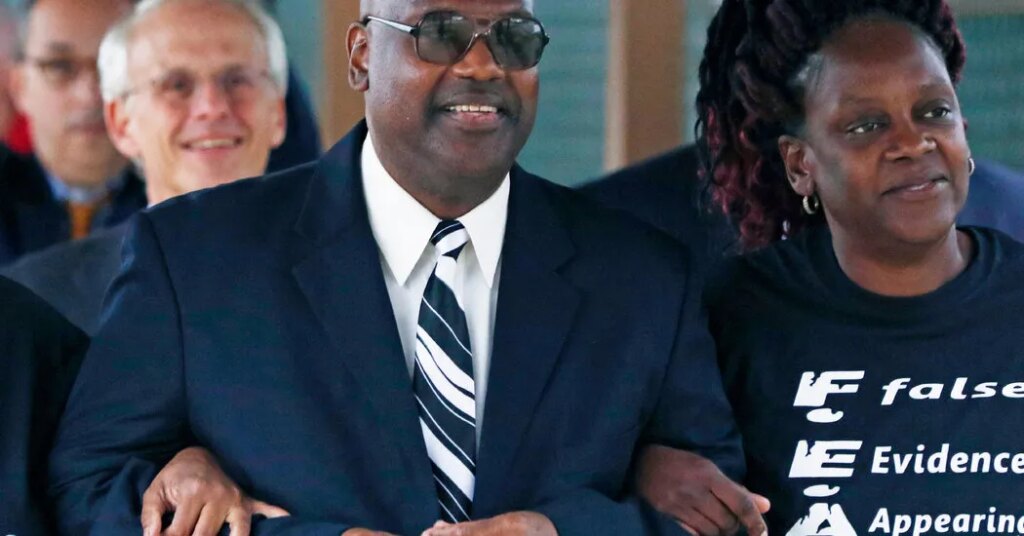
Curtis Flowers, a Black man whose six trials in the same Mississippi murder case became a national symbol of racial bias in jury selection, leading the Supreme Court to reverse his capital conviction in 2019, died at home this week in Winona, Miss. He was 56.
His sister Priscilla Flowers-Ward said he had been suffering from advanced diabetes, and that the family was awaiting an autopsy to identify the cause of death.
Mr. Flowers was transferred off death row in Parchman prison in Mississippi and released in December 2019, after nearly 23 years behind bars. His release followed the Supreme Court’s ruling that Black people had been unconstitutionally excluded from the jury in his sixth trial.
In the 7-2 majority opinion, Justice Brett M. Kavanaugh wrote that the state of Mississippi had pursued a “relentless, determined effort to rid the jury of Black individuals.”
Mr. Flowers was convicted in that trial of killing four people in 1996 at a furniture store where he had once worked in Winona, a small city in central Mississippi.
The white district attorney, Doug Evans, who tried all of Mr. Flowers’s six cases, spent two decades employing the same tactic: ensuring that few or no Black residents in the majority-Black county were seated on Mr. Flowers’s juries.
Across the half-dozen trials, 61 of the 72 jurors were white. Two of the prosecutions ended in mistrials, and four in convictions that were overturned on appeal.
Mr. Flowers’s ordeal gained broader attention through a 2018 podcast, “In the Dark,” which identified holes in the prosecution’s case. One witness who had testified at four of Mr. Flowers’s trials, and who had said that Mr. Flowers had confessed to the crime in jail, recanted to the podcast reporters.
Along with other high-profile examples, among them the 2020 killing of George Floyd by police in Minneapolis, Mr. Flowers’s wrongful convictions contributed to a national assessment of bias in the criminal justice system.
Mr. Evans never conceded any prosecutorial misconduct. After the Supreme Court ruling, he recused himself from trying Mr. Flowers a seventh time and turned the case over to the state attorney general.
“I have personally prosecuted the defendant in all six of his prior trials,” Mr. Evans said in a court filing at the time. “While I remain confident in both the investigation and jury verdicts in this matter, I have come to the conclusion that my continued involvement will prevent the families from obtaining justice and from the defendant being held responsible for his actions.”
The shock waves of the 1966 quadruple-murders at the Tardy Furniture store in Winona rippled through the small community for years. The owner and three employees, ages 16 to 59, died in a robbery-homicide that prosecutors tied to Mr. Flowers largely through circumstantial evidence. They said he was a former employee seeking revenge after being fired. The “In the Dark” podcast chipped away at elements of the case.
The attorney general’s office dropped all charges in 2020.
Curtis Giovanni Flowers was born on May 29, 1970, one of six children of Archie and Lola (Gibson) Flowers. His father managed a store, and his mother was a home health aide.
His mother spoke on the phone almost daily with her son, and with her husband drove every two weeks to visit him on death row in prison for more than two decades. She died in July 2018, just days after the final episode of the original “In the Dark” podcast. Mr. Flowers’s father died in 2025.
Besides his sister, Ms. Flowers-Ward, he is survived by a daughter, Crystal Flowers, who was 3 at the time of her father’s arrest and was raised by an aunt; three grandchildren; his brother, Archie R. Flowers; and his sisters Cora Tyson, Angela Jones and Charita Moore.
In 2021, Mississippi agreed to pay Mr. Flowers $500,000 over 10 years as compensation for wrongful imprisonment.
The post Curtis Flowers Has Died at 56. His Case Became a Symbol of Racial Bias. appeared first on New York Times.