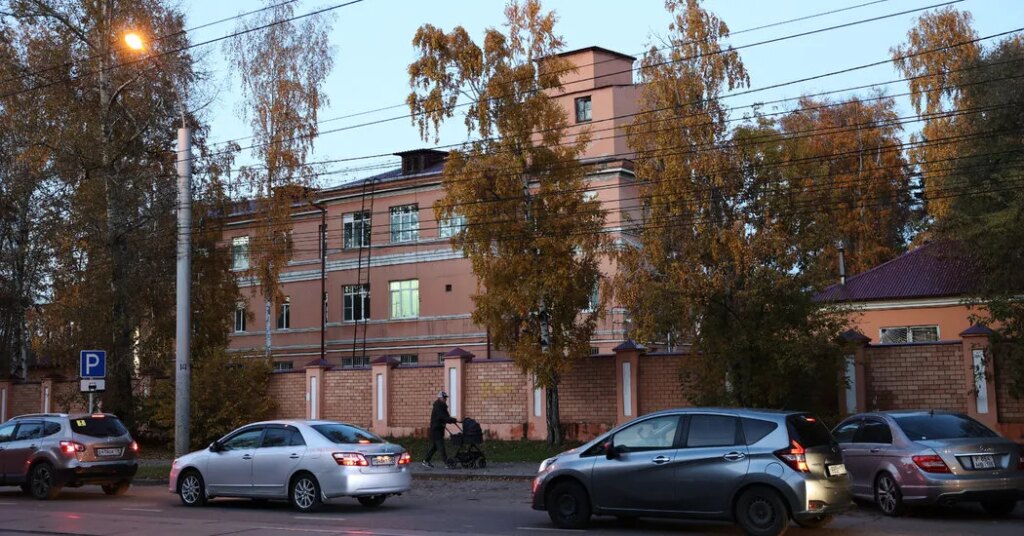
As rumors swirled this week that a woman working in a Siberian lab may have died of the plague, news programs on Russian state television paid scant attention. The authorities in Moscow released little information.
Faced with this potential new threat, the Kremlin seems to be resorting to a familiar playbook: avoiding bad news.
The lack of information has caused unease around the world, particularly given the memory of China’s effort to withhold information about Covid-19.
The Kremlin has a history of hiding bad news
In Russia, federal officials are generally reluctant, even fearful, about publishing anything that might cast the Kremlin in a negative light. The pace of news in Russia tends to be determined by the government, not by when events actually occur. The independent press has been driven into exile.
Perhaps the most notorious case was the hidden news that an explosion at the Chernobyl nuclear plant in April 1986 had contaminated a wide area with dangerous radiation. The Kremlin began to release information only after Sweden and other European countries, alarmed by high radiation readings, demanded an explanation.
In 1979, there was an accidental leak of anthrax spores from a secret biological weapon facility run by the Soviet military near what is now Yekaterinburg. Someone turned on a machine that dried the spores without realizing that a maintenance technician had removed a clogged exhaust filter.
More than 60 people died, as well as countless farm animals downwind of the facility. The Soviet authorities blamed the human toll on tainted meat, and the truth did not emerge until 1992, after the Soviet Union collapsed.
But the obfuscation did not stop, especially after Vladimir V. Putin became president in 2000.
In two of the most tragic episodes, the government either concealed the truth or promoted outright falsehoods. One was the sinking of the Kursk nuclear-powered submarine in the Barents Sea in 2000, with all 118 sailors aboard killed. In 2002, Chechen terrorists took over 900 people hostage during a performance of the “Nord-Ost” musical. Interior Ministry special forces knocked everybody out by pumping a chemical agent into the theater. But they failed to coordinate with the medical services, leading to the deaths of at least 116 hostages, as well as all 41 attackers.
Since Russian forces mounted a large-scale invasion of Ukraine in 2022, there have been examples of the government’s effort to camouflage the true scope of the war.
Earlier this year, when a bomb exploded in a Moscow restaurant where a top Russian general was celebrating, Russian state news initially reported it as a gas canister explosion. The Kremlin has resorted to extensive censorship to hide Russian losses in its war in Ukraine — which the government made illegal to call a war. Independent researchers have estimated that 450,000 Russian soldiers have died.
Russia’s press is full of disinformation
Although several state-run newspapers initially ran articles about the death in Siberia, the news disappeared from their websites.
Alexandra Arkhipova, a Russian anthropologist in exile, wrote on social media, “Instead of a straightforward description of what is happening in Irkutsk, news columns are filled with journalistic euphemisms — clearly by order from above.”
There is no mention of plague, she added, only headlines about the “Irkutsk infection,” referring to the region of Siberia where the woman, who was 28, died.
Local social media accounts are full of questions and concerns about the case, although the occasional comment reflects the official line that people should rely on government statements.
Alyona, reached via social media and identified by only one name to avoid retribution from the authorities, said she was an old school friend of the victim but had not been in touch for a long time. “Everyone is worried, especially since there have been no clear statements,” she said.
The mystery surrounding the death in Irkutsk deepened because the governor of a neighboring region had initially posted on social media that the woman had died of the plague, and then changed it later to say that she had “possibly” died of the plague.
Dmitri S. Peskov, the Kremlin spokesman, criticized the news media for reporting rumors rather than relying on official reports from the public health safety agency. Even though the agency’s head, a doctor, flew to Irkutsk to assess the situation, it avoids news conferences, communicating only by intermittent press releases.
Russia’s public health agency has said the pathogen that killed the woman was not the one she had been researching in the lab, for which she had been vaccinated.
On Thursday, the governor of Irkutsk, Igor Kobzev, who has been posting regularly on his social media channels, wrote that all preventive measures had been completed and after about 5,000 laboratory tests, nobody else the victim might have been in contact with at the institute or the hospital was infected. “Amid intense media scrutiny, the specialists thoroughly investigated the situation,” he wrote. “It was a test, but we passed it in worthy fashion.”
His post attracted comments from area residents asking for a clearer explanation of what exactly had happened and what had killed the woman.
Trust is low post-Covid
Russian officials have said the lab worker in Siberia died from pneumonia, of an unknown cause, on Friday night. Although the World Health Organization sent an initial query, the Russian authorities did not provide an answer in the required 24 hours, but three days later, the organization said.
The W.H.O. said Russia had not yet provided the details needed to make a formal “risk assessment” about the disease’s possible spread. Senior officials in both the E.U. and the United States, including President Trump and Marco Rubio, the secretary of state, all encouraged Russia to provide more information.
From 2019 to 2025, 10 countries reported almost 4,000 plague cases and 423 deaths, according to W.H.O. statistics. The United States reports about seven cases annually — the most recent was a woman in her 50s who died in June in New Mexico. Plague can be successfully treated with antibiotics if caught early.
Wrestling with the Covid pandemic, which completely disrupted ordinary life, left a legacy of public mistrust toward public health agencies and their ability to protect the public.
At a news conference on Wednesday, Maria Van Kerkhove, director of epidemic and pandemic management at the W.H.O. said, “Covid is certainly in the back of everybody’s mind.”
“If this individual did not die from the plague, then how did she die?” Dr. Van Kerkhove asked, adding, “We expect further answers from Russia.”
Alina Lobzina, Ivan Nechepurenko, Paul Sonne and Milana Mazaeva contributed reporting.
The post Russia’s Vague Account of a Mysterious Death Is Stoking Cover-Up Fears appeared first on New York Times.