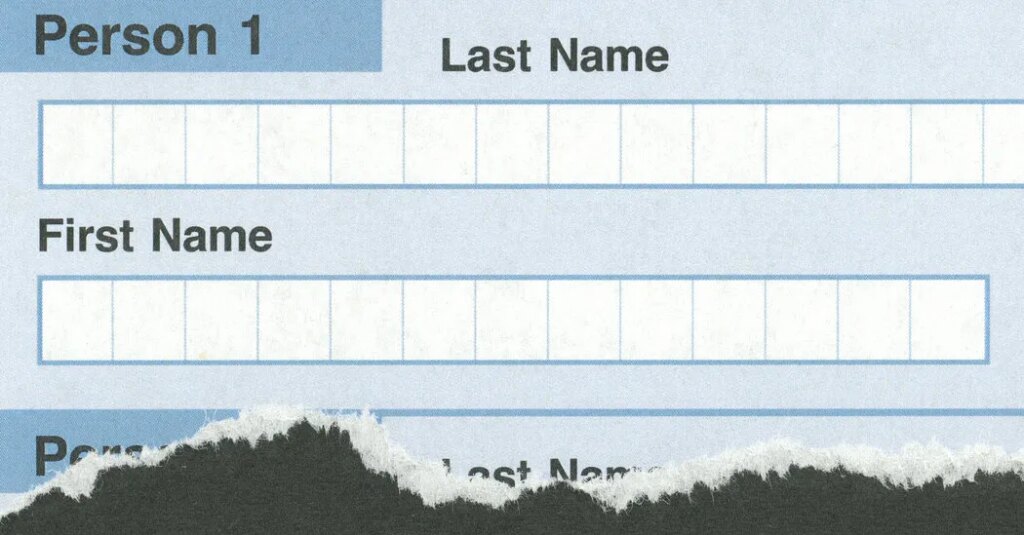
Last month, the Trump administration proposed new rules that would limit who is counted in the census. It’s an initiative that is ideologically consistent with President Trump’s voter-suppression efforts, his aggressive deportation policies and his executive order that seeks to purge national parks and museums of information about slavery and Native American history that, in his words, casts our country “in a negative light.”
The Constitution requires the census to count everyone in America, but Mr. Trump clearly wants to decide who counts.
Under current practice, the Census Bureau, which is part of the Department of Commerce, looks to count everyone living here, regardless of citizenship or immigration status. Census data is used for purposes ranging from congressional apportionment to government-funding formulas.
Under the administration’s proposal, the census would count only citizens and green card holders. Undocumented immigrants, international students, asylum seekers, refugees without permanent residency and others would be excluded. The administration argues that individuals in these groups lack the “sufficient tie and allegiance” required to establish them as “true inhabitants” of the United States — a rationale akin to one advanced by some critics of birthright citizenship.
In the name of making the census “colorblind,” the plan would remove questions about race and ethnicity from the census’ short-form questionnaire. It also would bar questions about sexual orientation.
Without physically removing a single person, these rules would bureaucratically disappear millions of people from the national count. They would also strip away an important reference point against which claims of unequal treatment can be measured.
The first Trump administration tried something similar. But in 2019, the Supreme Court blocked the Commerce Department from adding a citizenship question for the 2020 census. Then in 2020, Mr. Trump issued a memo directing the department to exclude undocumented immigrants from the population count used to apportion House seats. The Supreme Court declined to decide that issue on its merits, merely ruling that the case wasn’t ripe for judicial review. The directive didn’t go into effect.
If the administration succeeds with its current plan, the Census Bureau will — by my calculation, using data from the Pew Research Center and the Migration Policy Institute — fail to count roughly 16.5 million people.
Further, the addition of citizenship and immigration status questions could depress “self-response” to the survey, even among those here legally. A 2019 Census Bureau report found that a citizenship question would reduce responses in households that “may” include noncitizens. Fearing the potential repercussions, some respondents might choose to omit certain household members from their answers.
These uncounted individuals wouldn’t be evenly distributed. Many are clustered in large cities and near universities — regions that are disproportionately represented by Democrats in Congress.
This intentional undercounting would almost certainly tilt the apportionment of Electoral College votes and House seats. A recent Times analysis found that the proposed rules could actually wind up taking House seats away from red states. However, according to the Republican-leaning American Redistricting Project’s 2030 citizen-only model, five blue states — California, Illinois, New Jersey, New York and Rhode Island — could lose 11 House seats combined.
Because many federal agencies use census data, undercounting the population could wind up redirecting federal money away from the country’s most populous areas: As recently as the 2021 fiscal year, 353 federal assistance programs used census data in whole or in part to distribute more than $2.8 trillion.
Many noncitizens pay into these programs, and by law, noncitizens are entitled to some of these programs’ benefits. Moreover, accounting for noncitizens’ well-being, including by correctly distributing the funds allocated to these programs, helps facilitate the social and economic benefits that Americans gain from noncitizens’ presence as healthy workers, stable neighbors and supportive family members.
The push to drop race, ethnicity and sexual orientation questions is not merely symbolic. It undoubtedly serves a goal that goes hand in hand with a potential apportionment change: removing some of the key data that makes inequities visible.
For years, census data about race, ethnicity and gender has formed the evidentiary backbone of civil rights enforcement and redistricting, and it serves as a base line for independent survey research. It’s also relied upon to help ensure fair employment practices. It’s difficult, for example, to prove that a business or other institution is discriminating on the basis of race without demographic base lines to measure against. Remove the data and you remove the grounds for many claims.
The administration frames this proposed change as colorblindness and argues that race, ethnicity and sexual orientation are “immaterial” to a basic head count. It also claims that dropping the questions related to these categories would make responding to the census questionnaire easier. Conveniently, that logic didn’t extend to the first Trump administration’s proposal to add a citizenship question for the 2020 canvass — nor to the addition of a citizenship question to a newly drafted I.R.S. Form 1040.
These changes would look particularly ugly in light of the census’s history.
As the legal scholar David Bernstein has chronicled, early census classification was intertwined with slavery, citizenship and political representation. Census categories expanded from white and Black to include Native Americans, people of Asian descent and mixed-race designations that helped to entrench various constructions into everyday thinking and form the basis for marginalization. For example, the 1890 census had “mulatto,” “quadroon” and “octoroon” as categories.
This type of categorization was used to help enforce what was, in essence, a racial caste system. In the past several decades, however, the government, in effect, repurposed this type of categorization, partly to bolster its anti-discrimination programs. If the Trump proposal stands, these types of programs will be hamstrung.
When governments stop counting demographic characteristics, they cement an outdated demographic settlement rather than allow new facts to affect political institutions. In America, the share of non-Hispanic white people — long the country’s racial majority — has been declining, and it is projected to shrink to a minority of the total population by the 2040s. The census can’t reverse that reality, but revising the rules could prevent it from being officially measured.
The administration’s plan isn’t final; a public comment period ends Tuesday. Opponents will have both the opportunity and the grounds to contest it in court, and it must be fought: The census doesn’t just count people. It determines which people count.
Justin Gest is the author of “Democratic Drain: Global Migration and the Struggle for Democracy.”
The Times is committed to publishing a diversity of letters to the editor. We’d like to hear what you think about this or any of our articles. Here are some tips. And here’s our email: [email protected].
Follow the New York Times Opinion section on Facebook, Instagram, TikTok, Bluesky, WhatsApp and Threads.
The post Trump Wants to Decide Who Counts. And Who Doesn’t. appeared first on New York Times.